Castello Normanno-Svevo in Bari: A Historic Fortress and Cultural Museum


Visitor Information
Google Rating: 4.3
Popularity: Medium
Google Maps: View on Google Maps
Official Website: museipuglia.cultura.gov.it
Country: Italy
Civilization: Medieval European
Remains: Military

History
The Castello Normanno-Svevo stands in Bari, Apulia, southern Italy, on a site with a long history of fortification. Archaeological evidence and ancient authors such as Horace and Tacitus suggest a fortified place existed here since Roman-Greek times, possibly linked to the ancient settlement of Barium or a Byzantine kastròn, a type of fortress.
The castle’s first major construction dates to around 1131-1132, when Norman King Roger II built it atop the ruins of a Byzantine fortification. Its primary purpose was to control the city rather than serve solely as a defensive stronghold. In 1156, William I of Sicily, known as William the Bad, partially destroyed the castle during the suppression of a local rebellion.
Between 1233 and 1240, Emperor Frederick II of the Hohenstaufen dynasty rebuilt and expanded the castle. He transformed it into a residence with decorative features, adding a keep typical of German medieval castles. The castle’s entrance bears symbols of his authority, including an imperial eagle.
Under Angevin rule, Charles I of Anjou ordered restorations and created a new northern entrance facing the sea. Later, during Aragonese control, the castle was granted to the Sforza family. Isabella of Aragon and her daughter Bona Sforza, queen of Poland, enhanced the castle in the early 1500s by adding bastions and Renaissance-style staircases. Bona Sforza died within the castle walls in 1557.
In 1696, a lightning strike ignited gunpowder stored in one tower, causing an explosion that damaged nearby houses. During the Bourbon period in the 18th and 19th centuries, the castle served as a prison, notably housing juvenile offenders in the “Tower of Minors.” It later functioned as barracks for infantry and gendarmerie.
Since the 20th century, the castle has been used as a museum and cultural center. It houses the Directorate of Cultural Heritage and the Museo della Gipsoteca, which displays plaster casts of Apulian medieval sculptures and ceramics. A local tradition connects Saint Francis of Assisi to the castle around 1220. A chapel dedicated to him and a 1635 inscription commemorate a miracle attributed to the saint at this site.
Remains
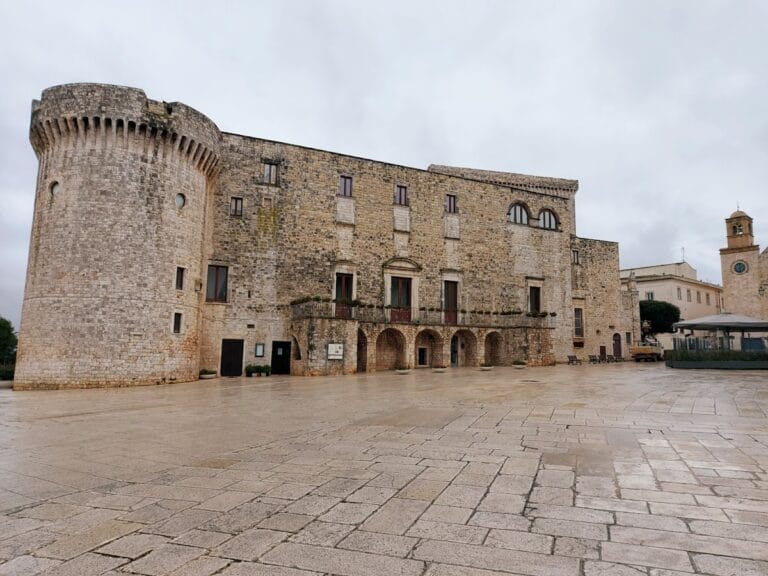
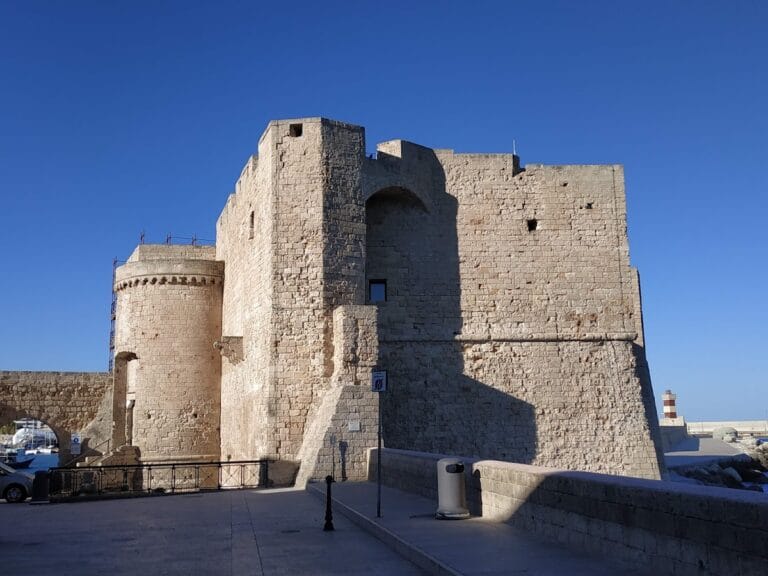
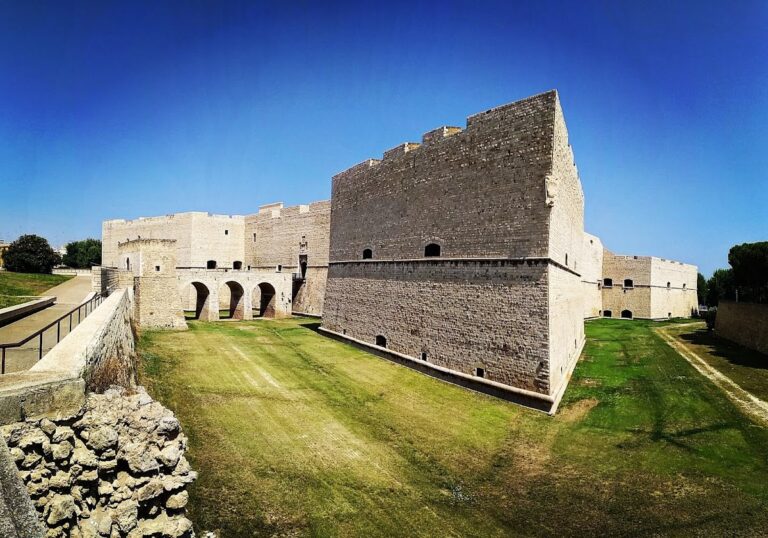
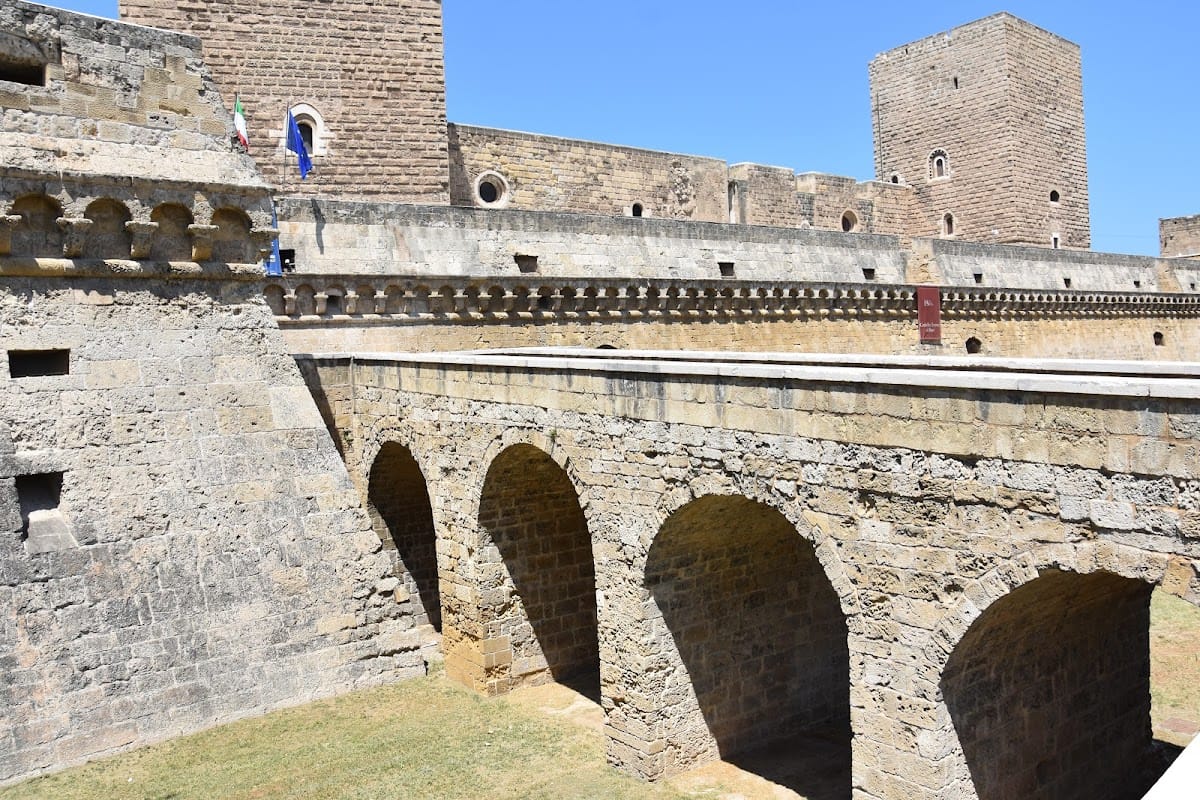
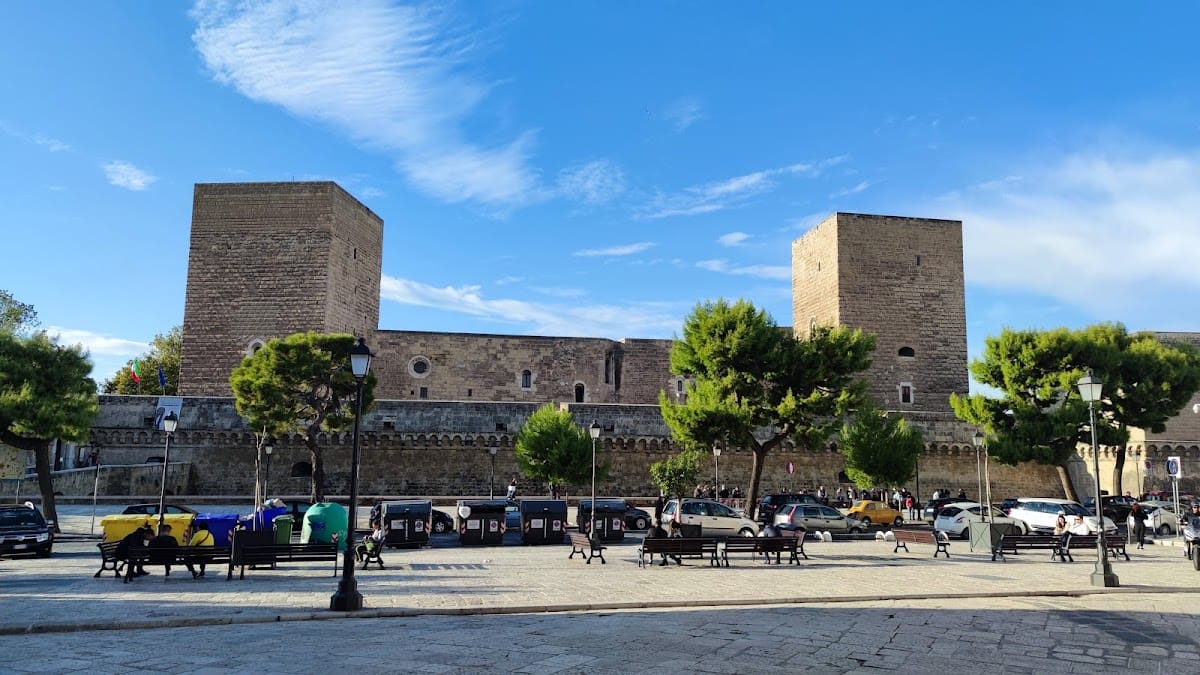
The castle has a trapezoidal layout, nearly square, with four corner towers named for historical associations: the “Tower of Minors” to the southwest, the “Visconti Tower,” the “Semaphore or Sea Tower” to the southeast, the “Monk’s Tower or St. Francis Tower” to the northwest, and the “Wind Tower” to the northeast. It is surrounded on three sides by a moat, while the northern side once faced the sea.
Access is gained via a southern bridge crossing the moat, leading to the main gate. This entrance features a pointed arch decorated with the Bourbon coat of arms and an imperial eagle clutching prey, symbolizing Frederick II’s rule. Beyond the gate lies a vestibule with high pointed vaults supported by columns and pilasters. The capitals of these supports are adorned with leaf patterns, crafted by local sculptors such as Minerrus de Canusia and Melis de Stelliano.
Inside, a Renaissance-style courtyard contains a notable double-flight staircase from the Aragonese period. The left flight replaced an earlier medieval stair, while the right was designed to allow horse riders to ascend. The castle includes a keep, or bergfried, added by Frederick II, and a residential palace within its walls.
In the 16th century, the outer defenses were strengthened with angular bastions shaped like spearheads to resist firearms. The castle’s condition is well preserved, with visible medieval and Renaissance architectural elements, including decorated windows and ornate round openings on the towers.
Today, the lower floors house the Museo della Gipsoteca, exhibiting plaster casts of Apulian sculptures dating from the 11th to the 17th centuries. The upper floors display temporary exhibitions and collections of 16th- and 17th-century Apulian ceramics and majolica.
Nearby sites