Castello Orsini-Odescalchi: A Medieval Fortress and Aristocratic Residence in Italy


Site at a Glance
- Rating
- 4.6
- Popularity
- Medium
- Country
- Italy
- Primary era
- Early Modern
- External website
- Open
- Eras represented
- Medieval, Early Modern, Modern
- Civilizations
- Papal States
- Site type
- Military
- Remains
- Castle
On this page28 sections
History
Castello Orsini-Odescalchi is a medieval fortress and aristocratic residence in Bracciano, Italy, on the southern shore of Lake Bracciano. Its origins reach back to a high stone defensive tower, probably built in the tenth century as a lookout and refuge during Saracen raids. The early fortification was known as Castrum Brachiani and later developed through successive phases into the castle associated with the Orsini and Odescalchi families.
Early fortification and the di Vico period
During the eleventh century, the surrounding territory came under the control of the di Vico family. They transformed the earlier tower into a castle, creating the foundation for the later stronghold. The site is also connected with the medieval Rocca dei Prefetti di Vico, a thirteenth-century fortification whose surviving truncated tower forms part of the present complex.
From 1375, the castle belonged to the papacy. In 1419, Pope Martin V confirmed the Orsini branch of Tagliacozzo in possession of Bracciano and the surrounding lands. Under Orsini control, the town grew in wealth, and the castle became the center of an increasingly powerful territorial lordship.
The Orsini reconstruction
A major rebuilding campaign began in 1470 under Napoleone Orsini, a condottiero, or military commander who led troops under contract in late medieval and Renaissance Italy. His son Gentil Virginio Orsini completed the work in 1485. The architect was Francesco di Giorgio Martini, a Renaissance architect, engineer, painter, and military theorist, and Sistine craftsmen probably also took part in the construction.
The expanded fortress combined military strength with the requirements of an aristocratic residence. By the end of the fifteenth century, it was both a major defensive stronghold and a luxurious court. Antoniazzo Romano, a leading fifteenth-century Roman painter, contributed to the interior decoration, while Taddeo and Federico Zuccaro later decorated rooms associated with Pope Sixtus IV.
Sixtus IV, a fifteenth-century pope of the della Rovere family, stayed at the castle in 1481 while fleeing a plague outbreak in Rome. In 1485, papal troops commanded by Prospero Colonna sacked Bracciano and the castle. The fortress was then strengthened with an additional outer line of walls, reflecting the continuing military pressures faced by the Orsini.
Conflict and aristocratic power
The castle was repeatedly drawn into conflicts involving the Orsini, Colonna, and Borgia families. In 1494, Charles VIII of France and his army stopped at Bracciano and received a friendly welcome from the castle’s owner. The leading Orsini were subsequently excommunicated, although the dispute was later settled.
In 1496, an army sent by Pope Alexander VI, a late-fifteenth-century pope from the Borgia family, attempted to seize the castle under the command of his son Giovanni Borgia. Orsini forces repelled the attacks. Cesare Borgia later also failed to capture the fortress. These struggles reflected the close connection between papal politics, aristocratic power, and military conflict in central Italy.
The Orsini family’s wealth reached a new stage in 1558, when Paolo Giordano I Orsini married Isabella de’ Medici, daughter of Cosimo I, Grand Duke of Tuscany. The marriage increased the family’s resources and brought Paolo Giordano the title of Duke of Bracciano. His successor, Paolo Giordano II Orsini, supported painting and literature, helping Bracciano develop as a cultural center.
Transfer to the Odescalchi family
Extravagant spending, increasing debts, and declining trade eventually weakened both the town and the Orsini finances. In 1696, the Orsini sold the castle and the Duchy of Bracciano to Livio Odescalchi, nephew of Pope Innocent XI. Livio was granted the title of Prince of the Holy Roman Empire by Emperor Leopold I in recognition of his service in wars against the Ottoman Turks. The Odescalchi family retained ownership of the castle.
During the French occupation, the complex was looted. Valuable furniture and many collections were removed, after which the castle was restored and used again as a luxurious residence. The castle and estate belonged to Duke Marino Torlonia until 1848, and Prince Livio Odescalchi III later bought back the family residence.
Restoration and museum use
King Umberto I of Italy stayed at the castle in 1900. During the early twentieth century, Prince Baldassarre Odescalchi and the architect Raffaello Ojetti directed a major restoration campaign. The work renewed the interiors and recovered the appearance of many historic wall and ceiling paintings.
Prince Livio IV Odescalchi opened the castle to the public in 1952. It now functions as a museum as well as a setting for cultural activities, celebrations, weddings, and private events. Castello Orsini-Odescalchi is recognized as an Italian national monument and remains privately owned by the Odescalchi family.
Remains
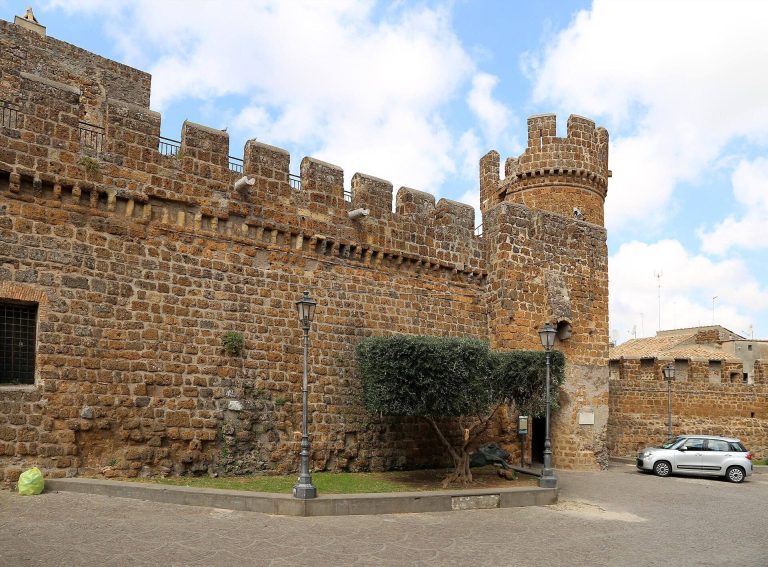
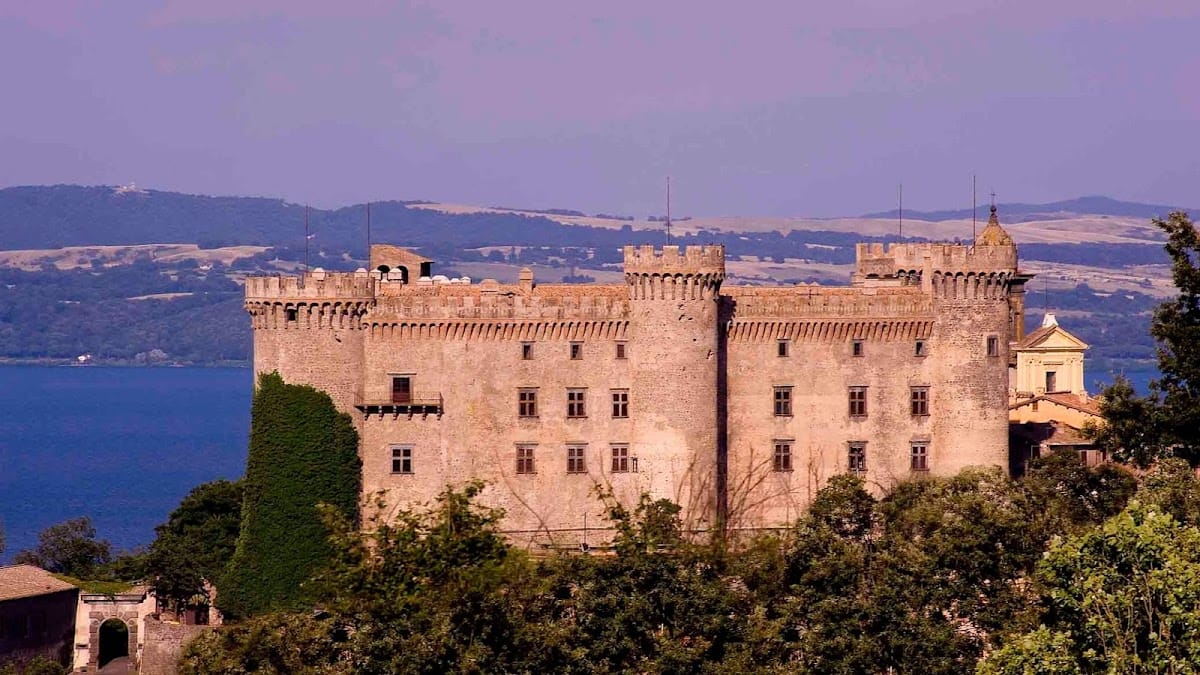
The castle is built mainly of stone and brick. Its core is a massive building with three wings arranged on an irregular triangular plan, enclosed by fortification walls. Five cylindrical towers are connected by a wall-walk, while a sixth, truncated tower belongs to the older Rocca dei Prefetti di Vico. Stairs, passageways, and covered and open loggias within the towers supported the defensive work of the garrison.
Walls, towers, and entrances
Fortification circuit
A projecting defensive tower rises at the center of the southwest wall. On the eastern side, a substantial fortified section protects the principal entrance, which is flanked by two additional round towers. A further outer wall once enclosed extensive areas around the main castle, and portions of this circuit survive.
Entrance arch
An entrance arch over the approach avenue was designed by Jacopo del Duca for Paolo Giordano Orsini after later work on the castle in the second half of the sixteenth century. Its projecting rustication, Orsini roses, and carved Orsini coat of arms express the identity of the family that controlled the duchy at the time.
Courtyard and rock-cut rooms
Beyond the arch is a large, irregularly triangular courtyard. The loggia along its western wall and the portal leading to the Hall of the Caesars may have been designed by Francesco di Giorgio Martini. Beneath a strong stone arch, a gate leads to rooms partly cut into the rock. These spaces served as quarters for the guard and garrison and included storage for arms and ammunition. The final room connects with a drainage passage that collected rainwater falling into the courtyard.
Service areas and domestic features
Service building
A large rectangular service building near the entrance contained a stable on the ground floor and grain-storage space above. Its arrangement reflects the castle’s role in managing the economic life of the feudal estate.
Former kitchens
The former kitchens retain four enormous fireplaces used to prepare court banquets during the Renaissance. Copper pans bearing inventory numbers are displayed there, together with an Odescalchi censer used to mark property. Preserved Odescalchi hunting trophies, including stuffed animals, are also kept in the kitchen area.
Lake-facing tower and garden
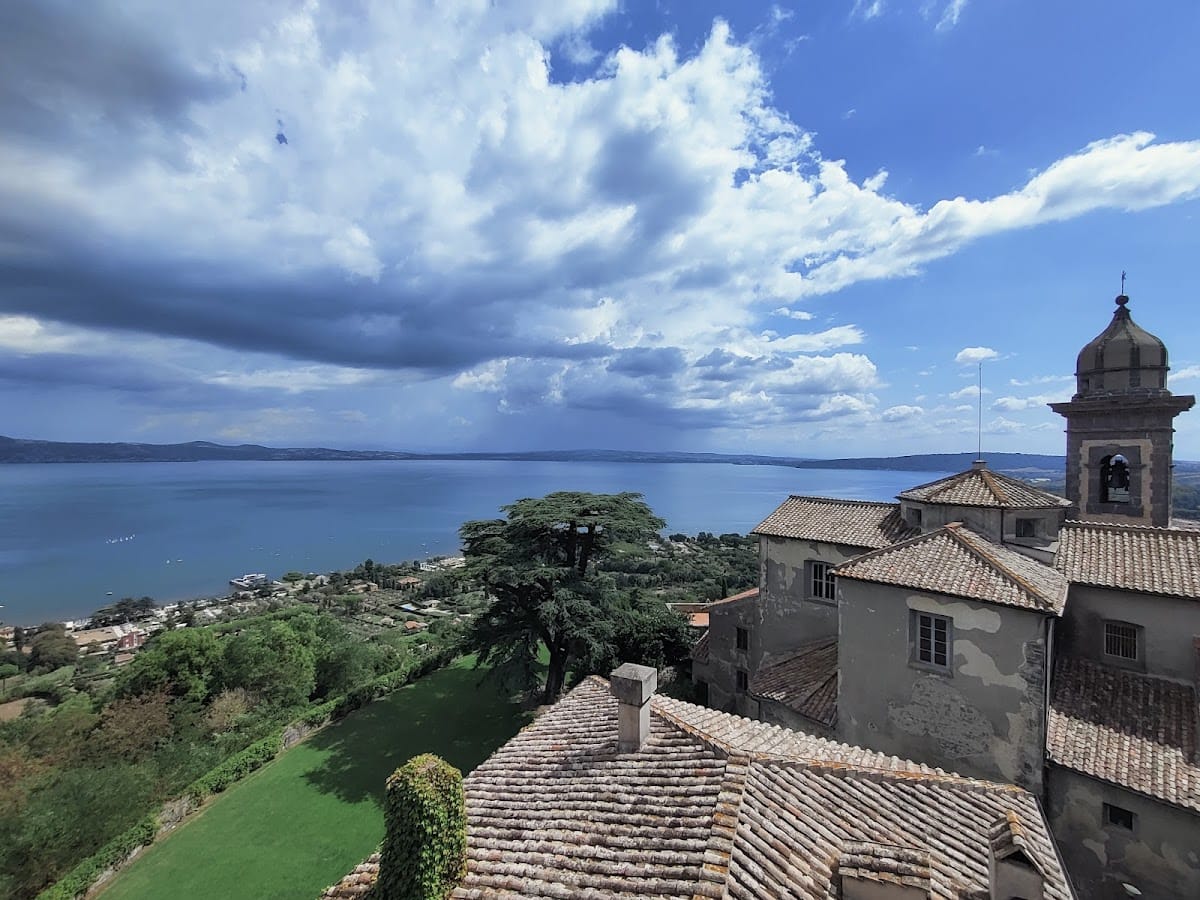
A tower facing Lake Bracciano bears the coats of arms of the Orsini and Odescalchi families. A hanging garden overlooks the lake. It was formerly arranged as a formal Italian garden with numerous fountains and is dominated by two monumental, centuries-old Lebanon cedars. Hunting scenes carved into the rock remain visible at the base of the castle walls, along with the division of the enclosing wall formed by brick pilasters and arches.
Painted rooms and family collections
Antoniazzo Romano fresco
Part of the interior contains a large fresco by Antoniazzo Romano, originally painted on the arch at the entrance to the courtyard. It depicts Gentil Virginio Orsini’s procession celebrating the capture of Aragonese arms and his meeting with Piero de’ Medici.
Rooms of court life
A room with a canopied bed preserves historic furnishings. Another takes its name from a frescoed frieze representing the sciences, although its images are Renaissance representations of tarot cards. A separate frieze commissioned by Felice della Rovere decorates another room. Felice was the daughter of Cardinal Giuliano della Rovere, who later became Pope Julius II.
Hall of Hercules
The Hall of Hercules takes its name from a frieze showing episodes from the life of the classical hero. It contains part of the arms collection begun by Prince Ladislao Odescalchi in the nineteenth century and completed by Prince Innocenzo before the Second World War. The collection includes rifles, cannons, and fourteenth-century execution axes.
Gothic Room and Sicilian Bed Room
The Gothic Room contains furniture in a nineteenth-century neo-Gothic style. Baldassarre Odescalchi reportedly produced its furnishings rapidly, using an original late-fifteenth-century German-school piece as a model. The Sicilian Bed Room contains an elaborately crafted wrought-iron bed probably dating from 1700.
Orsini Frieze Room and Diplomacy Room
The Orsini Frieze Room is named for its monumental frieze bearing symbols of the family that built the castle. The Diplomacy Room contains four large panels commemorating Nicolò da Pitigliano.
Orsini Room
The room known as the Orsini Room originally held portraits of the family. Its present decoration includes portraits of Paolo Giordano Orsini and Isabella de’ Medici, while stucco surrounds a coat of arms combining the emblems of the Orsini and Medici families in commemoration of their marriage.
Northern wing and papal decoration
Hall of the Caesars
The largest room in the northern wing originally had a double-height ceiling. The ceiling was lowered during the second half of the nineteenth century, creating a second room. White marble and peperino, a volcanic building stone widely used in central Italy, busts of the Caesars dating from the seventeenth century stand around the walls.
Collections of ceramics and paintings
Another room contains a frescoed frieze showing women engaged in different court pastimes, together with part of the castle’s ceramic collection. The ceramics represent important Italian production centers and date from the mid-fifteenth through the eighteenth century. A further room holds a bust of Paolo Giordano II Orsini attributed to the school of Bernini and a portrait of Queen Christina of Sweden by an unknown painter.
Umberto I’s room
The room occupied by Umberto I in 1900 has a coffered ceiling attributed to the school of Antoniazzo Romano and probably created near the completion of the castle’s construction, around 1491. Its furnishings, especially the bed fronts, include original sixteenth-century elements.
Papalina Room
The Papalina Room occupies the northern tower. Taddeo and Federico Zuccaro frescoed its ceiling in 1560 for the marriage of Paolo Giordano Orsini and Isabella de’ Medici. The decoration includes the couple’s wedding horoscope within gold-ground grotesques, Renaissance ornamental compositions combining figures, foliage, animals, and fantastic forms.
Museum collections
The museum occupies a substantial part of the interior. Its collections include historic weapons, furniture, paintings, books, manuscripts, jewelry, ceramics, decorative objects, and frescoes. Among the preserved objects are twelve busts of the Caesars, a rare sixteenth-century hourglass, an eighteenth-century Sicilian wrought-iron bed, fifteenth- and sixteenth-century European furniture, carved or pastiglia wedding chests made with raised decorative material, and an Italian wooden throne from the late fifteenth century.
The arms collection occupies much of the second floor and includes firearms, cannons, axes, and other historic weapons. The picture collection includes early Renaissance paintings, chiefly from central Italy, among them a Crucifixion, a Saint Anthony of Padua, and a Magdalene attributed to the school of Crivelli and influenced by fifteenth-century Venetian art. The Odescalchi also assembled part of their mainly Etruscan and Roman antiquities collection at the castle.