Castello di Monterone: A Historic Castle in Perugia, Italy

Visitor Information
Google Rating: 4.7
Popularity: Low
Google Maps: View on Google Maps
Official Website: www.castellomonterone.com
Country: Italy
Civilization: Unclassified
Remains: Military

History
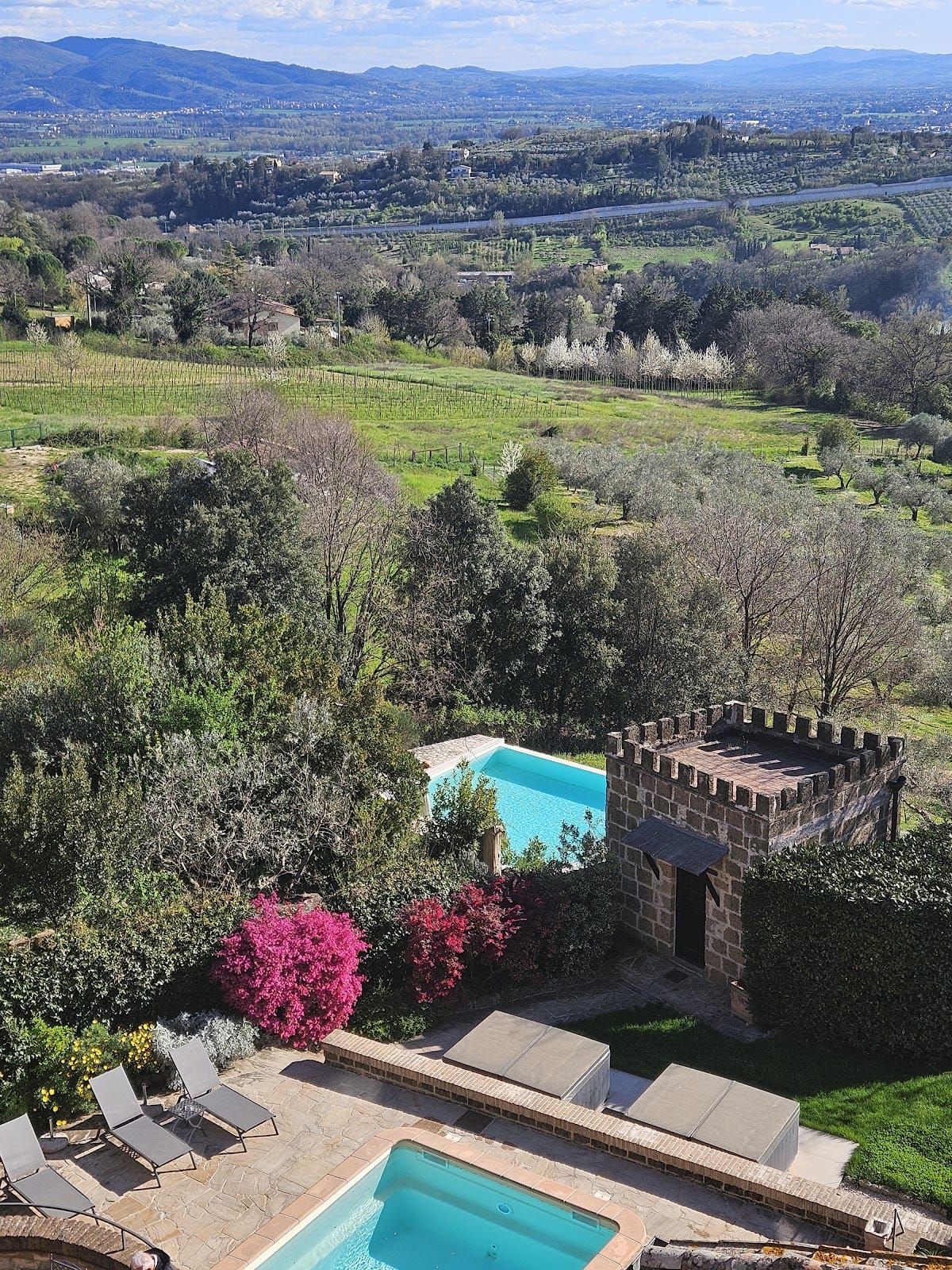
Castello di Monterone is situated in Perugia, Italy, on a strategic hilltop overlooking a small valley along the historic route that linked Perugia with Assisi. The location, originally settled by ancient civilizations, displays a long sequence of occupation beginning with Etruscan and Roman presence before medieval construction.
Archaeological finds indicate life at this site as early as the 3rd century BCE, including funerary urns typical of Chiusi and bronze mirrors bearing mythological scenes. The castle itself was first established during the 13th century, a period marked by regional tensions between Perugia and neighboring Assisi. In 1200, a document records a local lord, Gerardo di Ugolino di Alberico, becoming a Perugian citizen and linking his estates near Monterone to the city’s governance. Gerardo di Ghislerio, another ruler of the area, sought refuge here after his exile from Assisi and aligned with Perugia’s causes. Local tradition recounts that the young Francis of Assisi may have been held prisoner within the castle following the Battle of Collestrada in 1202.
From the mid-13th century until the suppression of the Knights Templar in 1312, the castle likely operated as a hospice for pilgrims, connected in some way to the Templar monastery of San Bevignate nearby. Stories and historical texts suggest the existence of underground passages linking these sites, reflecting their shared religious and defensive functions. After the Templar order was disbanded by Pope Clement V in 1312, the castle appears to have been abandoned for a lengthy period, mirroring the fortunes of the Templars and their affiliated properties.
During the years of communal government from the 14th to the 16th centuries, Castello di Monterone served as a watchtower guarding routes into Perugia. This role made it a target during conflicts between rival factions, as seen when condottieri mercenaries such as Braccio da Montone in 1416 and Malatesta Baglioni in 1582 inflicted considerable damage on the fortress during their campaigns.
The castle’s history becomes less clear after the 17th century, experiencing phases of neglect interspersed with intermittent habitation and structural alterations as owners adapted it to their needs. By the late 1700s, the Counts Ansidei transformed the castle into a “suburban villa,” indicating an expansion from its purely military and religious past to a more domestic use.
In the 19th century, the Piceller family, originally from Val Gardena, took ownership and made the castle their family home. Members such as Giuseppe Piceller contributed to Perugia’s cultural life, founding its first music band, while Bernardino Piceller was known for his historical and sacred art. Alessandro Piceller, in particular, combined his interests in archaeology and antiquities with a passionate restoration and enlargement of the castle. His efforts brought many architectural embellishments and historical elements into the design, including a chapel contemporary with the 14th-century Casetta Piceller in nearby Collestrada. The restoration was overseen by architects Filippo Lardoni and Alessandro Arienti, who also designed Perugia’s monumental cemetery. The castle was consecrated in 1849 by Vincenzo Gioacchino Pecci, the Bishop of Perugia who later became Pope Leo XIII.
Following Alessandro Piceller’s death in 1929, the castle once again fell into disuse. During the Second World War, it served as a refuge for displaced persons but sustained heavy damage from bombing and subsequent military occupation. After the war, Professor Antonini Giuliano acquired the property and devoted significant efforts to restoring it. Additional restoration work by Professor Orlando Scalco, along with support from a notable Umbrian family, has allowed the castle to regain much of its historical character.
Remains
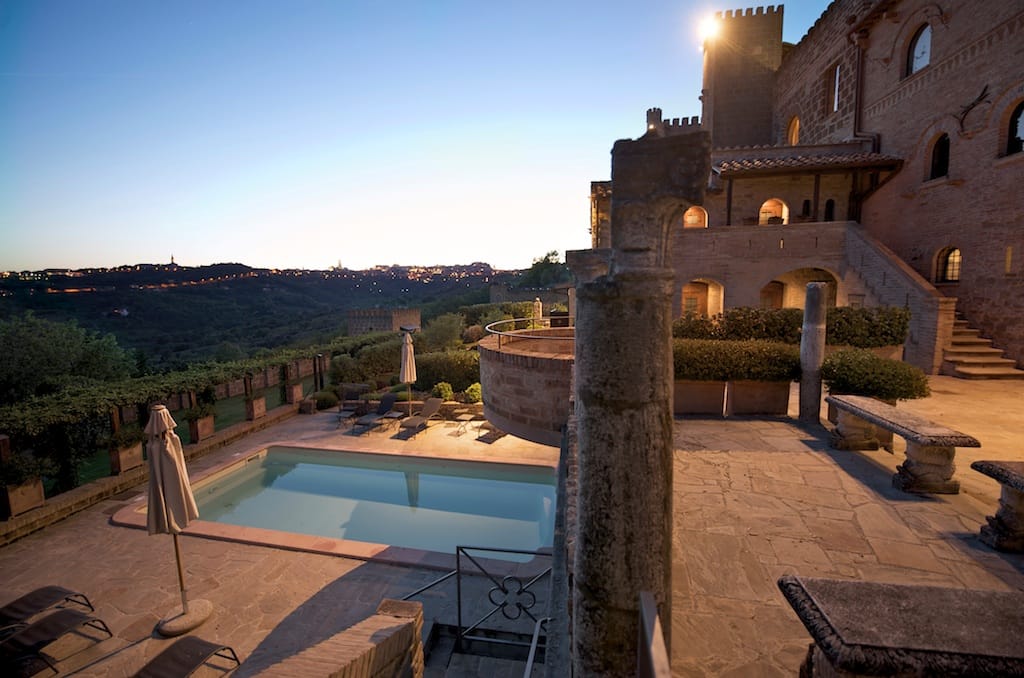
Castello di Monterone stands prominently on a ridge that overlooks the surrounding valley near the route from Perugia to Assisi. The core medieval structure dates to the 13th century, constructed using local sandstone, pietra serena (a fine-grained sandstone commonly used in Tuscany and Umbria), brick, and alternating bands of pink and white stone. These varied materials contribute to the castle’s distinct and eclectic appearance, especially after its 19th-century renovation introduced romantic architectural elements uncommon in the region.
The castle’s courtyard is a notable feature, enclosed by round columns with marble capitals collected by Alessandro Piceller during his archaeological work. These capitals, along with several Etruscan funerary urns and bas-reliefs preserved there, reflect the site’s deep historical connections, spanning from antiquity through the medieval period. The eclectic decorations include bas-reliefs, ornamental statues, a small rose window, stone balconies, and mullioned windows, all integrated into the later restoration and expansion.
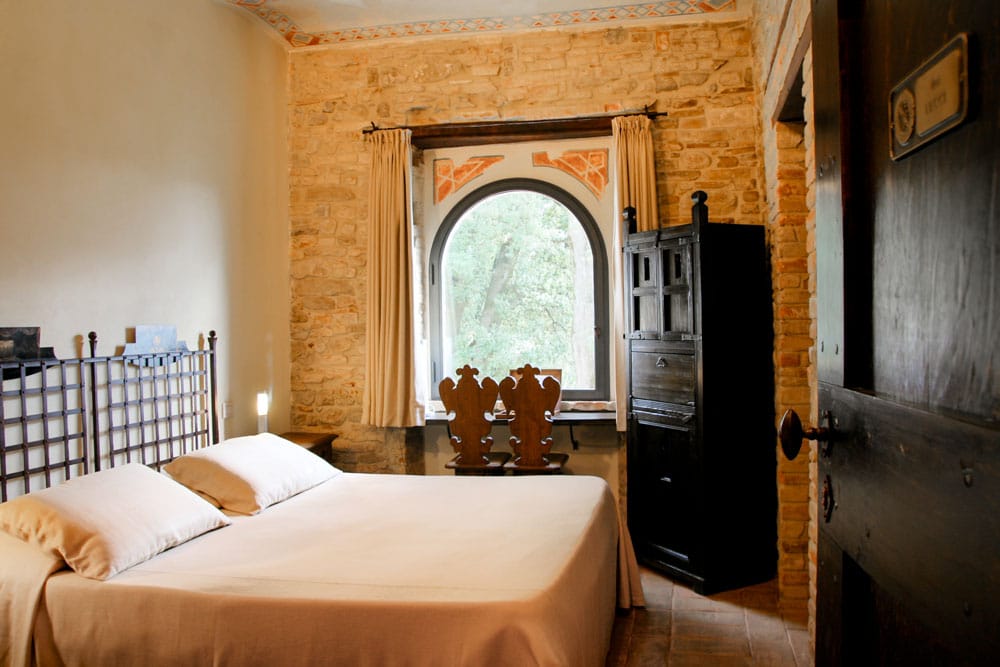
Inside, frescoes adorn the walls, celebrating the heritage of late medieval military leaders known as condottieri. These paintings were executed by Matteo Tassi, an artist who also contributed to the decoration of Perugia’s municipal palace. Among the interior artworks is a detached fresco originally from a roadside tabernacle, depicting the Madonna of Loreto flanked by Saints Peter and Paul, attributed to Cristoforo di Jacopo da Foligno.
A significant inscription fragment in uncial Latin script, measuring over half a meter wide, is preserved within the castle. Likely dating from the early 1400s, this stone bears a partially legible dedication linked to the condottiero Fortebraccio, praising qualities such as valor and virtue. This epigraphic evidence emphasizes the castle’s connection to local military and political figures of the late medieval period.
Oral tradition and historical writings speak of subterranean tunnels that once linked Castello di Monterone with the nearby Church of San Bevignate, suggesting an underground network used for discreet movement between these important religious and defensive sites. Although physical details of these passages are not documented, their mention highlights the castle’s role within a broader medieval landscape of strategic and spiritual significance.
Following extensive damage during the Second World War, both from aerial bombardments and occupation, major restoration efforts have returned the castle to its historical appearance, preserving the variety of architectural and archaeological elements accumulated over centuries of use and transformation.
Nearby sites


