Castello di Francavilla Fontana: A Historic Fortress and Museum in Southern Italy
Visitor Information
Google Rating: 4.6
Popularity: Low
Google Maps: View on Google Maps
Country: Italy
Civilization: Unclassified
Remains: Military

History
The Castello di Francavilla Fontana is located in the town of Francavilla Fontana in southern Italy. It was built during the mid-15th century by members of the Italian nobility to serve defensive purposes along a major Roman route.
The construction of the fortress began around 1450-1455 under Giovanni Antonio Orsini del Balzo, who was the Prince of Taranto. Orsini acquired the feudal lands of Francavilla in 1455 as part of a land exchange. Recognizing the strategic importance of Francavilla, situated on the Appian Way connecting Taranto to Brindisi, he fortified the area by erecting a square tower with a moat and a drawbridge. This initial structure functioned primarily as a military outpost rather than a noble residence.
In the mid-16th century, about 1547, the castle underwent significant expansion under Duke Giovanni Bernardino Bonifacio. Known as a humanist and the heir to the domains of Francavilla and Oria, Bonifacio enhanced the fortress with Renaissance elements while reinforcing its military character.
Ownership changed in 1572 when the Imperiali family took possession of the castle and surrounding lands. During the early 18th century, between 1720 and 1730, Michele Imperiali began transforming the stronghold into a more comfortable noble residence. This included removing parts of the northern defensive walls and adjacent shops, as well as modifying the main entrance portico to reflect residential architecture.
After Michelino Imperiali’s death in 1782 without direct heirs, the castle was temporarily absorbed into the royal estate. It was later recovered by Vincenzo Imperiali of Latiano, who inherited the title Prince of Francavilla Fontana along with the castle’s contents and collections.
During the Second World War, the castle served a military function once again, housing units such as the 67th Infantry Regiment named “Legnano,” the 139th Regiment, and the CC.NN. “Val Bradano” Legion, evidencing its continued strategic relevance.
Starting from the year 2000, the Castello di Francavilla Fontana underwent extensive restoration aimed at preserving its structure and adapting it for new cultural uses. Since 2018, part of the castle has hosted the Museo Archeologico di Francavilla Fontana (MAFF), showcasing local archaeological finds. The restoration process revealed preserved elements of the original fortifications, including an ancient tower wall and a 16th-century votive chapel decorated with frescoes. This effort was supported by regional and national heritage programs, funded with over 5.6 million euros, though some sections of the building remain closed due to ongoing work.
Remains
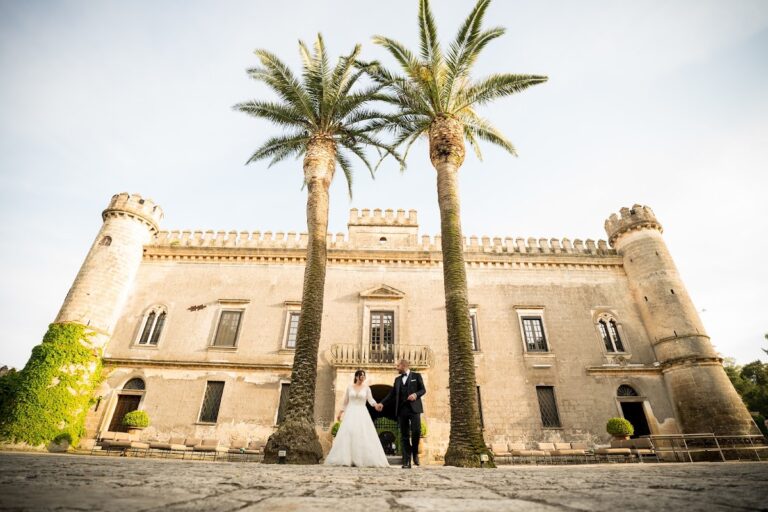
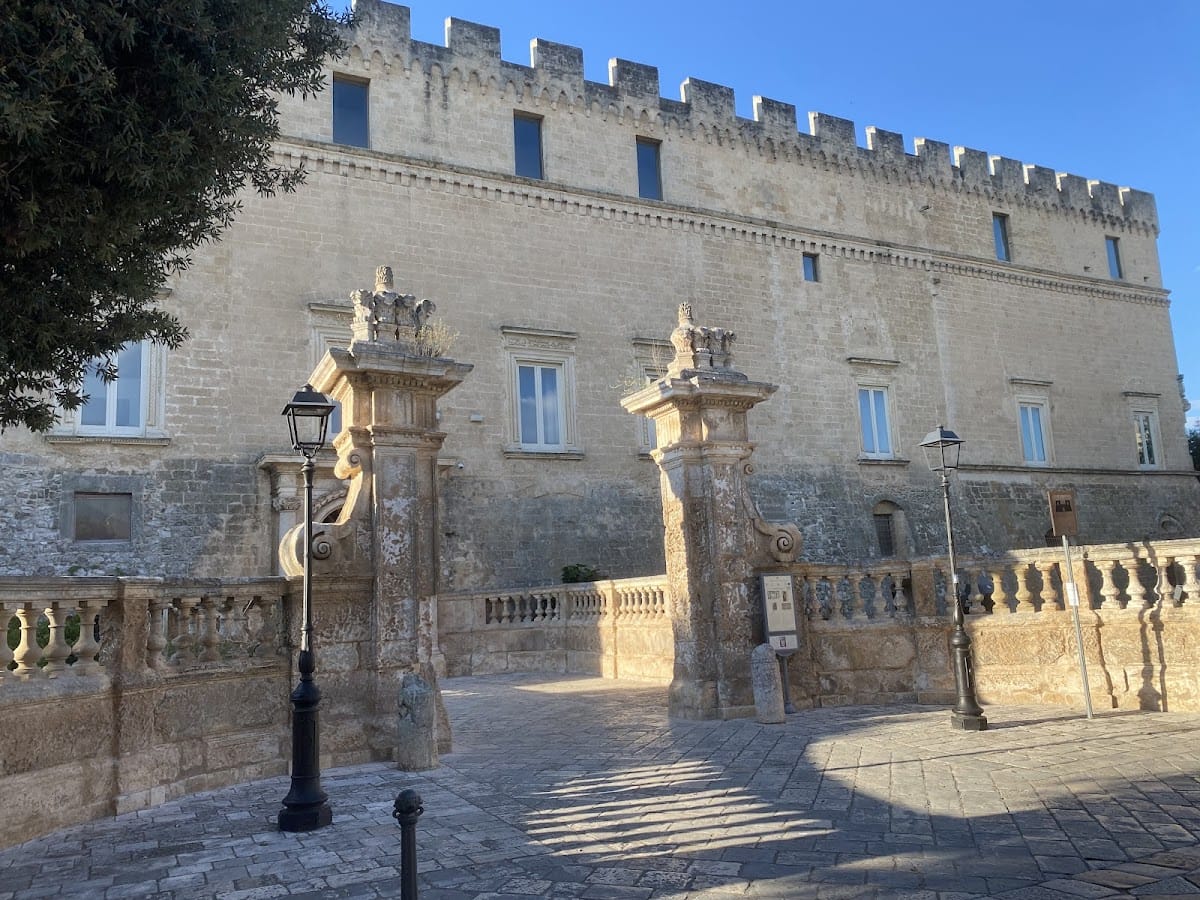
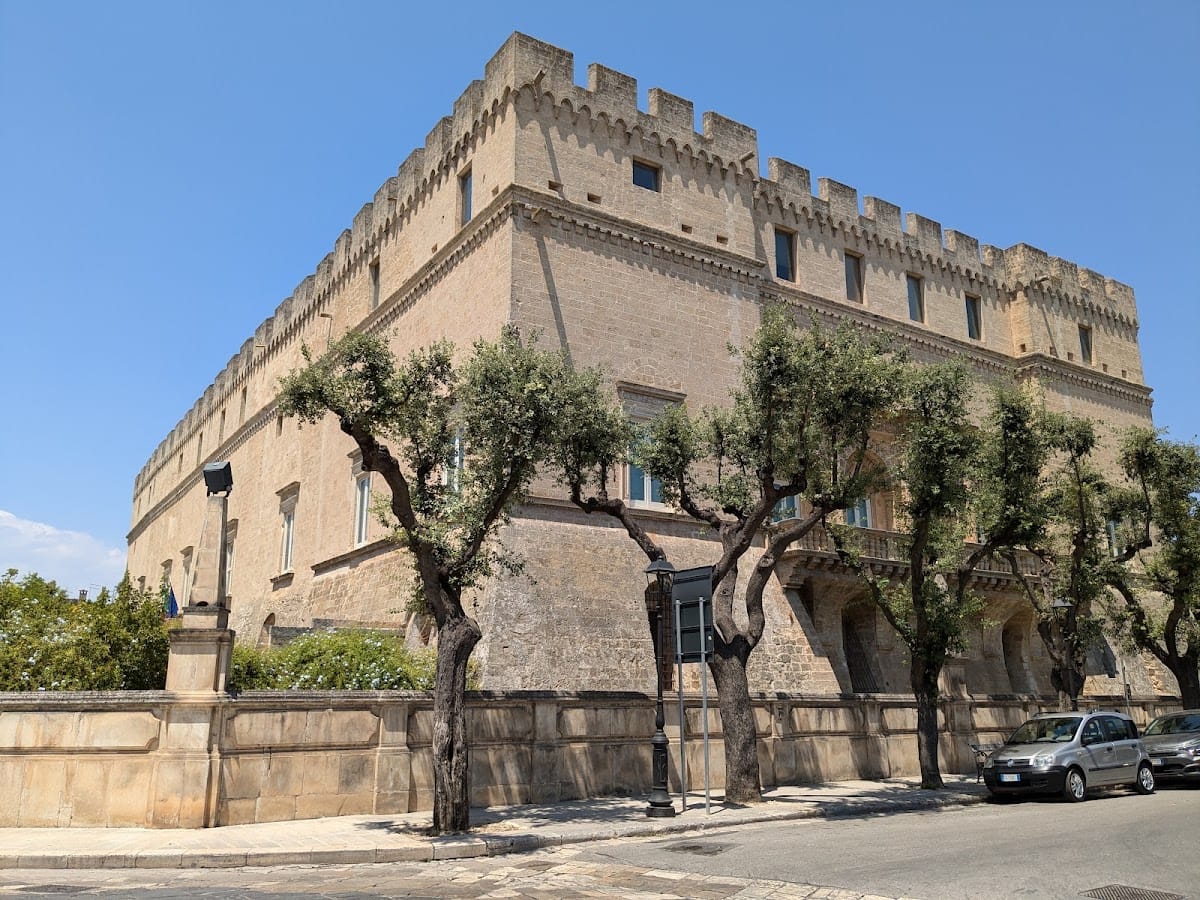
The Castello di Francavilla Fontana presents a rectangular layout, built with three floors arranged unevenly and encircled by a wide moat, typical of defensive medieval fortifications. The base level displays a scarped surface, designed to deflect attacks, punctuated by windows of various sizes and casemates—small openings with angled sides facilitating the placement of firearms.
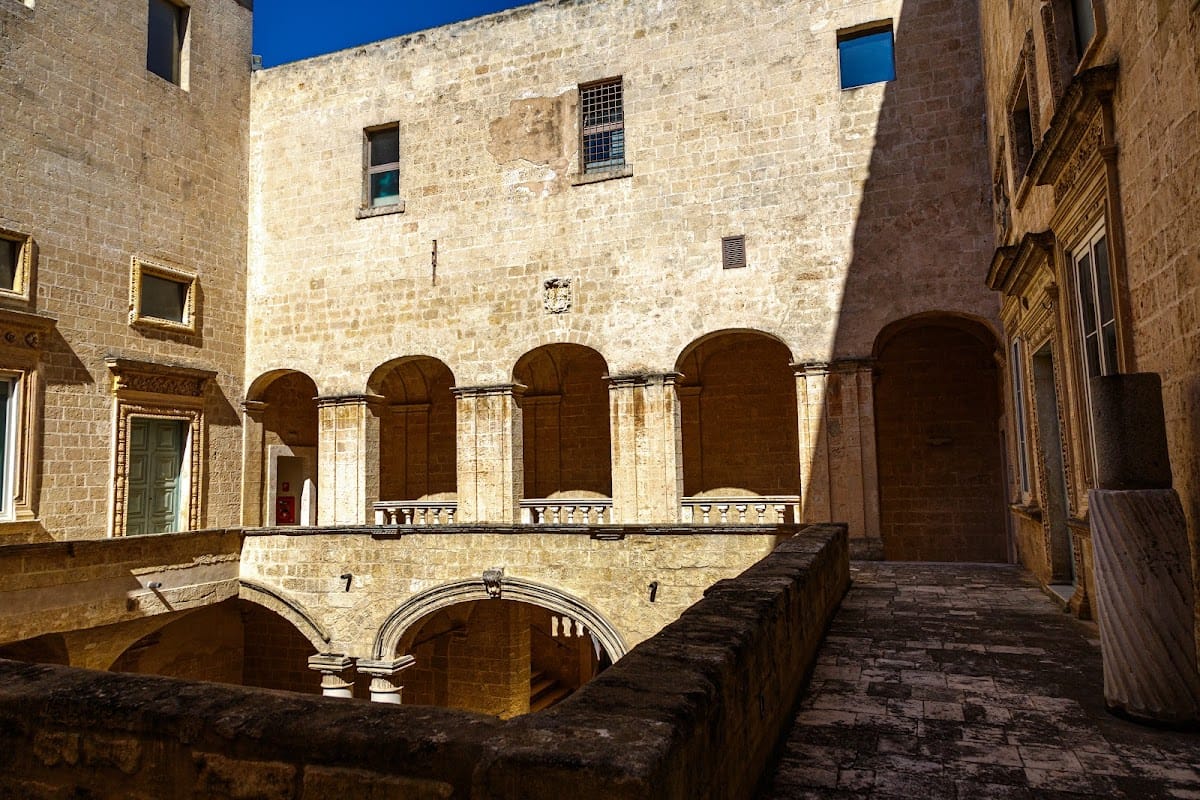
Several Renaissance architectural details endure, most notably the battlements atop the walls and the continuous horizontal bands decorated with dentil molding, a tooth-like pattern common in classical design. The internal courtyard has largely preserved its Renaissance character, featuring a square open space surrounded by a triangular portico supported by sturdy Doric-Tuscan columns. These columns combine features from different classical orders and have capitals with both carved rounded echinus shapes and Ionic egg-and-dart trim.
A prominent feature within the courtyard is a baptismal font dating back to the 14th century, originally from the old local mother church. This stone font is adorned with pod-like motifs and a frieze depicting pairs of dolphins facing each other, connected by floral patterns. The font is also marked with an emblem resembling a bucranium, which is a decorative ox skull symbol, or possibly a horse’s head. This emblem carries a cross associated with the Knights of Malta on one side, a winged griffin on the other, and a Latin motto below, likely related to the religious or chivalric associations of the original owners.
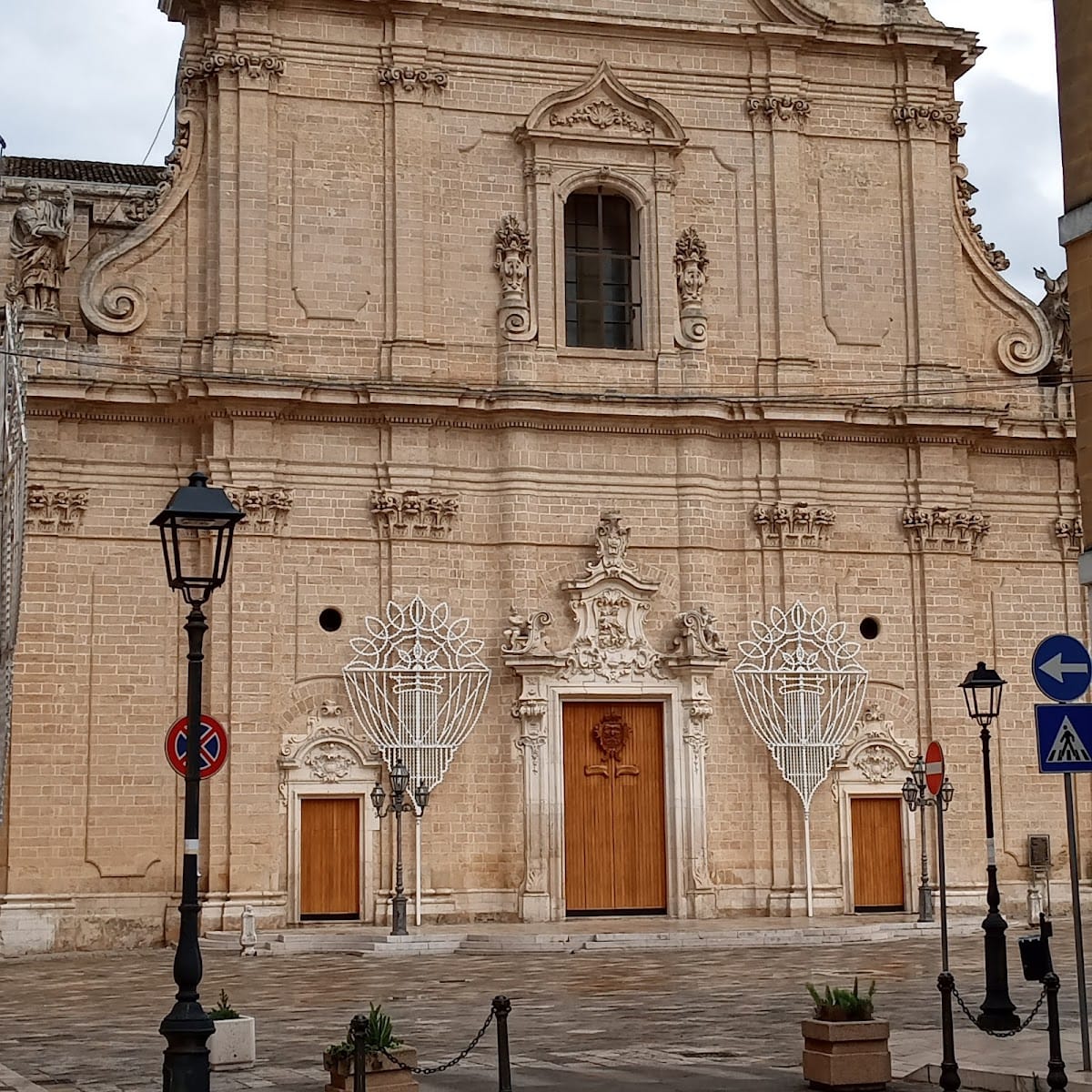
The main façade includes a finely crafted portal shifted slightly westward, framed by composite columns—columns combining Ionic and Corinthian features—resting on blocks with capitals that uphold elongated flat slabs called abaci. This entrance is richly detailed with molded and rounded frames, interrupted at the arch by the Imperiali family coat of arms, indicating their patronage. A more substantial rear portal to the east is topped by an iron balcony, a later addition enhancing the palace’s residential elegance.
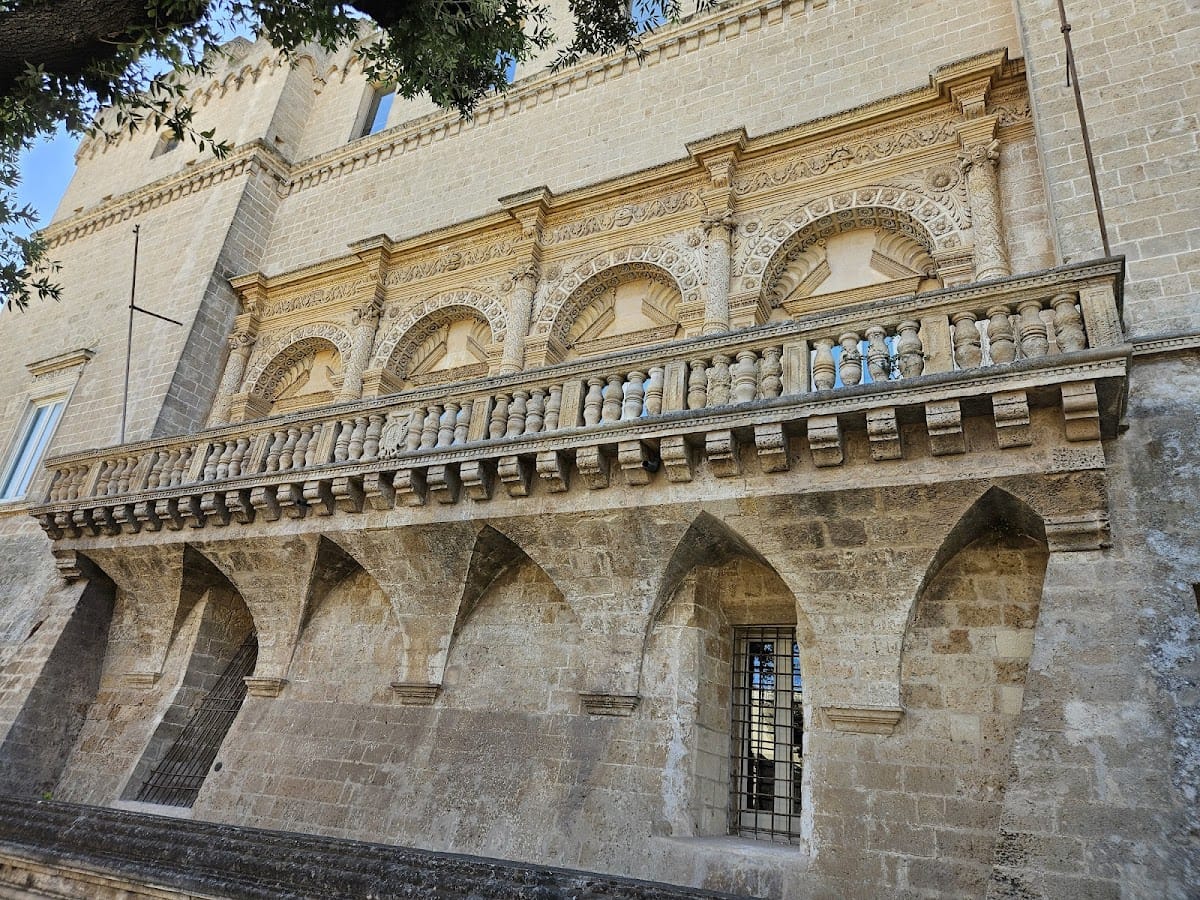
The castle’s upper floors continue this mixture of Renaissance and Baroque ornamentation. Windows on the first floor are framed with delicate designs of intertwined petals or clusters of laurel leaves inside rings, surmounted by small pediments decorated with floral garlands. The eastern façade includes a Baroque-style loggia typical of Lecce’s decorative tradition, comprising four arches embedded into the wall. Each arch encloses tall openings framed with leaf patterns and topped by broken triangular pediments with palm leaf motifs. The supporting columns rest on pedestals and hold up an animated entablature. Above the loggia, a balustrade features miniature classical columns and pilasters decorated with grapevine tendrils and rosettes, showcasing the Renaissance and Baroque blending of nature-inspired ornament and heraldic symbolism.
Inside, a barrel-vaulted passage leads from the entrance to the courtyard. Circling the courtyard are rooms that have served diverse functions over time, including a refectory, aviary, prisons, cellar, storerooms, pantry, and armory, reflecting the castle’s varied roles from fortress to noble residence.
A staircase attributed likely to the architect Mauro Manieri ascends to an upper gallery overlooking the courtyard. This gallery’s windows and doors echo the 16th-century façade’s detailed framing, while some interior doors display distinguishing “ear” moldings, identified as part of Manieri’s design contributions.
The council chamber houses a 17th-century fireplace carved from the local Lecce stone, richly sculpted with floral festoons along its jambs and a frieze that depicts birds drinking from the same vessel. The fireplace’s tympanum is draped and bears the Imperiali-Spinola coat of arms, topped with a crown and flanked by two female profiles also crowned with laurel, symbolizing nobility and victory.
Painted decorations adorn the walls of the second floor, including portraits of notable family members Andrea and Michele III Imperiali, as well as religious scenes such as a Last Supper and an image of Saint Agnes by the artist Pacecco De Rosa.
The hall known as the Mayor’s Hall or Hall of San Carlo features a pavilion-shaped vaulted ceiling decorated with stucco and gilding. Although later maintenance altered some of these decorations, they retain the elegant Baroque style typical of the castle’s later modification phase.
Within the castle, the chapel of Santa Maria delle Grazie was commissioned by Michele Imperiali. Over time, it lost much of its originally rich furnishings, including furniture, jewels, and silver items. However, the chapel remains an important element tying the castle’s defensive, residential, and religious functions together.
Today, the Castello di Francavilla Fontana combines historical architecture with modern uses. It accommodates municipal offices and tourist services alongside the Museo Archeologico di Francavilla Fontana, which exhibits artifacts uncovered from varied periods in the surrounding region, connecting the castle’s history to the wider cultural heritage of the area.
Nearby sites