Castello Monaci: A Sixteenth-Century Fortress and Wine Estate in Italy


Site at a Glance
- Rating
- 4.8
- Popularity
- Medium
- Country
- Italy
- Primary era
- Early Modern
- External website
- Open
- Eras represented
- Early Modern, Modern
- Civilizations
- Kingdom of Naples, Spanish
- Site type
- Military
- Remains
- Castle
On this page7 sections
History
Castello Monaci is a sixteenth-century castle in Salice Salentino, Italy, in the Salento region of Apulia. Built as a lowland fortress, it later served noble families and has been restored for uses that include winemaking, hospitality, and cultural presentation.
Early Christian and Basilian traditions
The surrounding countryside preserves associations with Basilian monks, members of Eastern Christian monastic traditions linked to the Byzantine world. Monks who fled persecution in the Byzantine East sought secluded caves and wooded areas in southern Italy, where they found places for residence, worship, prayer, and retreat.
A settlement developed between the tenth and eleventh centuries around a small church dedicated to Saint Pancratius, an early Christian martyr whose cult belonged to the religious tradition of late antiquity. A donation document from 1063 calls it the “venerable church of Saint Pancratius” and also mentions dwellings and a farm transferred to the Archdiocese of Brindisi. Basilian monks probably helped establish the church.
Construction and later ownership
A land-register document from Salice Salentino records the construction of Castello Monaci in the sixteenth century. The Basilian monks used the castle for worship and meditation, and as a refuge for people in need.
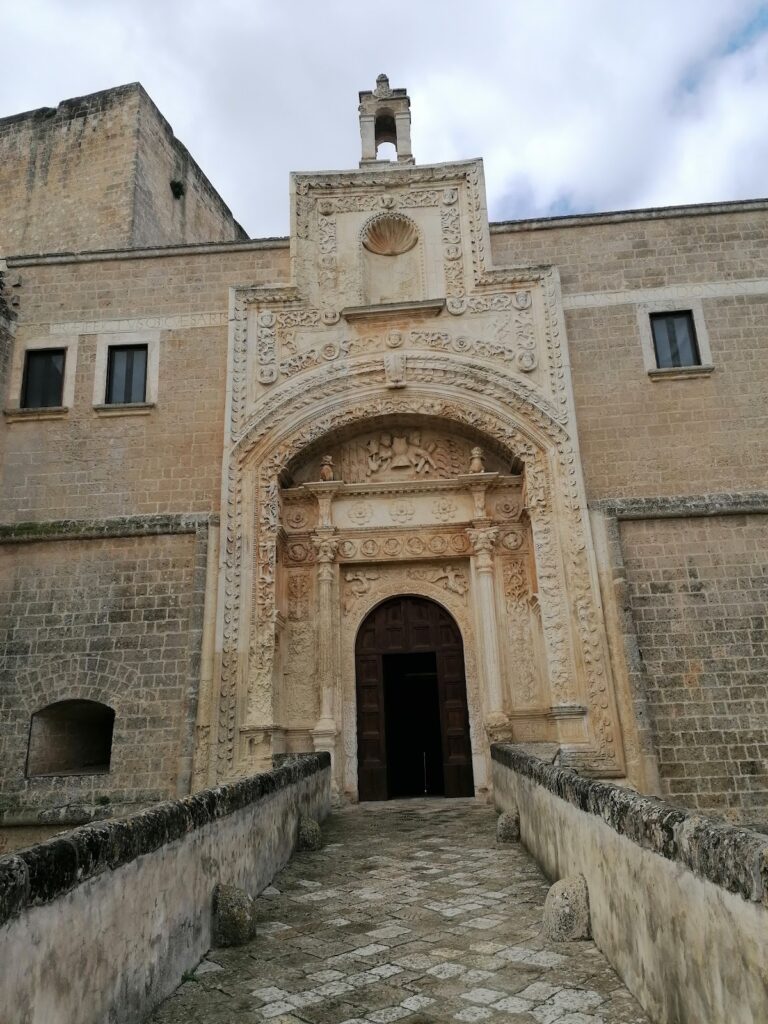
The building later became the residence of noble families, including the Martino, Parry, and Grainger families. During the nineteenth century, a new facade changed its external appearance. Restoration subsequently preserved the castle and allowed the complex to accommodate a winery, a wine museum, a restaurant, and facilities for hospitality and events.
Remains
Castello Monaci is a restored lowland fortress built from dressed stone. The sixteenth-century structure remains in excellent condition, while its nineteenth-century facade forms part of the building’s later architectural history. The property now combines the historic castle with spaces connected to winemaking, a wine museum, hospitality, events, and a restaurant.
Nearby rock shelters and religious features
Angel’s Cave
In the nearby Torrevecchia area of San Pancrazio Salentino, the Angel’s Cave contains fine frescoes of saints. Their forms follow Byzantine iconography, the artistic system used in the Byzantine Christian world to represent sacred figures in religious paintings and frescoes.
Caves of Caragnuli and Caretta
Other nearby caves in the Caragnuli and Caretta areas contain altars, sleeping places, and wells. These features reflect the practical and devotional uses associated with Basilian communities in secluded rock shelters.