Castello di Carimate: A Medieval Gothic Fortress in Italy



Visitor Information
Google Rating: 4.2
Popularity: Low
Google Maps: View on Google Maps
Official Website: www.icastelli.net
Country: Italy
Civilization: Medieval European
Remains: Military

History
The Castello di Carimate is situated in the town of Carimate, Italy, and was originally constructed by medieval Lombard rulers. Its history traces back to an earlier fortification that existed by at least 1149. This initial structure was destroyed during the 13th century amid the conflicts between the cities of Como and Milan, two powerful rivals of the time.
In 1345, Luchino I Visconti, ruler of Milan, undertook the reconstruction of the castle on the original site. This rebuilding formed part of a network of defensive strongholds intended to protect the area north of Milan along the vital via Regina road, which linked Milan with Como and stretched further towards Switzerland. Over the following decades, the castle came under various hands, including the Malabarba family, before Bernabò Visconti strengthened its defenses. By 1380, Bernabò transferred ownership to his wife, Beatrice Regina della Scala. Under Caterina Visconti, the castle’s fortifications were enhanced with the addition of a moat and a drawbridge.
In 1434, Filippo Maria Visconti, Duke of Milan, granted the castle along with the fief of Carimate to Giorgio Aicardi, nicknamed “Scaramuzza,” in recognition of his role in uncovering a noble conspiracy. This grant also allowed Aicardi to take on the prestigious Visconti name. The ownership was reaffirmed in 1477 by Galeazzo Maria Sforza to Giorgio’s heirs. The Visconti line continued to care for the castle, with Lancelotto Visconti overseeing refurbishments in 1481 and further updates in 1493.
That same year, 1493, the castle played host to an important ceremonial event. It was a stop on the route of Bianca Maria Sforza, sister of the Duke of Milan, as she traveled to marry Maximilian I, the Holy Roman Emperor. Among the distinguished figures present were Ludovico il Moro and Beatrice d’Este. Maximilian I himself stayed at the castle on two occasions, in 1496 and again in 1499. The latter visit was particularly significant as the castle served as Ludovico il Moro’s final refuge before his flight to Germany.
Ownership of the castle remained within the Visconti family and their descendants until the late 18th century. In 1795, parts of the property reverted to the Milanese Curia, the church administration, before being sold in 1800 to Cristoforo and Carlo Arnaboldi. During the Third Italian War of Independence in 1866, King Victor Emmanuel II and the national hero Giuseppe Garibaldi observed military exercises from the castle’s tower, highlighting its continued strategic importance.
The late 19th century saw a major restoration led by architect Ercole Balossi Merlo under the commission of Bernardo Arnaboldi Gazzaniga. This project aimed to revive the castle’s medieval character through careful archaeological study and historical research, during which frescoes were rediscovered in the chapel of Santa Maria dell’Albero.
In the early 20th century, the castle was used as a film location for the 1910 short “Gioacchino Murat dalla locanda al trono,” involving local aristocrats and hundreds of extras. The Arnaboldi family maintained ownership until 1957, when it was sold to a real estate company that developed the surrounding land into Italy’s first residential area featuring single-family homes and a golf course.
By the mid-1970s, the castle had a new cultural function as a music recording studio, hosting prominent artists from Italy and abroad between 1977 and 1987. Since 1986, Castello di Carimate has operated as a hotel and restaurant, with parts of the former stables converted into a cultural and civic center during the 1990s by a local cooperative.
Remains
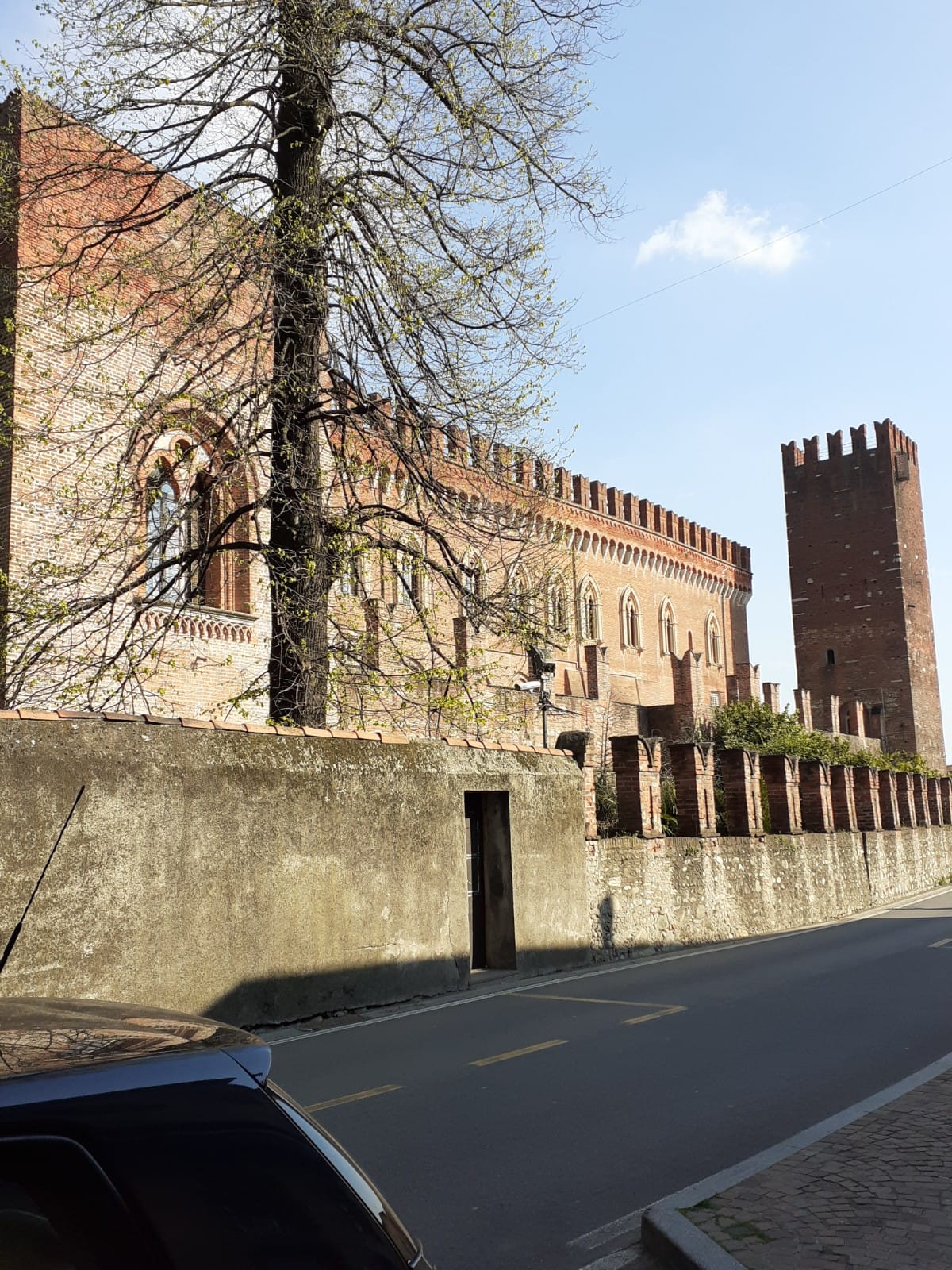
The Castello di Carimate stands as a large quadrangular fortress built in the Gothic style, characterized by a central open courtyard and constructed primarily of brick. Its overall layout reflects a defensive design common to medieval castles, emphasizing both functionality and imposing presence.
A prominent feature is the tall brick tower at the southwest corner of the complex. Notably, this tower is physically detached from the main building mass, suggesting strategic positioning perhaps intended to serve as an independent watchpoint or keep.
The main entrance to the castle still reveals traces of its original defensive mechanisms. Evidence of a portcullis—a heavy gridded door designed to slide vertically to block entry—and a drawbridge can be seen. The gatehouse area shows noticeable asymmetry in its structure, a characteristic that may be linked to the castle’s various building phases and adaptations over the centuries.
Along the second floor, a series of stone-framed bifora windows are arranged in a rhythmic manner. These mullioned windows, divided into two narrow arched sections separated by a small column, reflect typical Gothic architectural elements intended to admit light while maintaining security.
The roofline and the protective fences facing the town are crenellated with Ghibelline merlons. These swallowtail-shaped battlements served defensive purposes and were often associated with the Ghibelline faction, supporters of imperial authority in medieval Italy. This distinctive feature adds both functional and symbolic character to the castle’s silhouette.
On the northern side, the castle includes an elevated terrace overlooking the surrounding grounds. This terrace would have offered strategic views and also provided a place for leisure or observation.
Inside the castle, decorative elements such as neo-Gothic ribbed ceilings and frescoes were introduced during the 19th-century restoration. These frescoes, uncovered and meticulously restored at that time, are located in the chapel dedicated to Santa Maria dell’Albero, indicating the castle’s religious association and importance of its sacred spaces.
The present appearance of the Castello di Carimate largely owes itself to the 1874 restoration that blended archaeological findings with historical knowledge and romantic architectural styles popular in the 19th century. This approach sought to honor the castle’s medieval origins while adapting it to contemporary tastes and preservation standards.
Nearby sites