Castello della Rancia: A Historic Fortress in Tolentino, Italy

Visitor Information
Google Rating: 4.3
Popularity: Medium
Google Maps: View on Google Maps
Official Website: www.tolentinomuseicivici.it
Country: Italy
Civilization: Medieval European
Remains: Military

History
Castello della Rancia stands in the municipality of Tolentino, Italy. Its origins trace back to the late 12th century when the site was used by the Cistercian order as a fortified granary, known as a “grancia.” This structure primarily served agricultural purposes linked to Fiastra Abbey, supporting storage and farming activities under monastic management.
In the mid-14th century, between 1353 and 1357, the Varano family, rulers of Camerino, notably Rudolfo II, seized the site by expelling the monks. They repurposed the granary into a military fortress designed to protect the Chienti valley and to control a parallel Roman road vital for regional movement and defense. The castle’s transformation was completed in 1357 by the architect Andrea Beltrami, establishing a stronghold that reflected the changing military needs of the period.
By the late 16th century, the castle’s military significance had declined. In 1581, following the acquisition of the Fiastra Abbey by the Jesuits, the fortress ceased its defensive role and shifted into a large farming estate. During this time, it also accommodated pilgrims journeying to Rome, functioning as a hostel along a significant religious route.
Ownership changed again in 1782 when Pope Pius VI transferred the castle and the abbey’s assets to the noble Bandini family. Their possession continued until the last descendant donated the castle to the Municipality of Tolentino in 1974, marking a transition from private to public stewardship.
The castle also played a role during the Napoleonic Wars, specifically in the Battle of Tolentino held on May 2–3, 1815. This confrontation pitted the Neapolitan forces led by Joachim Murat against the Austrians. The castle was fiercely contested, with the Austrians ultimately gaining victory. Today, this event is commemorated annually near the castle in an event called “Tolentino 1815.”
According to local tradition and unconfirmed reports, a second tank or tank-like structure in the courtyard may have served as a burial site for many who fell during the battle. Additionally, legends speak of a concealed medieval tunnel linking the castle to the Basilica of San Nicola in Tolentino, underscoring the site’s layered historical and symbolic associations.
Remains
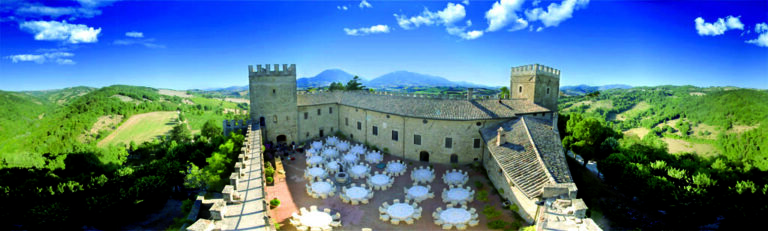
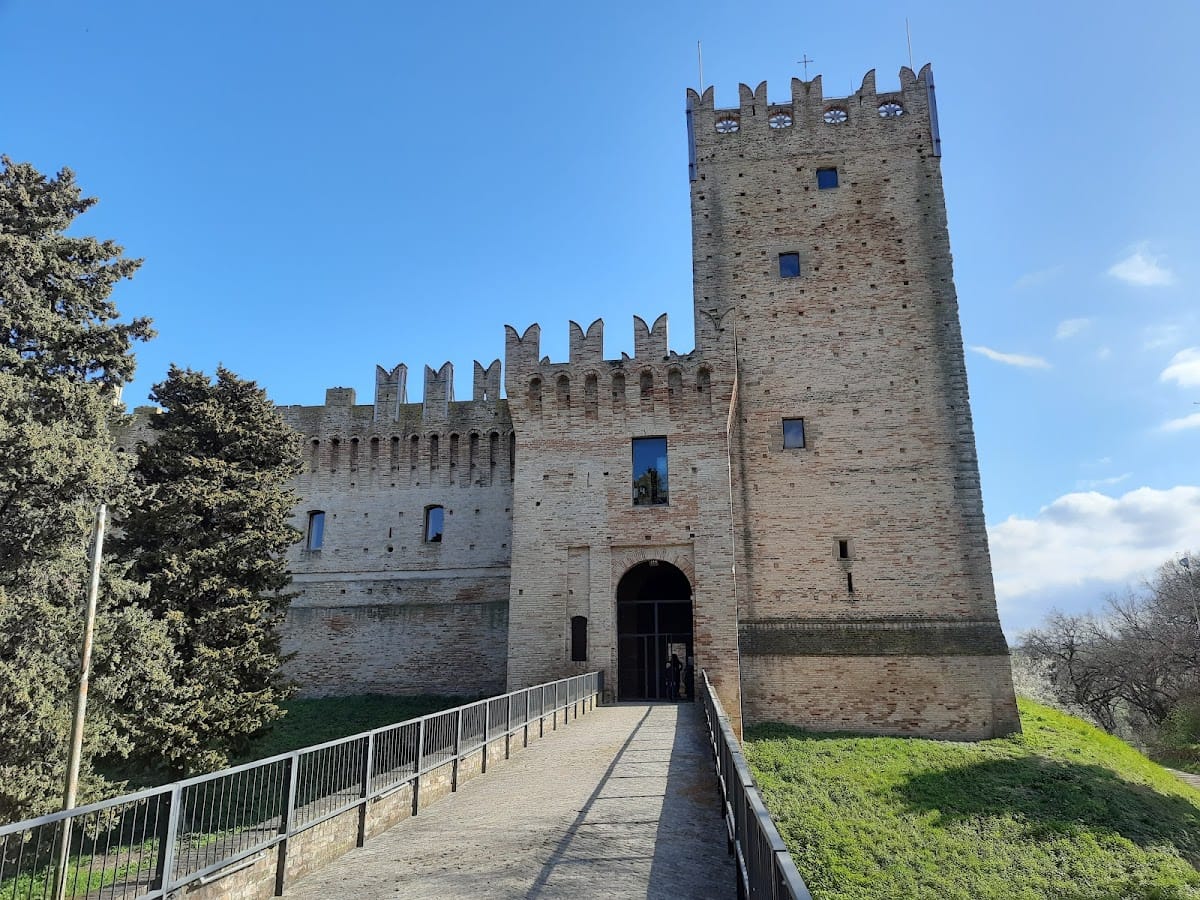
The castle features a roughly square layout enclosed by fortified walls that are topped with battlements, characteristic of defensive constructions from the mid-14th century. Three towers reinforce the corners of the walls, with the main entrance protected by an additional tower. Originally, access to this entrance was granted via a drawbridge, but over time it was replaced by a stable brick bridge reflecting changes in military architecture and use.
Dominating the structure is the main tower, or mastio, elevating to approximately 25 to 30 meters. This tower rises four floors high, with the first three floors showcasing cross vaults—arched ceilings that intersect to distribute weight. The basement of this tower functioned as a prison, as revealed by large iron rings embedded in the walls and narrow, tall slits that allowed light while preventing escape.
Within the castle lies a central courtyard, which contains a remarkably deep cistern designed to collect and store water. Two adjoining sides of the courtyard are bordered by porticos featuring rounded arches resting on sturdy cylindrical brick pillars. These elements illustrate an architectural blend of defense and residential function.
Above the courtyard, on the first floor, another portico is present. This one leads into a spacious hall believed to have been the castle’s living quarters. From the courtyard, visitors can also access a Baroque chapel constructed during the Jesuit period, indicating continued use and adaptation of the castle’s spaces for religious purposes after its military era had ended.
While the physical remains provide a clear picture of the castle’s layout and functions, local legends add further intrigue. Stories of an underground passage connecting the castle to a nearby basilica, although unverified, speak to the site’s importance in regional history and folklore. Similarly, the supposed second tank as a mass grave from the 1815 battle adds a somber narrative layer that echoes the castle’s role in Italy’s Napoleonic conflicts.
Nearby sites