Castell del Catllar: A Historic Fortified Site in El Catllar, Spain


Visitor Information
Google Rating: 4.4
Popularity: Low
Google Maps: View on Google Maps
Official Website: www.castell.elcatllar.cat
Country: Spain
Civilization: Unclassified
Remains: Military

History
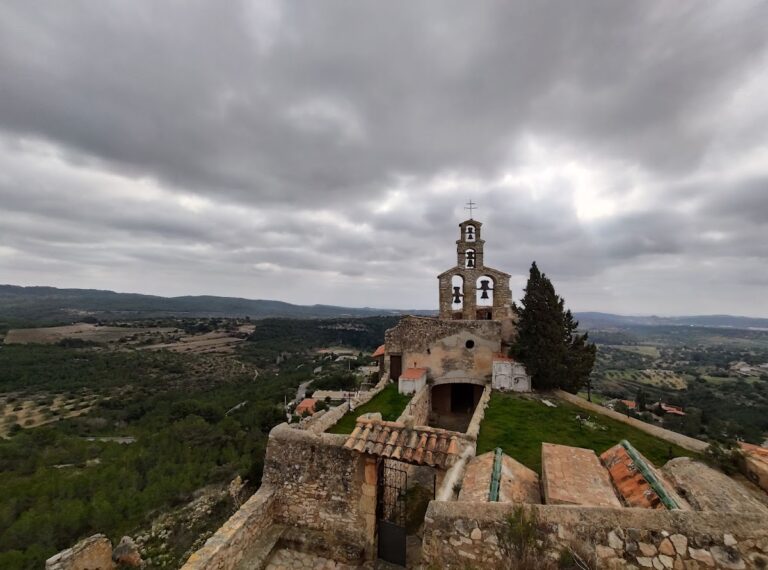
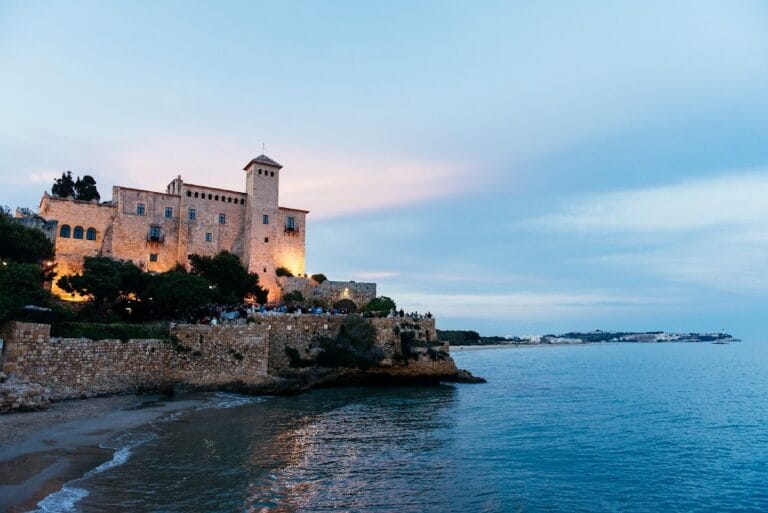
The Castell del Catllar stands on a hill within the municipality of El Catllar, Spain. It occupies the site of an ancient fortified settlement established during the Iron Age between the 7th and 5th centuries BCE.
The earliest archaeological evidence reveals that this location was initially fortified by Iron Age communities who took advantage of the natural curve of the Gaià River to control and defend the surrounding territory. While written records first clearly identify the castle structure in the 11th century, excavations hint that its origins may be even older, possibly linked to Muslim occupation or earlier periods before the Christian reconquest.
In the year 1066, the land where El Catllar sits was part of the domain known as Puigdelfí. This territory was given by the Counts of Barcelona to Ponç de Montoliu, who established a fortress there to secure the frontier against Al-Andalus. The Montoliu family controlled the area until 1344, when Humbert de Montoliu transferred ownership to Pere de Requesens. The Requesens lineage became connected to the site through marriage when Berenguer de Requesens wed Blanca de Montoliu, who held the titles of lady of El Catllar and Puigdelfí.
By the mid-14th century, the castle gained strategic importance during a revolt in 1358, when a group of knights resisted royal food taxes. These rebels fortified themselves within the castle, prompting a royal siege that ended with their deportation to Sardinia. Shortly afterward, the lordship of El Catllar passed through marriage alliances to the Queralt and then Castellar families.
Throughout the 15th century, the castle was a royal fief, exercising full jurisdiction over the territory and local residents. It was notably involved in legal conflicts during 1428 and played a role in the conflicts between the Generalitat, the Catalan government, and King Joan II. In 1463, Roger de Clariana was appointed captain to defend and strengthen the fortress under the rule of Elionor de Pallars. After her death in 1466, the lordship passed to Pere IV de Queralt.
A significant event occurred in 1592 when Guerau de Queralt successfully defended the castle against an assault by more than one hundred attackers who inflicted considerable damage. The Queralt family maintained lordship over the estate until the abolition of feudal privileges in the 19th century, marking the end of its role as a feudal stronghold.
Remains
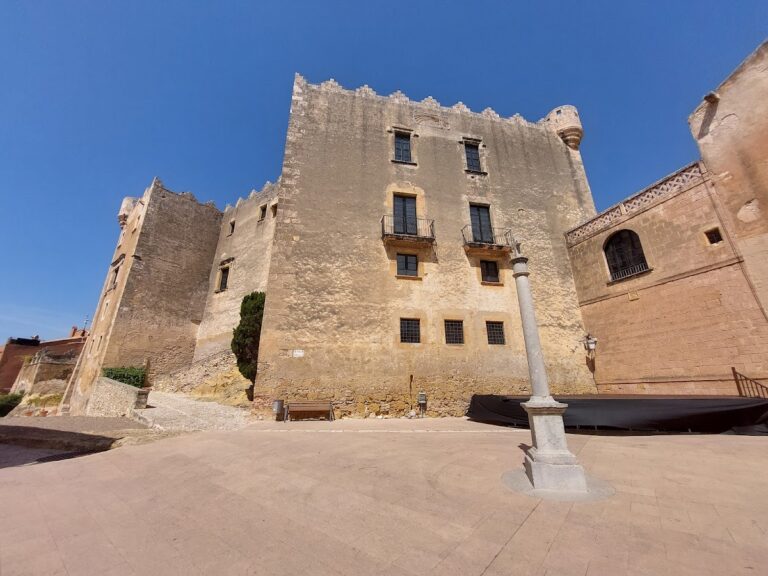
The Castell del Catllar is positioned atop its elevated site, surrounded by defensive walls oriented along a north–south axis. The enclosure is anchored by two main towers at either end, which represent the strongest surviving elements of the castle. These towers date from the 13th century and display a slightly rectangular shape, measuring around six meters on each side with heights ranging from 12 to 14 meters. Both include multiple narrow arrow slits designed for defense and windows for light and observation. The tower on the northern end features a small door set roughly six meters off the ground, likely intended for strategic access.
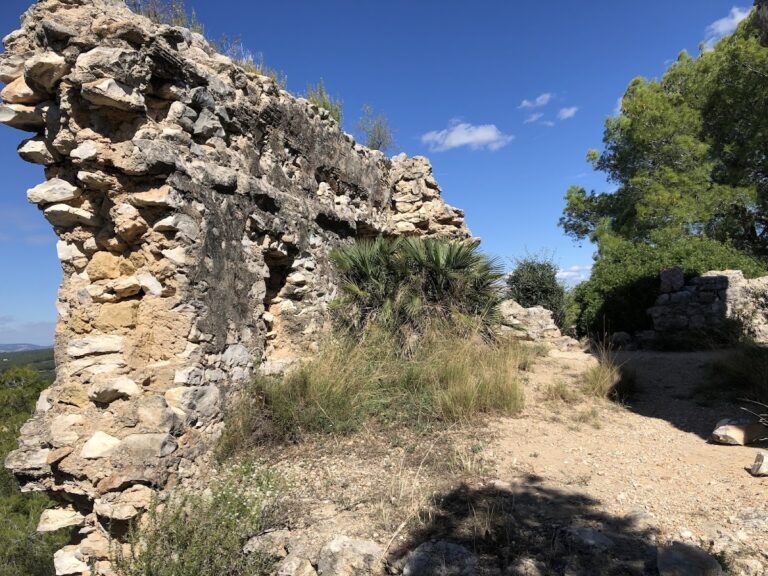
The connecting walls show variation in form: the eastern section curves gently, following the natural contours of the terrain, while the western wall is straighter, with a single angled bend along its length. The construction primarily consists of roughly shaped stones arranged in rows, interspersed with finely cut ashlar stones reinforcing the corners, providing structural stability. The western wall is notable for containing opus spicatum masonry, a herringbone pattern that probably was added during or after the construction of the towers, reflecting a construction technique common in medieval fortifications.
Over the centuries, the visible remains have been shaped by successive building phases, particularly from the 13th through the 16th centuries. Numerous expansions and the addition of ancillary buildings reused the original walls and towers as foundations, resulting in a composite structure reflecting continuous occupation and adaptation to defensive needs. Today, the castle’s most prominent features—the towers and surrounding walls—remain well-preserved, offering a clear impression of its medieval military architecture.
Nearby sites