Castell de Sentmenat: A Medieval Gothic Fortress in Catalonia, Spain


Visitor Information
Google Rating: 4.1
Popularity: Low
Google Maps: View on Google Maps
Official Website: visitvalles.com
Country: Spain
Civilization: Unclassified
Remains: Military

History
The Castell de Sentmenat is located in the municipality of Sentmenat in Spain and was constructed by medieval Catalan nobility. Its origins stretch back to the mid-11th century, with the earliest written references dating to 1056 related to Ramón Miró. By 1065, the castle had received further notice, and by 1083 it became associated with the Montcada family, a notable Catalan noble house. On this occasion, Guillem and Albert Ramon de Montcada engaged in a financial agreement with Countess Mafalda, exchanging funds for rights and income tied to the castle’s domain, indicating its growing importance in regional governance and land control.
During the 12th and 13th centuries, the castle came under the stewardship of the Montcada seneschal Guillem Ramon II and subsequently passed to the Sentmenat family. This family acted as vassals of the Montcadas and gradually consolidated their authority, with Pere de Sentmenat gaining full control by 1243. In 1237, in a notable transaction, Garsenda, widow of Guillem de Montcada, swapped certain estates with the commander of the Hospitaler Order based in Barcelona to secure rights over the castle, linking the fortress with religious military orders of the period.
Ownership shifted again in the early 14th century when the castle came into the possession of Bearnèsia, wife of Bernat de Centelles, in 1301. This transfer triggered a series of disputes between the Centelles and the Sentmenat families over rightful control. Attempts to resolve these tensions included a royal intervention in 1316 when King James II exempted the castellan of Sentmenat from the obligation of paying homage to the Centelles. Despite this, conflicts continued until a formal agreement was reached in 1328. Later, in 1380, Pere de Sentmenat purchased full lordship of the castle and its lands from Eimeric II of Centelles for 9,000 pounds, ending decades of contest over the property.
By the 15th century, the Sentmenat family had acquired the judicial title known as “mer i mixt imperi,” granting them both civil and criminal jurisdiction within the castle’s territory. This elevated their status significantly in local society. Centuries later, in 1691, King Charles II elevated Joan de Sentmenat i de Toralla by bestowing upon him the noble title of Marquis of Sentmenat, reflecting the enduring prominence of the family and the estate within the region. From the 17th through the 18th centuries, the castle’s original defensive role diminished as it was converted into a farmhouse or masia. It continued to be inhabited until as recently as 1990, after which it has stood unoccupied. Today, the castle is recognized as a heritage site of national interest in Catalonia and is officially listed as a Bien de Interés Cultural in Spain.
Remains
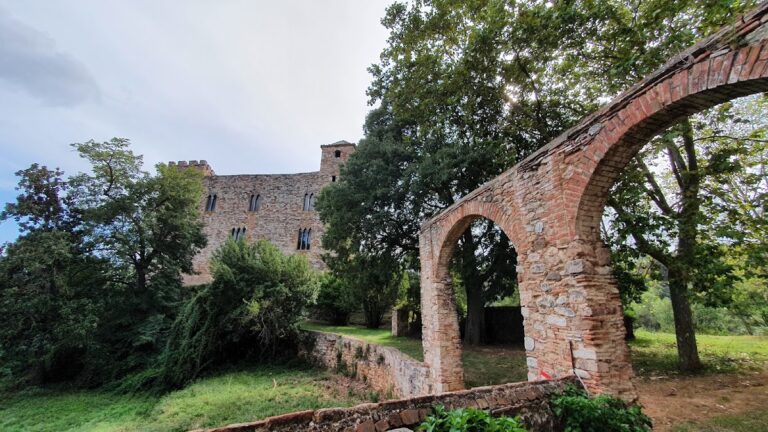
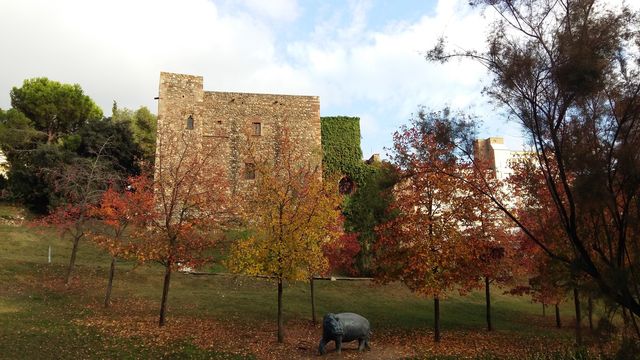
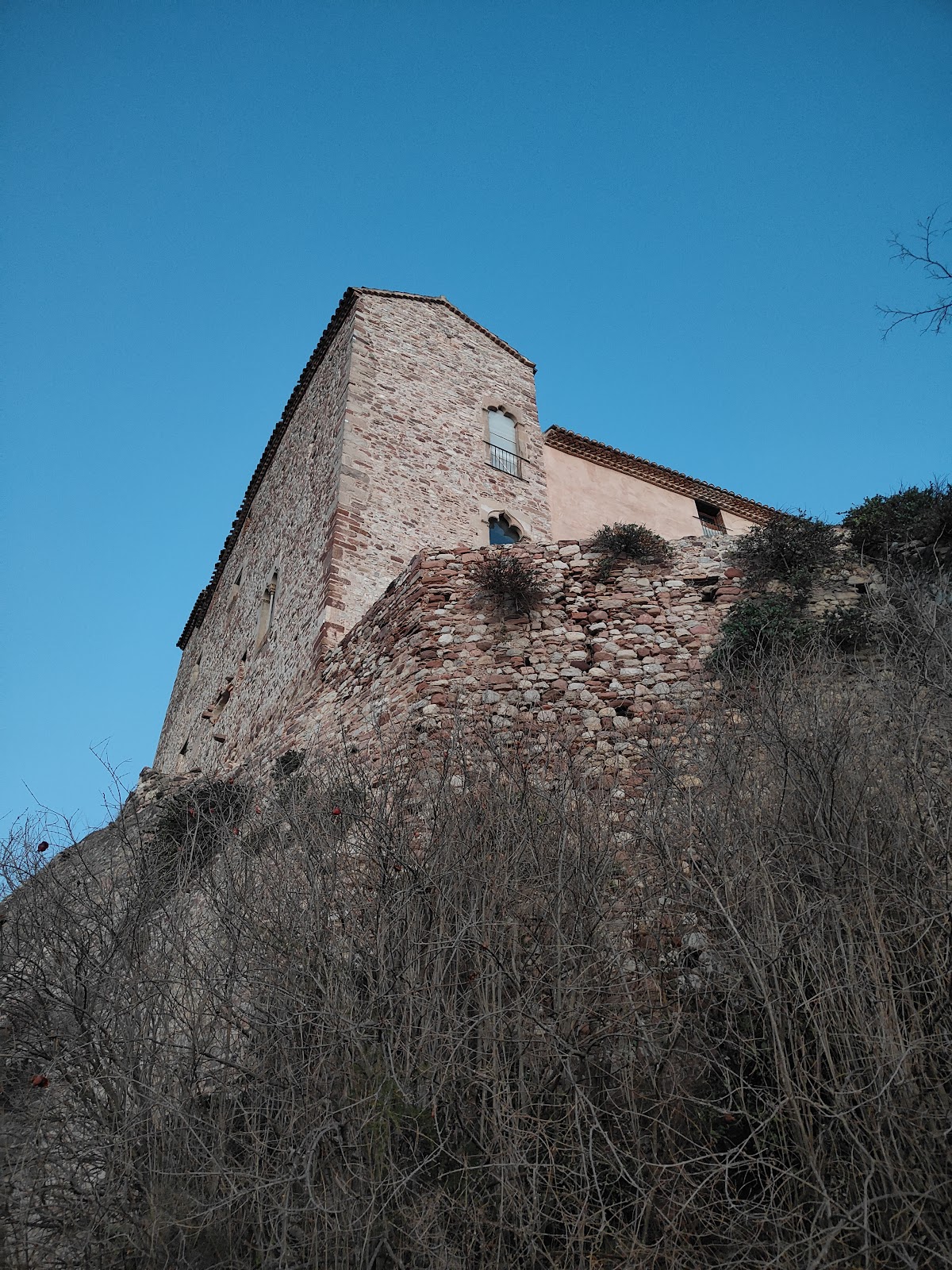
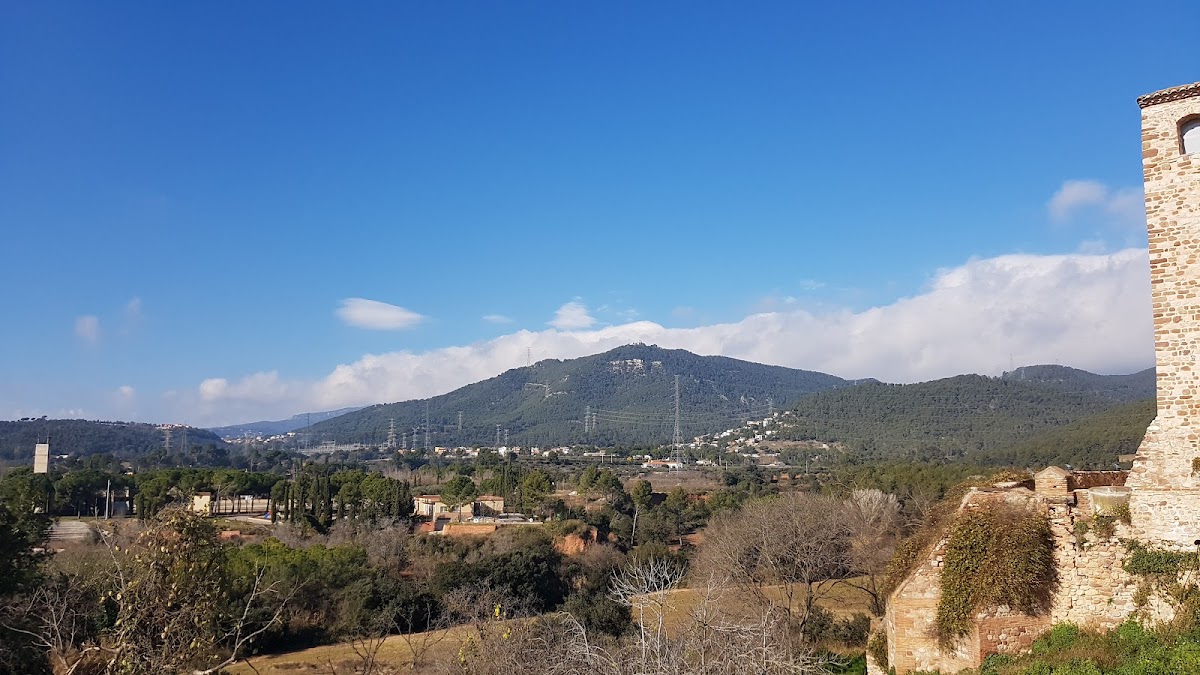
The Castell de Sentmenat is a large Gothic fortress erected atop earlier foundations, located on a flat ridge just over a kilometer northwest of the nearby parish church of Sant Menna. Its layout consists of two main rectangular wings arranged perpendicularly to one another and joined by a curving third segment forming a quarter-circle. This design encloses a trapezoidal courtyard at the center, a feature common in medieval military architecture aimed at combining strong defense with functional space.
Access to the castle is granted by a stone bridge, which likely replaced an earlier drawbridge, highlighting adaptations in defensive infrastructure over time. The exterior walls are notably thick, about three meters in width, constructed primarily from irregular stone blocks bound with mortar. The west-facing main façade is positioned above the edge of the Sentmenat stream, while the rear façade curves semicircularly to overlook the surrounding plain. This design balances defensive needs with advantageous viewpoints over the landscape.
The principal entrance consists of two distinct doorways. One maintains an original round-arched form, typical of medieval fortifications, while the other features a more prominently placed arch with a large keystone adorned by the coat of arms of the Marquisate of Sentmenat. This heraldic stone signifies the castle’s noble associations and marks the symmetry axis of the entrance arch. Inside, the rooms preserve wooden beam ceilings that speak to traditional construction methods.
Around the year 1500, an additional nave was annexed to the castle to create a carriage entrance opening into a large, elongated rectangular courtyard of shallow depth. Within this courtyard stands a two-flight uncovered staircase leading to an upper gallery supported by projecting corbels—stone brackets that distribute weight and create open space below. The ground floor beneath the courtyard retains stone round arches supporting a barrel vault that follows the courtyard’s irregular curved layout, showcasing advanced medieval masonry skills.
Some vaulted sections contain traces of wooden centering, a temporary wooden framework used during construction to shape the stone vaults until the mortar set. This technique marks the castle’s 16th-century modifications and demonstrates knowledge of medieval building practices in the region. Despite centuries of alterations, the overall external appearance of the castle remains largely unchanged, reflecting careful preservation.
The castle’s towers are integrated into its structure without prominent projection, yet they served defensive purposes by strengthening the walls and vantage points. Constructed entirely from stone, the castle is well maintained, standing as a solid example of medieval Gothic military architecture. On the east side, a particularly robust wall exceeding three meters in thickness protects the more accessible flat terrain, underscoring the strategic care placed in fortifying vulnerable approaches to the fortress.
Nearby sites