Calonge Castle: A Medieval Fortress in Catalonia, Spain

Visitor Information
Google Rating: 4.4
Popularity: Low
Google Maps: View on Google Maps
Country: Spain
Civilization: Unclassified
Remains: Military

History
Calonge Castle is located in the municipality of Calonge in Spain. It was built and developed during the medieval period by feudal lords who controlled the surrounding territory.
The first historical references to the area date back to the late 9th century, when Calonge was mentioned as part of the northern border of the Vall d’Aro granted to the bishop of Girona by Carloman in 881. By the late 10th century, the nearby monastery of Sant Feliu de Guíxols owned land in Calonge, a fact confirmed by a royal diploma issued by King Lothair I in 968.
The castle itself emerges in documentation from the early 12th century. By the late 1100s, it belonged directly to the counts-kings, who granted it as a fief to Ramon de Solius. In 1193, Ramon formally swore allegiance to King Alfonso II for the lordship known as “Calonge de Marítima,” indicating the strategic and administrative significance of the castle during this period.
In the 13th century, control passed to the noble house of Cruïlles, beginning with Gastó I, who died in 1229. Members of this family played active roles in regional politics and military campaigns. Notably, Gilabert III of Cruïlles participated in the conquest of Mallorca and was involved in managing the castle’s income through financial dealings. The Cruïlles maintained possession of the fortress through much of the 13th and 14th centuries, with some interruptions. In 1371, jurisdiction returned temporarily to the crown but was regained by the family in 1393.
During the 15th century, the castle witnessed conflict linked to civil wars and peasant uprisings known as the remensa revolts. It suffered destruction by fire in both 1477 and 1485 but was rebuilt promptly after these events. Ownership transitioned from the Cruïlles family to the Requesens by the late 1400s. Subsequently, through marriage alliances, the castle came under the Cardona-Anglesola family and later passed to the dukes of Sessa. By the 18th century, it belonged to the Osorio de Moscoso lineage.
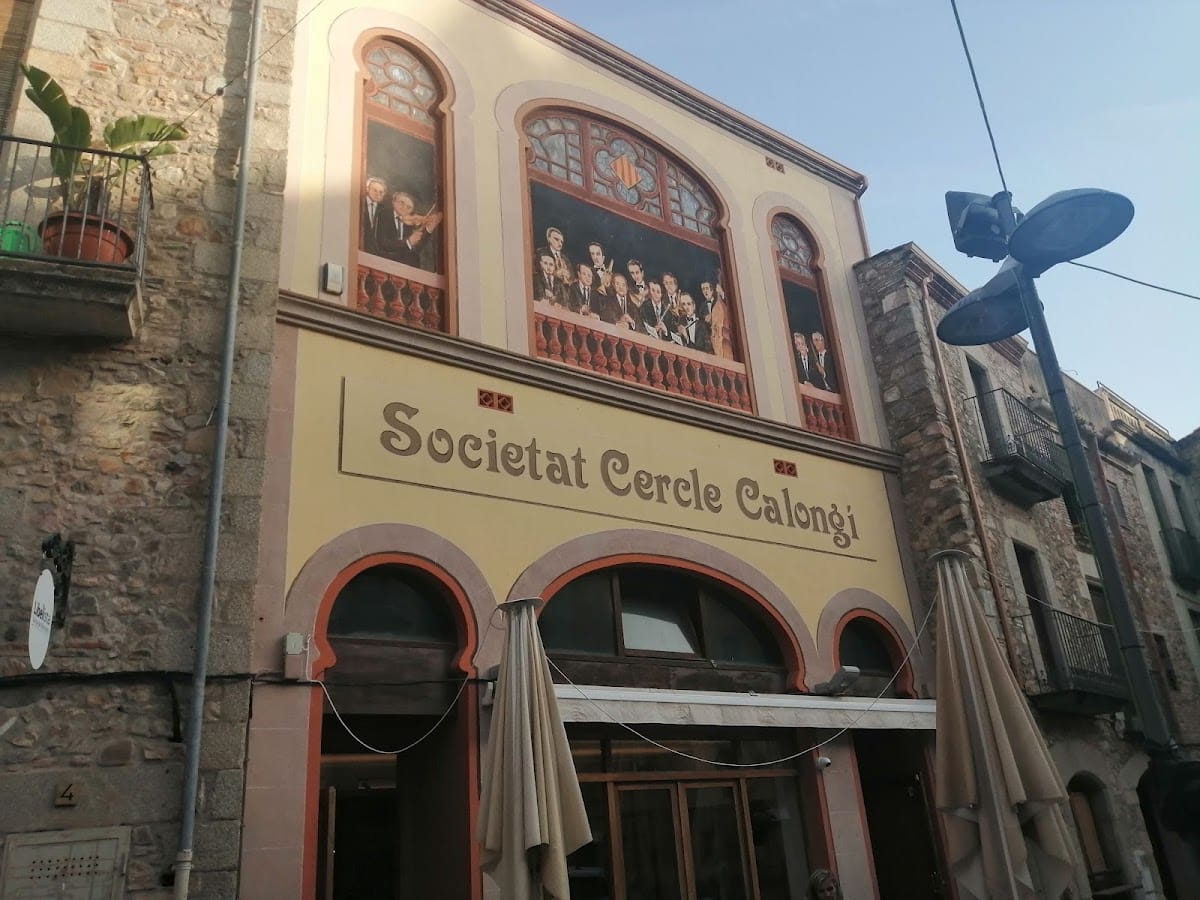
In 1899, the castle was sold to a local family named Casellas, who adapted it for social activities such as a casino and theater. In modern times, it entered public ownership under the Generalitat de Catalunya, which undertook restoration and adaptation efforts. Since 1968, the castle has been used as a venue for a music festival, highlighting its ongoing cultural role.
Remains
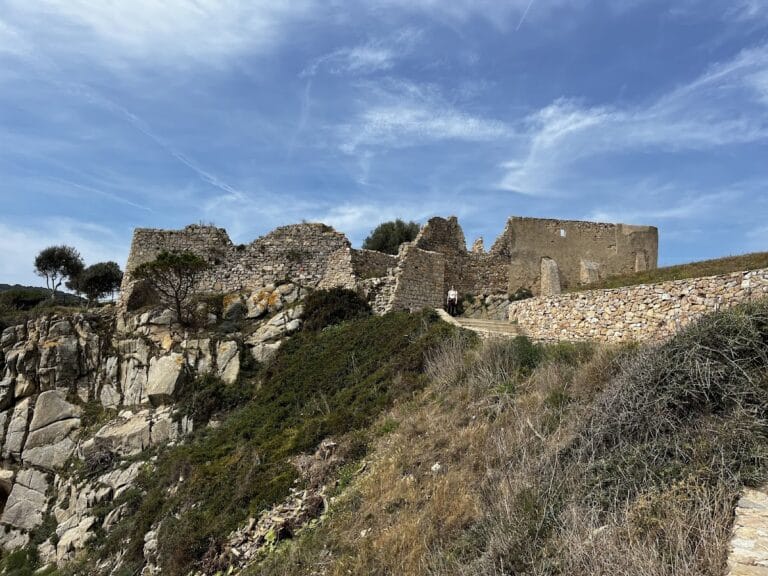
Calonge Castle is composed of a series of fortifications and buildings constructed and expanded from the 12th century onward, reflecting changes in design and function through the medieval and early modern periods. Its layout consists of an original square tower, a trapezoidal enclosure, and later additions including towers and palace wings, all surrounded by defensive walls.
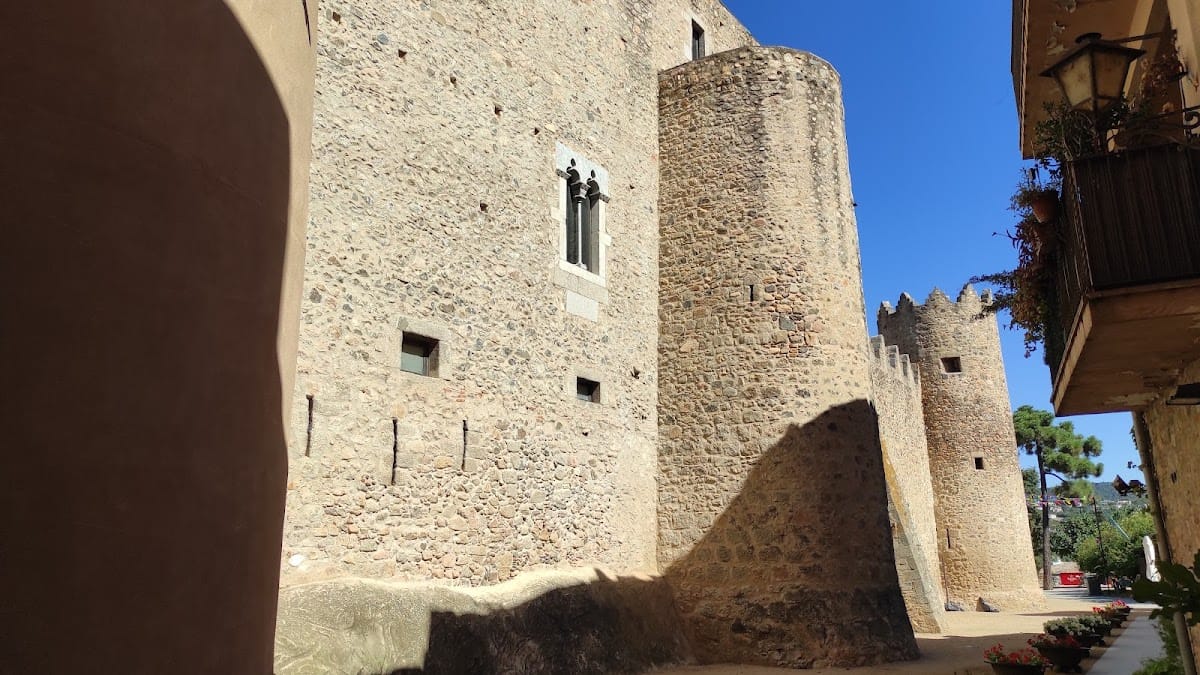
The oldest surviving structure is a nearly square tower situated in the southwestern corner. This tower, dating from the 12th century or slightly later, measures approximately 11.60 by 11.15 meters with walls about 1.10 meters thick. Its height reaches up to 10 meters today. Inside, the tower was divided into multiple floors supported by wooden beams that rested in recesses within the stone walls. Defensive openings known as arrow slits pierce the lower walls, with six on the northern side, seven on the east, and two on the south. These narrow vertical openings, each roughly 50 centimeters wide and 70 to 90 centimeters tall, allowed defenders to shoot arrows while remaining protected. Access to the tower was through a door on the eastern façade positioned about 6 meters above ground level, framed by a semicircular arch made of nine wedge-shaped stones called voussoirs. This elevated entrance was likely reached by a wooden ladder or rope to enhance security.
The masonry of the tower combines roughly hewn stones about 15 by 20 centimeters with larger, smoothly finished cornerstones and carefully cut blocks framing the arrow slits. This combination of stonework provided both strength and defensive advantage.
In the 14th century, the castle was expanded with a larger trapezoidal enclosure surrounding the original tower. This new enclosure featured its own arrow slits and battlements with crenellations—stone parapets with gaps that allowed defenders to observe and fire upon attackers safely. Several rounded towers were added at three corners of this enclosure, while the original square tower occupied the fourth. A semicircular tower was built on the eastern wall, further reinforcing defense in that area.
Following the destructive fires in the 15th century, a late Gothic palace wing was constructed along the south and east sides of the enclosure, indicating an increased focus on residential comfort and status within the castle walls. Later, in the 16th and 17th centuries, a Renaissance-style wing was appended, bearing the coat of arms of the dukes of Sessa, who owned the property at that time.
In the 20th century, several internal buildings within the castle courtyard were demolished. Among these was the house of Lluís Vilar i Subirana, a prominent scholar who studied the castle extensively.
Today, the castle stands as a protected cultural heritage monument under both Catalan and Spanish systems, preserving a complex architectural history that spans centuries of medieval and early modern fortification and residence.
Nearby sites