Jardíns de Cap Roig: A Historicist Estate and Botanical Garden in Spain


Site at a Glance
- Rating
- 4.5
- Popularity
- Low
- Country
- Spain
- Primary era
- Modern
- Eras represented
- Modern
- Civilizations
- Spanish
- Site type
- Domestic
- Remains
- Castle
On this page9 sections
History
Jardíns de Cap Roig is a twentieth-century historicist estate and botanical garden in Spain, near Palafrugell, created from 1927 by the Russian émigré Nikolai Woevodski and his English wife, Dorothy Webster. Its principal building reinterprets medieval forms, while the surrounding garden was developed as part of the couple’s residence and estate.
Creation of the estate
Woevodski, a former tsarist colonel who had left Russia after the 1917 Revolution, began acquiring land at Cap Roig in 1927. He designed the project himself, despite having no formal architectural qualification. Webster was an antiquities specialist, and the couple’s backgrounds shaped an estate that combined a residence, historicist architecture, and a botanical collection.
The castle is popularly called Cal Rus or El Castell del Rus, names associated with Woevodski’s Russian origins. By 1931, the property included houses for gardeners and other workers, and the couple lived for a time in one of them. The castle itself then consisted only of its southern wing and monumental entrance.
Garden development and later construction
Around the residence, Woevodski and Webster established a botanical garden containing approximately 1,000 species. During the dictatorship of Primo de Rivera, an authoritarian Spanish regime of the period, they also privatized public paths and coastal areas.
Because Woevodski’s two sons from a previous marriage were considered unable to maintain the estate and its botanical garden, the couple entered an agreement with the Savings Bank of Girona in 1969 in return for a lifelong income. The arrangement allowed construction of the castle to continue. The works were completed in 1975, shortly before Woevodski’s death.
Ownership and protection
After Dorothy Webster died in 1980, the estate passed to the savings bank. It now belongs to the La Caixa Foundation. The castle and estate are protected in Catalonia as a Cultural Asset of National Interest, a high-level heritage designation for nationally important sites, and as a Spanish cultural-interest monument, a status declared in 1988.
A special plan approved in 2019 proposed constructing three buildings on the estate and attracted criticism. The proposal forms part of the modern history of a property whose identity was established through the relationship between its buildings, gardens, and coastal setting.
Remains
Jardíns de Cap Roig occupy a large estate in the southern part of the municipality of Palafrugell. The surviving complex brings together a principal historicist building, auxiliary dependencies, a botanical garden, a coastal landing place, and the Woevodski family tomb. Its architecture is eclectic, combining elements drawn from several traditions rather than following one historical style.
The castle and estate buildings
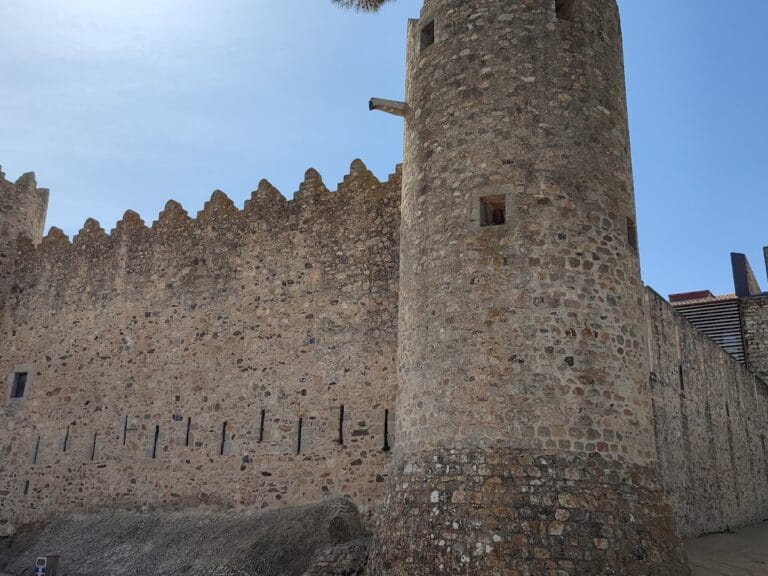
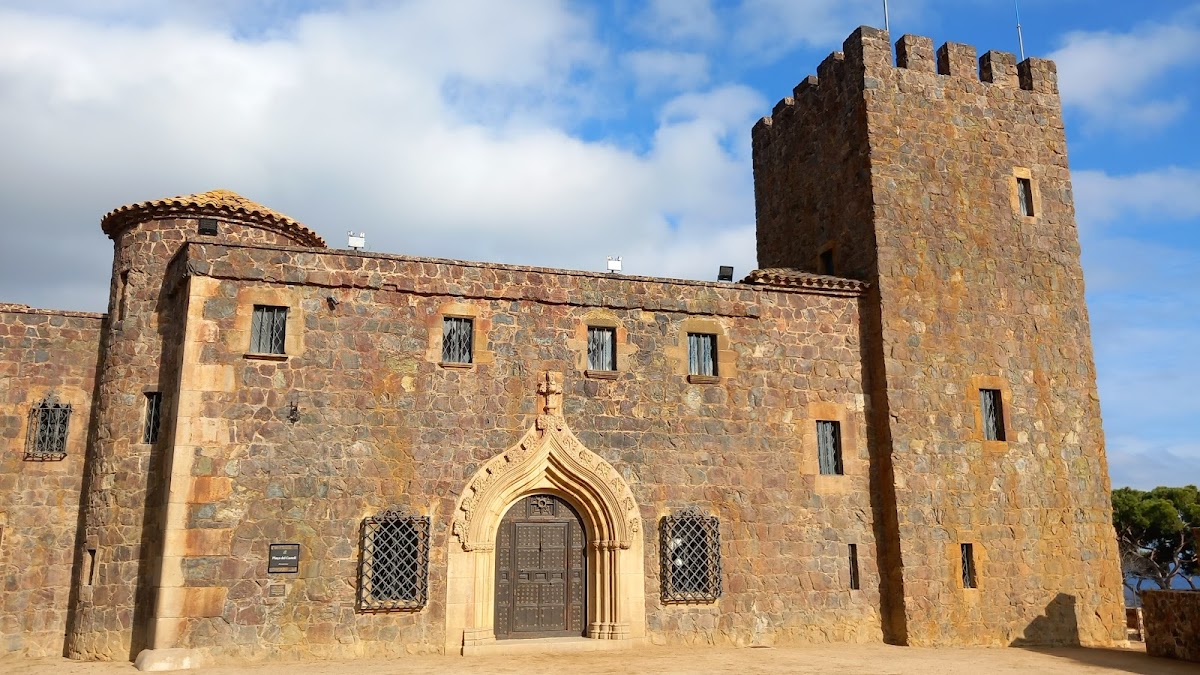
The castle is a twentieth-century medievalizing building, meaning that it deliberately evokes medieval architecture. Its crenellated tower has a parapet formed by alternating raised sections and openings. The composition brings together features associated with a medieval castle, a cloister, a tower, and a church. Gothic details and reused ancient elements are incorporated into the building, producing a picturesque and deliberately varied appearance. Auxiliary buildings and workers’ houses form part of the wider estate.
The botanical garden
The botanical garden surrounds the residence and contains approximately 1,000 species. Its planting was conceived as part of the estate rather than as a separate feature, and Josep Pla particularly praised the gardens and their integration with the surrounding landscape.
Coastal landing place
A flight of steps descends from the estate to Cala d’en Massoni, where the landing place is situated. It is popularly known as the Russian woman’s bathing place, a name connected with the estate’s association with Woevodski and his family.
Family tomb
The Woevodski family tomb stands on an open esplanade above Cap Roig, facing the sea. Its tombstone is topped by a stone Russian Orthodox cross. Small gravestones for a dog and a cat stand nearby, forming part of the commemorative landscape of the estate.