Castell de Solius: A Medieval Fortification in Catalonia


Site at a Glance
- Rating
- 4.5
- Popularity
- Low
- Country
- Spain
- Primary era
- Medieval
- External website
- Open
- Eras represented
- Medieval, Modern
- Civilizations
- Crown of Aragon, Spanish
- Site type
- Military
- Remains
- Castle
On this page7 sections
History
Castell de Solius is a castle in Spain, associated with Solius in Santa Cristina d’Aro, and dated by site data to the fifteenth century. Its surviving fabric is vernacular architecture, while the site’s earlier history is connected with the castle known as Castell de la Roca and with the territorial authority of the See of Girona.
Early ownership and territorial control
In 1057, Ramon Berenguer I and Almodis, the count and countess of Barcelona, recorded that Ramon Seniofred d’Olius held an allodial estate at Solius. This was land owned outright rather than held as a feudal tenure. Seniofred agreed not to build or maintain a castle or tower without permission from the counts, indicating that no such fortification existed there at that time.
The castle later known as Castell de la Roca was first mentioned in 1208. By 1210 it belonged to Arnau de Creixell, bishop of Girona, who described it in his will of 1214 as his complete castle of Roca. For economic reasons, Arnau’s successor exchanged the castle with Guillem de Montgrí, the sacristan. The transfer angered the monastery of Sant Feliu de Guíxols and prompted a legal conflict that continued until 1394. In that year, the sacristan’s office secured control of the territory from the Ridaura stream to the sea, retaining it until the nineteenth century.
War and changing control
During the Catalan Civil War in 1462, the castle imposed taxes on livestock herders bringing animals to supply the Catalan capital. The policy provoked a conflict in 1467, as resentment among the remença peasants continued to intensify. These Catalan tenant farmers faced especially heavy feudal obligations, and their revolts formed a major part of the fifteenth-century Remença wars.
The fortification appears again in 1485, when Miquel Safont of Cassà de la Selva seized it during the Remença wars. In ordinary conditions it served as a dwelling, but wartime turned it into a fortress. Because it belonged to the See of Girona, the institutional authority of the bishop and cathedral church of Girona, some peasants of Solius had to defend it, stand guard, and provide labor for barriers and barbicans, defensive structures protecting an entrance or approach. Control changed hands repeatedly during the prolonged conflicts. For a time, around one hundred peasants led by Narcís Goxat of Llambilles held the castle before it eventually returned to its owners.
Nineteenth-century decline
The castle later lost importance because maintaining it was difficult. During the Carlist period, in 1830, the owner of Can Dalmau carried out works of little solidity. The surviving rebuilt elements date from this intervention.
Castell de Solius is recognized as a Cultural Asset of National Interest in Catalonia and as a Spanish Bien de Interés Cultural monument, a statutory heritage designation. It received the Spanish designation in 1988 under reference RI-51-0006106 and is listed in Catalonia’s architectural heritage inventory under code 1574.
Remains
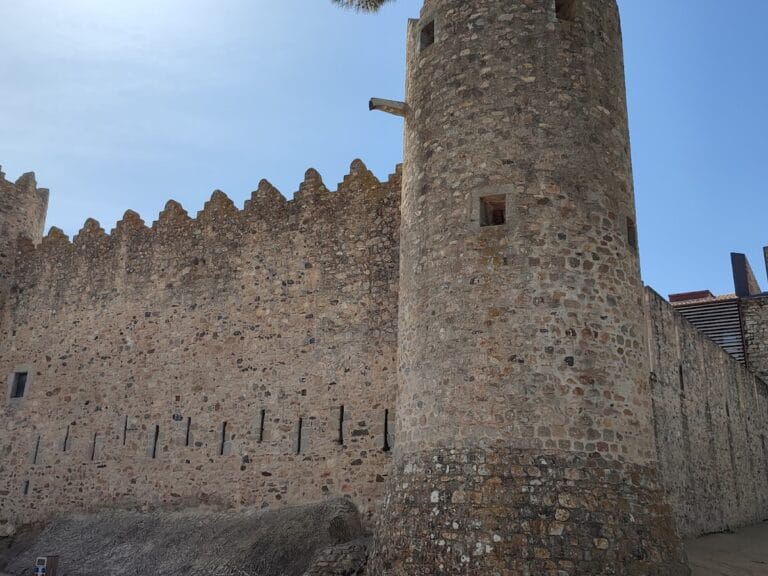
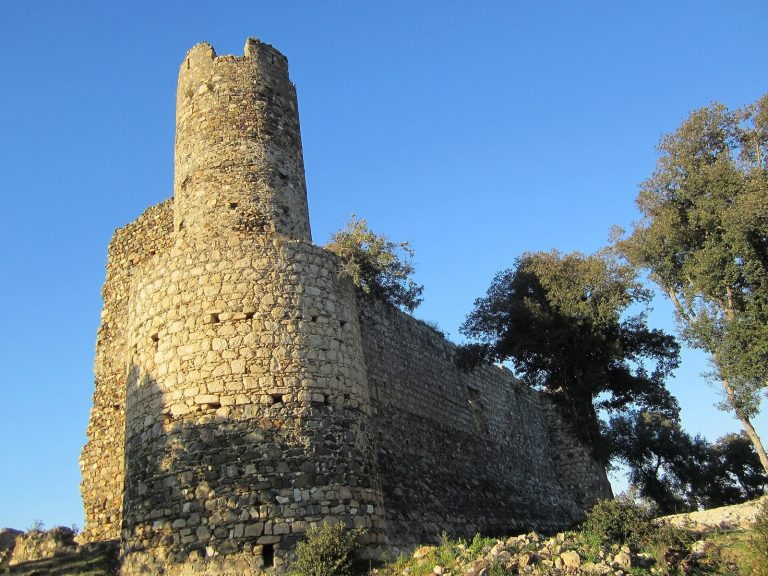
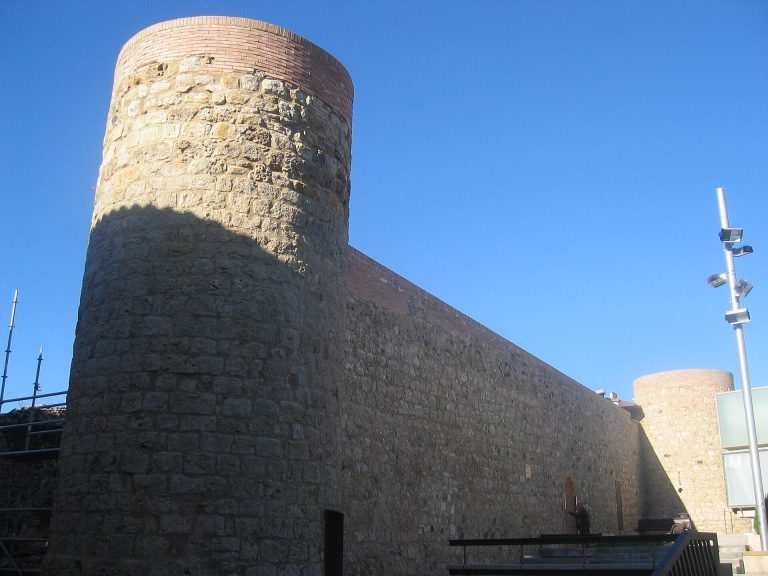
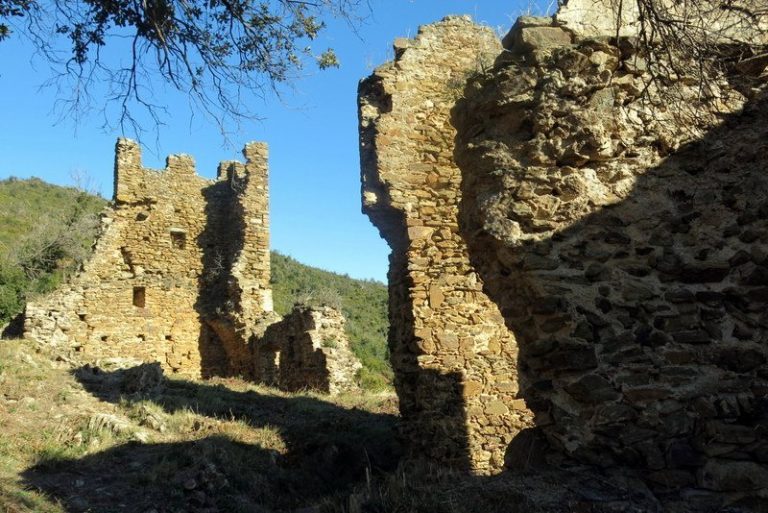
The surviving site occupies a steep crag above the parish. Its remains consist of rock-cut features and fragments of the fortification, including sections rebuilt during the nineteenth-century wars. The ruinous enclosure preserves evidence of both its defensive use and the later efforts to maintain it.
Fortification
One surviving fortified wall contains a doorway with a lowered arch. The entrance leads to an ascending stairway, much of which was cut directly into the rock. Rounded holes along the remaining walls once held wooden structures used to close or block access to the enclosure. Together, these features show how the rocky summit was incorporated into the castle’s defensive arrangement.
Water supply
A stone cistern or water collector survives halfway up the mountain. Dense vegetation partly conceals it, but the structure remains part of the physical evidence for water management at the fortified site.