Calatubo Castle: A Historic Fortress and Farmstead in Sicily


Visitor Information
Google Rating: 4
Popularity: Low
Google Maps: View on Google Maps
Country: Italy
Civilization: Medieval European
Remains: Military

History
Calatubo Castle is located near Alcamo in the Free Municipal Consortium of Trapani, Sicily. Its origins trace back to the Norman period around 1093, when Count Roger I of Sicily defined the boundaries of the diocese of Mazara del Vallo, which included Calatubo and its surrounding lands. However, the site itself shows signs of much earlier human presence, with remains of an Elymian settlement and a necropolis dating to the 7th century BCE, indicating its long-standing strategic and cultural importance.
During the medieval era, Calatubo Castle formed part of a coastal defense system stretching from Palermo to Trapani. This network of fortifications was designed to warn against Saracen raids by transmitting light signals between outposts at Carini, Partinico, and Castellammare del Golfo. The castle thus played a key role in regional security and communication during this turbulent period.
Following the conquest by Emperor Frederick II, the nearby village of Calatubo, which had prospered through cereal trade and the production of millstones using both water and wind mills, was abandoned. As a result, the castle lost its military significance and was transformed into a farmstead, known locally as a baglio. Agricultural buildings such as warehouses and stables were added to support this new function.
In the late 19th century, the castle’s second courtyard was adapted to house wine production facilities for the local “Calatubo” wine. This marked a shift from defensive and agricultural uses to commercial wine storage. The castle remained in relatively good condition until the 1968 Belice earthquake caused significant damage.
Subsequent deterioration occurred due to its use as a sheepfold, unauthorized excavations targeting artifacts from the ancient necropolis, and a fire in July 2013 that blackened both interior and exterior walls. In 2007, the municipality of Alcamo acquired the castle, and it has since been included multiple times in the Italian Environmental Fund’s “I Luoghi del Cuore” initiative, ranking third in 2014-2015. This recognition has supported limited public access and volunteer-led cultural activities.
Since 2017, a partnership between the municipality and the volunteer group “Salviamo il Castello di Calatubo” has focused on protecting the castle, its limestone outcrop, the surrounding archaeological area, and the nearby Cuba delle Rose. Local tradition holds that underground tunnels once connected Calatubo Castle with the Castle of the Counts of Modica and the Ventimiglia tower on Monte Bonifato, though this remains part of popular legend rather than confirmed history.
Remains
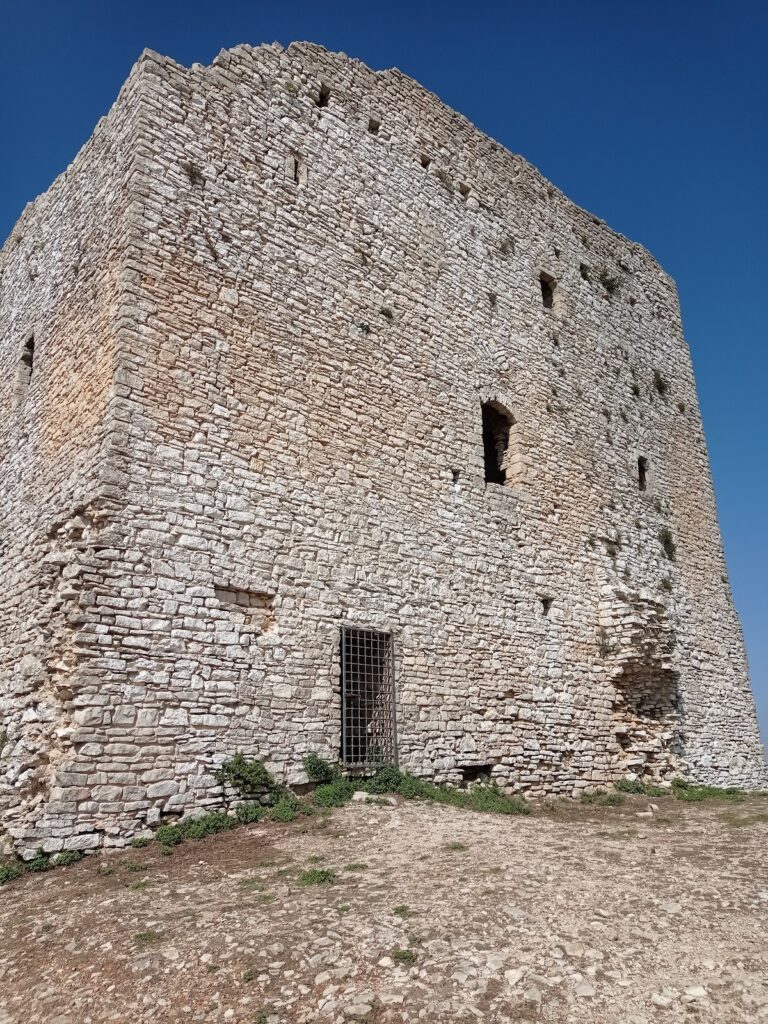
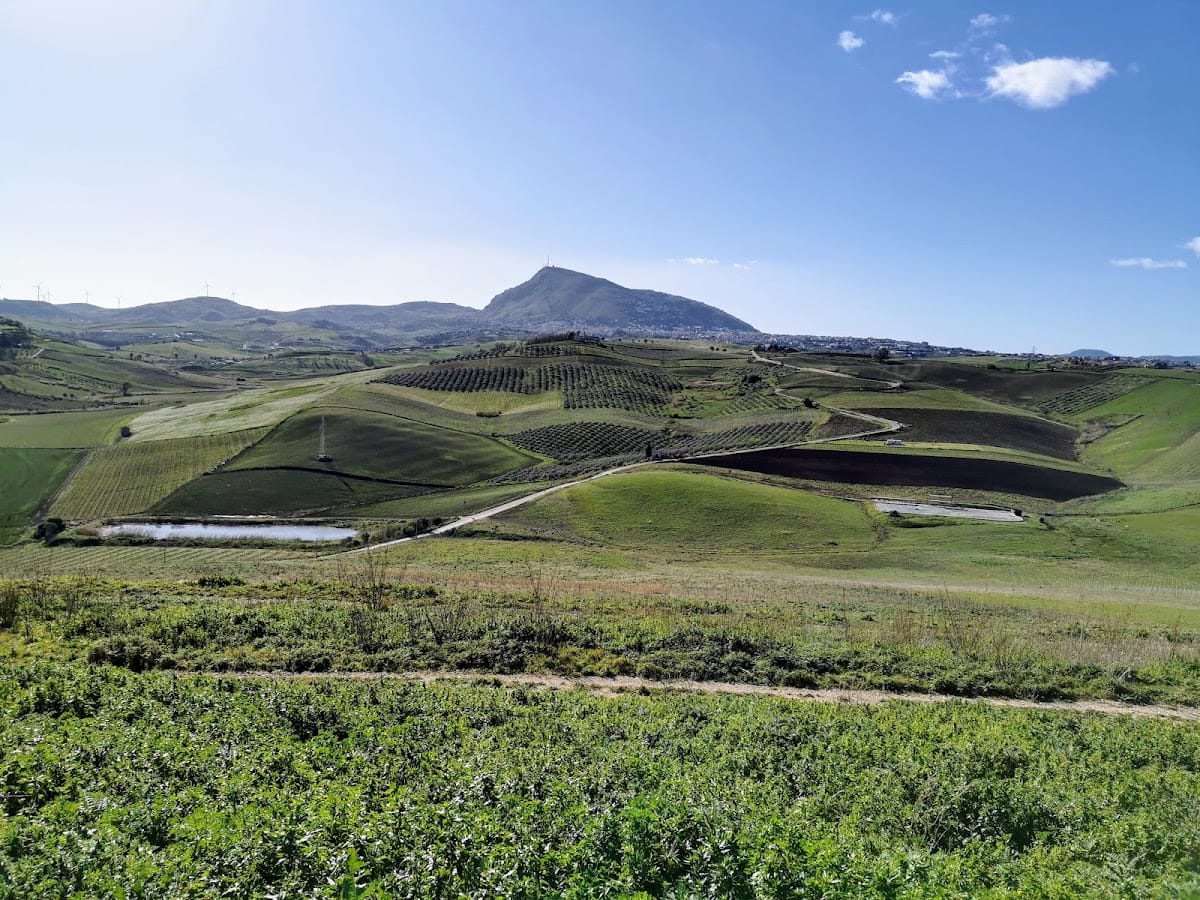
The castle complex extends roughly 150 meters east to west and 35 meters north to south, built atop a limestone rock rising about 152 meters above sea level. This elevated position offers commanding views of Monte Bonifato and the Gulf of Castellammare. The site is naturally protected on three sides by steep rock walls, with the only entrance located on the western side, accessible via a stepped ramp leading to the first defensive line.
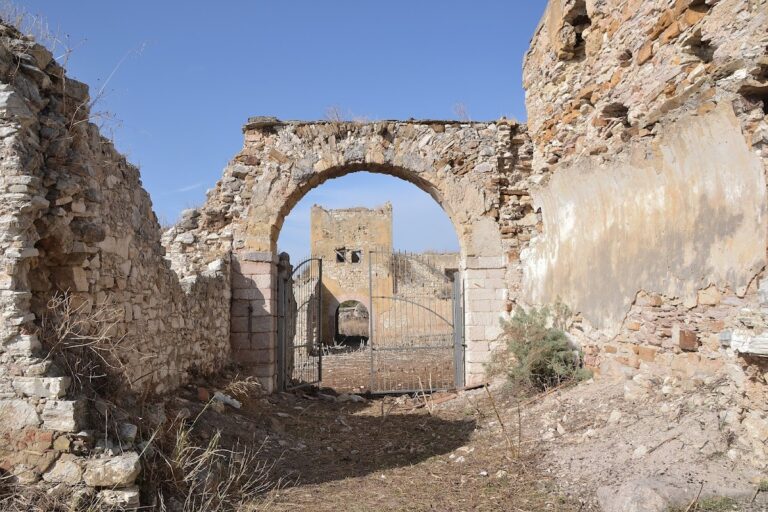
The first defensive area includes a well, a church with an adjoining hall, and several other rooms. From this courtyard, a portal leads to a second ring of walls, which in turn connects to a third ring containing an oblong tower. The castle’s main structure is a rectangular building measuring approximately 7 by 21.5 meters, situated on the southern part of the rock.
Over the centuries, the castle underwent numerous modifications to accommodate changing uses. Originally a military fortress, it was later converted into a farmstead with added warehouses, stables, and administrative buildings. In the late 1800s, parts of the castle were adapted for wine production storage.
Today, the castle is in poor condition. The chapel’s entrance door remains, bearing the coat of arms of the De Ballis family, though the chapel itself suffered fire damage. One of the towers has partially collapsed due to neglect. Archaeological excavations have uncovered artifacts from the ancient Elymian settlement and the 7th-century BCE necropolis beneath the site.
The castle is generally closed to the public, with access limited to occasional guided tours organized by volunteers. Its preservation is challenged by past natural disasters, fire damage, and unauthorized digs, but ongoing efforts aim to protect and study this historically layered site.
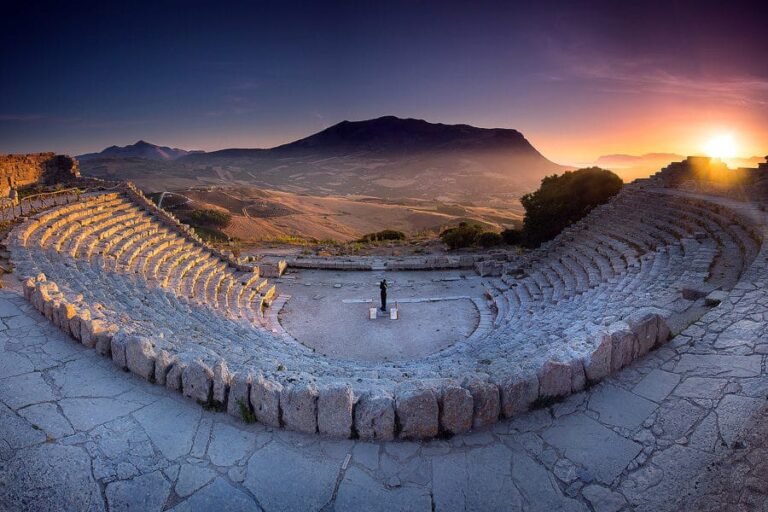
Nearby sites