Castello di Inici: A Fortified Rural Estate in Sicily


Site at a Glance
- Rating
- 3.5
- Popularity
- Very Low
- Country
- Italy
- Primary era
- Early Modern
- Eras represented
- Early Modern, Modern
- Civilizations
- Kingdom of Sicily, Spanish
- Site type
- Military
- Remains
- Castle
On this page12 sections
History
Castello di Inici is a fortified rural complex in Italy, on the southern side of Monte Inici near Castellammare del Golfo. Its documented construction had begun before 1535, although the origins of the site remain uncertain. The complex developed through medieval and early modern phases around a tower and enclosed courtyards, and later became an important agricultural estate, religious retreat, and local residential center.
Ancient traditions and early feudal history
Traditions connect Inici with the ancient, probably pre-Roman city of Inico, placing the castle at the center of that settlement. Another tradition identifies the site with Atala, said to have been founded by the Trojan Acestes in honor of his wife. Acestes belongs to the ancient traditions surrounding the Trojan settlement of Sicily and is also associated with the foundation of Segesta. Archaeological traces near the boundary between the Inici and Balata fiefs included roof tiles, bricks, remnants of ancient buildings, and column bases.
The earliest history of the castle itself is less certain. Its tower has been proposed as a structure dating from around the year 1000, based on an inscription associated with the castle, but this interpretation does not establish a secure construction date. In the Swabian period, Nicoletto Asmundo, a resident of Calatafimi and falconer of Emperor Frederick II, was said to have been an early feudal lord of Inici.
On 8 March 1234, Asmundo sold the Inici territory to Gilberto Abate of Trapani for 1,750 tari, a Sicilian monetary unit. The transaction covered cultivated land, woodland, and forest, but did not mention a castle or tower. The Abate family held Inici until 1349. Filippa De Milite, the wife of Nicola Abate, inherited the territory on 5 February 1348 and died on 13 January 1349.
The Sanclemente barony
Inici was owned by the Mannina family in 1408. After Bartolomea Mannina married Giovanni Sanclemente, the territory passed to the Sanclemente family, who became its barons. Inici, together with Bayda and Arcodaci, formed a feudal barony under the jurisdiction of Monte San Giuliano.
The people of Erice held rights to gather firewood and hunt in these fiefs, but the barons frequently disputed those rights. During the sixteenth century, the complex appears to have been arranged around a single courtyard. A church stood beside a tower by 1574, and the property also provided a stopping place and lodging for travelers heading toward Trapani or Palermo.
Castello di Inici gained a lasting imperial association in 1535, after Charles V returned from the conquest of Tunis. Charles V was the Habsburg ruler of the Holy Roman Empire and the Spanish monarchy. He stayed at Inici for one night as the guest of Giovanni Sanclemente, his companion during the campaign, and occupied a room in the tower. His portrait was later hung there to commemorate the visit.
During the stay, Charles V walked among the estate’s olive groves and rested beneath an old olive tree beside a stream. The stream thereafter became known as the Acqua dell’Imperatore, meaning “Emperor’s Water.” The poet Sebastiano Bagolino wrote verses commemorating the visit.
Jesuit administration and agricultural expansion
In 1597, Donna Allegranza Sanclemente donated the castle and the Inici territory, along with other properties, to the Jesuits. The Society of Jesus was a Catholic religious order founded in the sixteenth century, known for its colleges, missionary work, and organized management of landed properties. After Allegranza’s death on 5 May 1599, the Jesuits took possession of the castle and fief at the beginning of the seventeenth century.
Administered by the College of Trapani, Inici entered a period of prosperity under Jesuit control. The order expanded agricultural and economic activity and developed the extensive estate into one of Sicily’s most productive agricultural enterprises. The complex also acquired a second courtyard during this period, with stables and new storehouses opening onto it.
The Jesuits further adapted the chapel in the Sicilian Baroque style, adding stucco and frescoes. In 1738, the Trapani painter Domenico La Bruna received a commission to decorate its walls with scenes from the lives of the saints. The adjoining rooms and chapel served for religious retreat and ascetic practice, giving the complex a religious role beyond worship for agricultural workers.
Cardillo ownership and modern decline
Following the expulsion of the Jesuits in November 1767, the castle and former barony were purchased on 20 February 1780 for 35,000 onze, another historical Sicilian monetary unit. Giuseppe Pappalardo acted as nominee for the recently ennobled Marchese Agostino Cardillo, whose father had been a functionary of Charles III. The Cardillo family retained the property until 1870, when it passed to the Alliata family. Renovation and enlargement during the Cardillo period affected the interior courtyard.
Castello di Inici remained inhabited in 1960. The 1961 census counted about fifty residents within the castle, which functioned as a local center for a district of approximately 400 inhabitants. A post office, a Carabinieri barracks, and a school operated there.
The 1968 earthquake severely damaged the complex and was followed by increasing abandonment. The medieval tower, which had formed the central link between the two courtyards, collapsed in 1998. Castello di Inici is designated Italian national heritage.
Remains
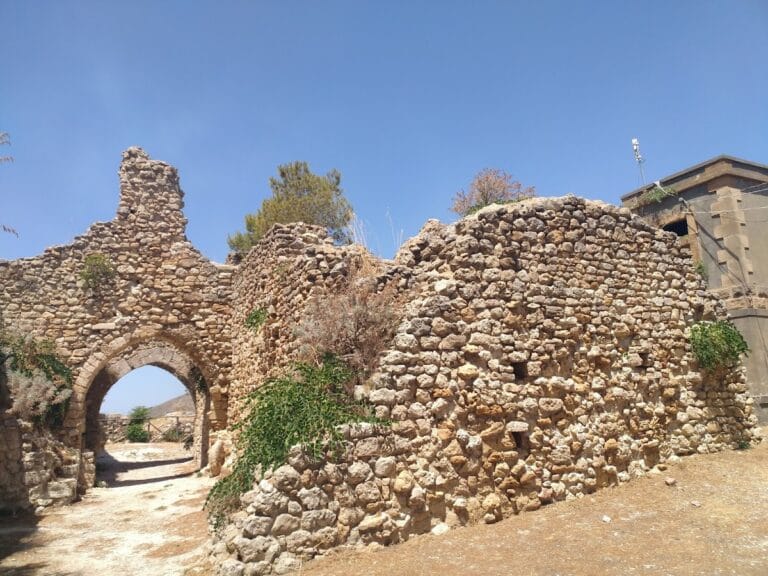
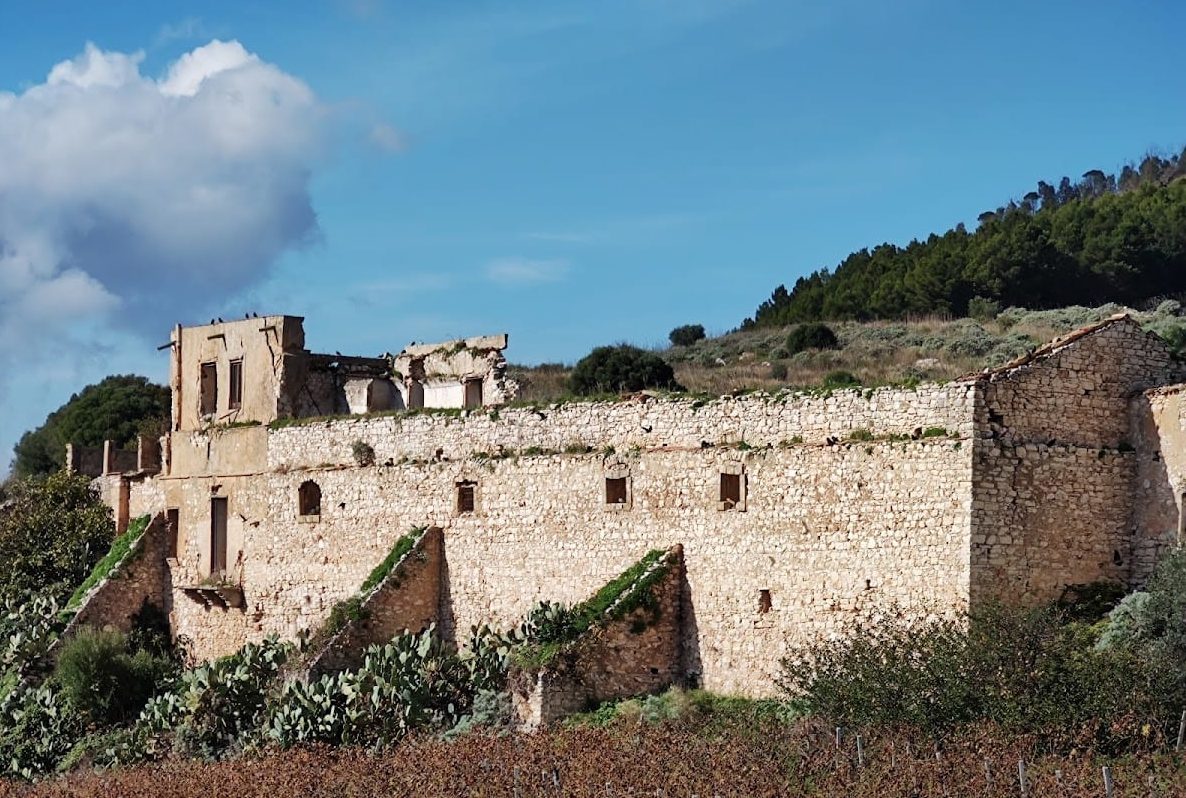
Castello di Inici is a turrited baglio, a fortified rural complex organized around courtyards and marked by a tower. Its buildings were constructed from irregular rubble masonry and calcarenite bonded with mortar. The original development grew around the tower and a first courtyard. A second courtyard was added during the Jesuit period, creating the double-courtyard arrangement shown on Samuel von Schmettau’s map of 1720. The abandoned complex is privately owned, and earthquake damage followed by prolonged neglect has affected the condition of the surviving buildings.
Courtyards and agricultural buildings
First and second courtyards
The first courtyard formed part of the original development around the tower. By the sixteenth century, the complex had a single-courtyard arrangement. Under Jesuit administration, the site expanded with a second courtyard, around which stables and newly built storehouses were arranged. This enlargement reflects the estate’s agricultural development and the growth of its economic functions. Later works carried out during Cardillo ownership renovated and enlarged the interior courtyard.
Religious buildings
Chapel and frescoes
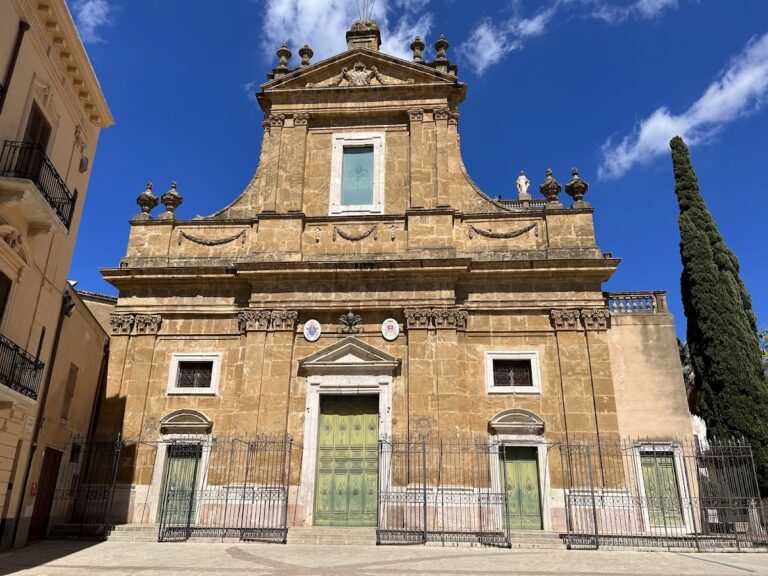
A chapel occupies the central part of the complex beside the tower that once connected the two courtyards. During the Jesuit period, it was reshaped in the Sicilian Baroque style and enriched with stucco and frescoes. Domenico La Bruna’s 1738 fresco cycle represented the lives of the saints. The chapel and adjoining rooms were also used for religious retreat and ascetic practice. The frescoes are now preserved in the Mother Church of Castellammare del Golfo rather than at Castello di Inici.
Central tower
Tower and imperial lodging
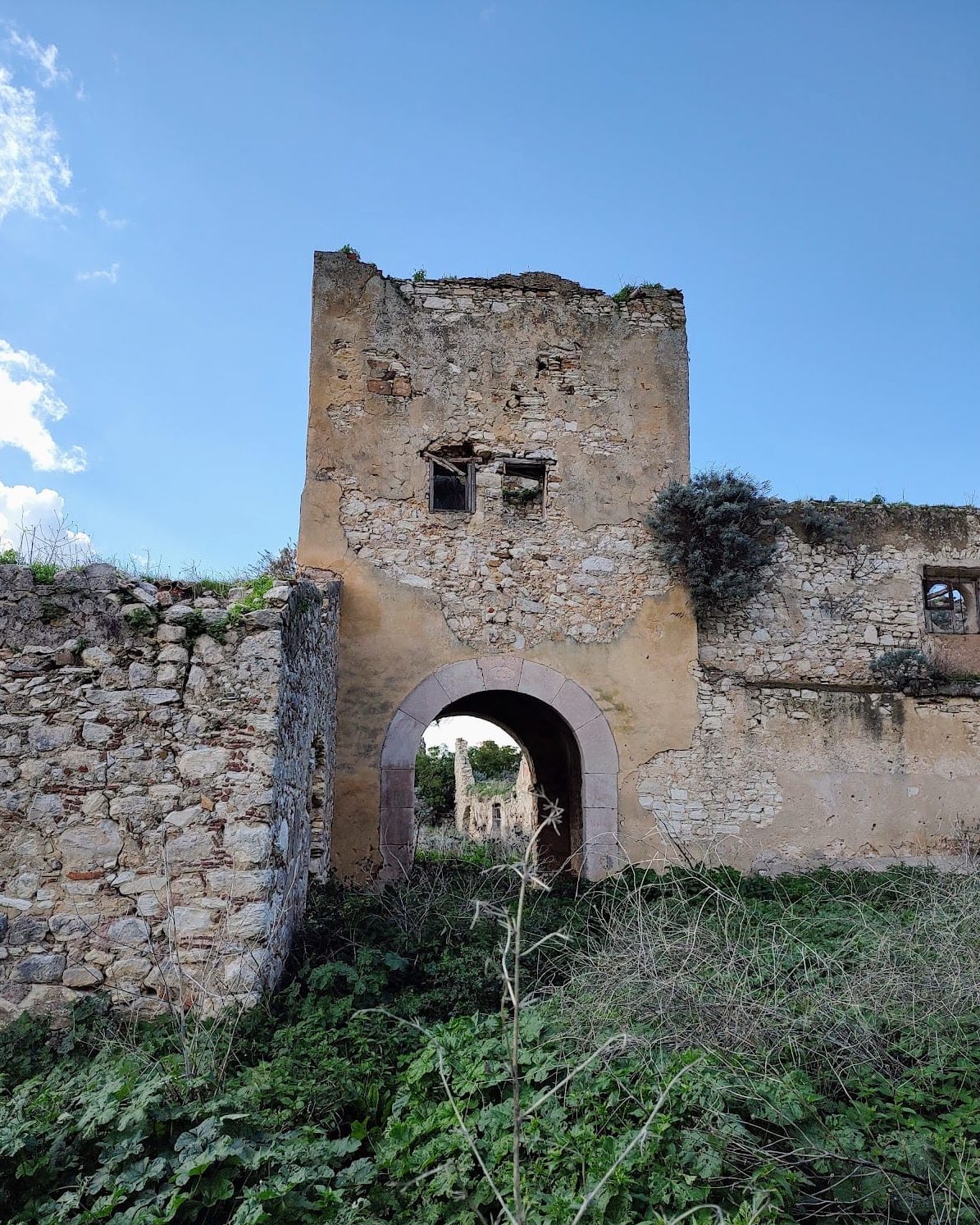
The tower was the central structural link between the two courtyards and may date from around the year 1000, although its early history remains uncertain. It was associated with Charles V’s overnight stay in 1535, when the emperor occupied a room within it. A portrait commemorating the visit was later displayed in the tower. The structure collapsed in 1998 after the complex had suffered earthquake damage and a long period of abandonment.