Burg Straußberg: A Medieval Castle in Sondershausen, Germany

Visitor Information
Google Rating: 4
Popularity: Very Low
Official Website: www.burg-straussberg.de
Country: Germany
Civilization: Unclassified
Site type: Military
Remains: Castle

History
Burg Straußberg is a medieval castle located in the municipality of Sondershausen, Germany. It was constructed by the regional powers of Thuringia around the year 1200 as a ministerial seat, likely connected to the Landgraves of Thuringia, who were consolidating territories after the outlawing of the Duke Henry the Lion.
The earliest known written record of the castle dates from 1267, when Berthold von Schlotheim, a steward loyal to the Wettin Landgraves, issued a deed there related to a land grant. Over the following decades, Burg Straußberg evolved into an important administrative center. Between 1285 and 1316, it served as a place where officials like chamberlains from the nearby imperial city of Mühlhausen convened. During this time, local noble families, known as knights, were entrusted with overseeing the castle’s defense and governance.
Ownership changed hands several times in the 14th and 15th centuries. Around 1318, the Counts of Hohnstein acquired the castle, which later passed by inheritance in 1356 to the Counts of Schwarzburg. In 1421, the lordship was pawned to the Archbishop of Mainz, a move that influenced ongoing regional power struggles between ecclesiastical and secular authorities. From 1465 to 1548, the castle was held by the Tütcheroda family under a pawning arrangement, after which it returned to the Counts of Schwarzburg.
Count Wilhelm of Schwarzburg made Burg Straußberg his residence from 1552 until his death in 1598. During this period, significant renovations were undertaken in 1581 to adapt the aging structures, including modernization of the kitchen and gatehouse. After Wilhelm’s passing, the castle became property of the state and was repurposed primarily as a domain estate. Its robust buildings were used for grain storage, and structural reinforcements were added to preserve the site.
Burg Straußberg maintained its structural integrity well into the 20th century and functioned as an administrative seat of Schwarzburg-Rudolstadt until around 1850. During that time, it kept official measurement stones meant to prevent fraudulent grain measuring practices. However, beginning in the 1950s, the castle fell into a state of decay. Since 1990, local preservation efforts have worked to maintain what remains of the site under expert guidance.
Remains
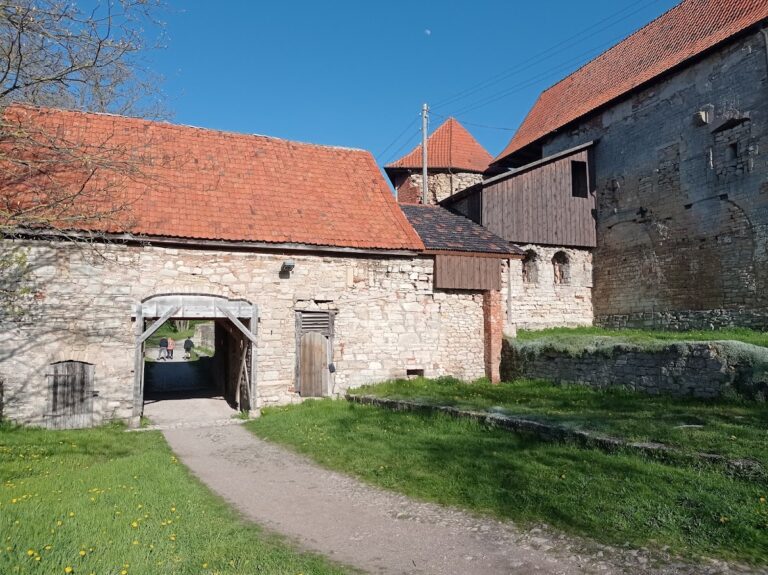
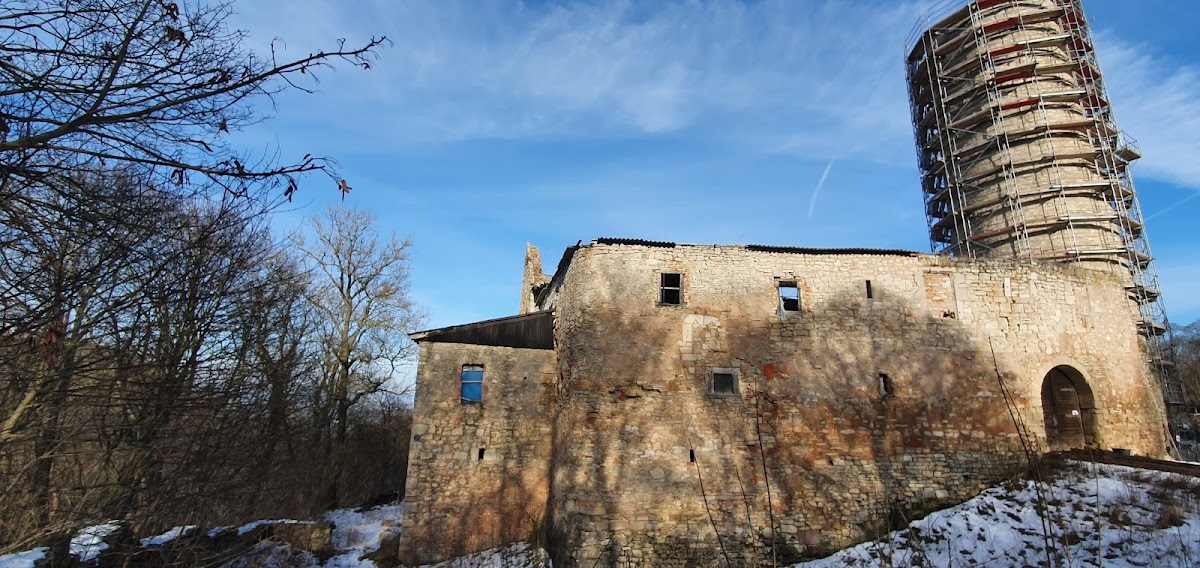
Burg Straußberg occupies a roughly trapezoidal area measuring about 70 by 70 meters, surrounded by a moat and situated on a 390-meter-high spur of the Dün ridge. The layout reflects its medieval origins as a fortified stronghold and administrative center.
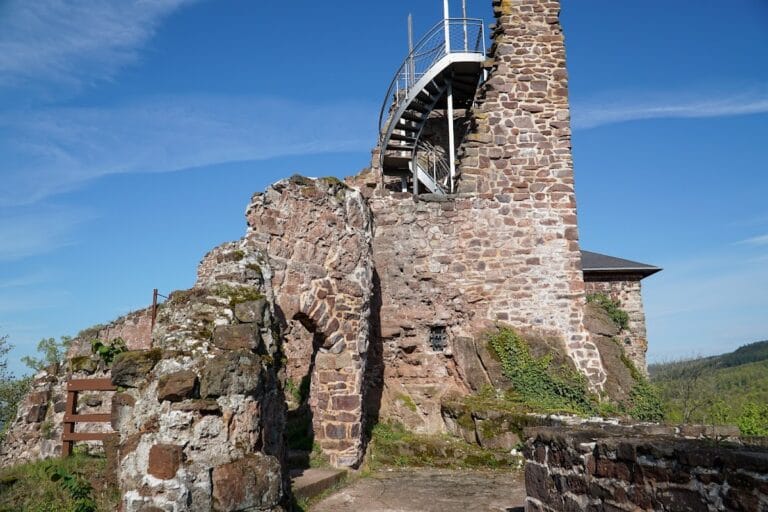
The oldest surviving part of the castle is the bergfried, a tall, round keep projecting from the southern castle wall. Built of small rubble stones, its thick walls contain narrow slits for windows that allowed defenders to observe and shoot while remaining protected. Originally, the bergfried’s entrance was positioned high above ground level and accessed by a ladder, a defensive feature common in medieval keeps. Although the tower now serves as a viewing platform lacking battlements, nineteenth-century illustrations depict it topped by a tall conical roof with a weather vane.
The main gate once stood on the southern side of the castle and was defended by a drawbridge crossing the moat. The gatehouse itself has fallen into ruin but would have formed the primary point of controlled entry to the stronghold.
Residential buildings were arranged on the north side of the inner courtyard, with the palas serving as the main living quarters. Historical records from around 1880 note the presence of associated outbuildings nearby, including a smithy and an old kitchen featuring a chimney that had fallen into ruin.
West of the bergfried lies the castle chapel, which was partially restored around 1870. The remaining choir section survived remodeling, while the nave was converted into a grain storage area, chosen for its relatively dry conditions. Inside the chapel’s antechamber, there were three distinctive stones resembling hollow measures used as official standards for grain. These allowed authorities to verify that local grain containers met the proper volume by filling the stones’ cavities with grain, helping to prevent fraudulent short-measure practices.
Renovations carried out in 1581 adapted several of the castle’s parts that were already centuries old and showing signs of wear. These efforts affected the residential buildings and helped extend their use into the early modern period.
Burg Straußberg is part of a broader network of medieval fortifications along the nearby Hainleite ridge, which includes ruins and castles such as Sargberg, Kirchberg Alte Kirche, Kirchberg Alte Burg, Rauchenberg, Schloss Wernrode, and Zengenberg, reflecting the dense territorial division and strategic significance of this region during the Middle Ages.
Nearby sites