Wasserschloss Seebach: A Former Moated Castle in Germany


Site at a Glance
- Rating
- 4.5
- Popularity
- Low
- Country
- Germany
- Primary era
- Medieval
- External website
- Open
- Eras represented
- Medieval, Modern
- Civilizations
- Holy Roman Empire
- Site type
- Military
- Remains
- Castle
On this page6 sections
History
Wasserschloss Seebach is a former moated lowland castle in Germany, in Seebach, now part of Mühlhausen in Thuringia. Its origins are placed around 1200, and it is said to have been built around 1227 by Lutz von Seebach on behalf of the Archbishops of Mainz, who were also territorial rulers controlling land and feudal rights. The castle was associated with the former municipality of Weinbergen and remains an identifying landmark of the area.
Medieval Origins and Feudal Ownership
Originally a Mainz fief, the castle was held as land or a legal right granted by a lord to a vassal in return for service. Such rights could also be pledged as security for a debt. On 25 July 1307, the Archbishop of Mainz pledged half of Seebach Castle to the brothers Albert and Hermann von Sebeche.
Wolf von Seebach, the last member of his family to live at the castle, died there without children in 1522. The following year, his sister Brigitta von Seebach transferred the family estate through marriage to the Saxon ducal councillor Günther von Bünau. After legal disputes, Bünau sold the feudal rights to Hans Sittich von Berlepsch in 1523 for 6,000 gulden. Berlepsch was captain of the Wartburg and an official in Eisenach and Querfurt. From the mid-sixteenth century onward, the castle became a Saxon fief and was repeatedly used as pledged property.
Destruction and Rebuilding
In early May 1525, during the German Peasants’ War, a widespread uprising of peasants and townspeople in 1524–1525, insurgents and citizens of Mühlhausen plundered and destroyed the castle and its settlement. Hans von Berlepsch was imprisoned in Mühlhausen, but the Duke of Saxony secured his release. The Berlepsch family then recovered possession, received the fief again in 1527, and rebuilt the castle.
Nineteenth- and Twentieth-Century Changes
Wasserschloss Seebach was remodeled during the nineteenth century and again between 1911 and 1914. These changes produced the multi-storey structure that survives today. A bird-protection park was established on part of the grounds in 1885–1886. It remained privately operated until 1908 and has functioned as the State Bird Protection Station Seebach since 1936. The institution is devoted to conserving birds and protecting their habitats, and it is Germany’s oldest bird-protection institution.
Remains
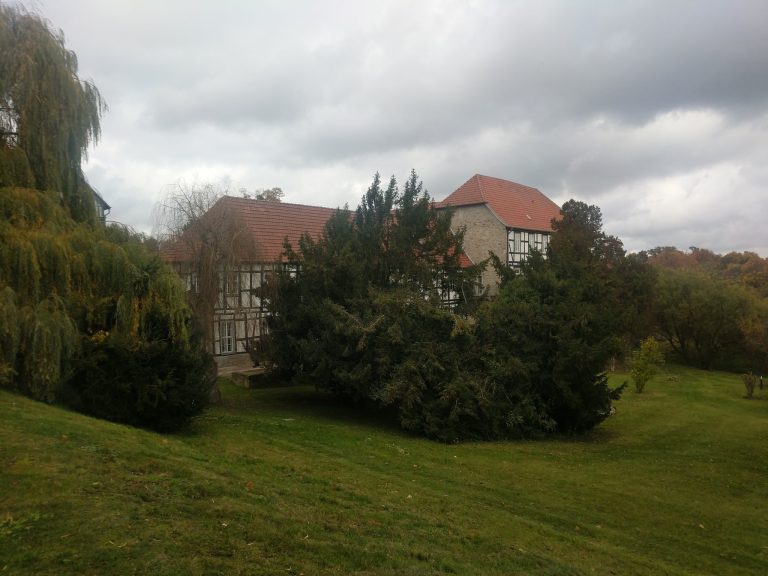
Wasserschloss Seebach survives as a lowland, or water, castle built on relatively level terrain, where surrounding water or wet ground formed part of the defensive setting. The present complex is a substantially preserved multi-storey stone building with a timber-framed structure added above it. Part of the castle grounds is occupied by the bird-protection park.
Castle Building and Grounds
The surviving building combines a substantial stone lower structure with an upper section formed by visible timber framing and infill panels. Its multi-storey form reflects the remodeling carried out in the nineteenth century and between 1911 and 1914. The associated bird-protection park occupies part of the surrounding grounds and remains integrated into the castle complex.