Burg Bodenstein: A Medieval Hilltop Fortress in Germany


Site at a Glance
- Rating
- 4.3
- Popularity
- Low
- Country
- Germany
- Primary era
- Medieval
- External website
- Open
- Eras represented
- Medieval, Early Modern, Modern
- Civilizations
- Holy Roman Empire
- Site type
- Military
- Remains
- Castle
On this page12 sections
History
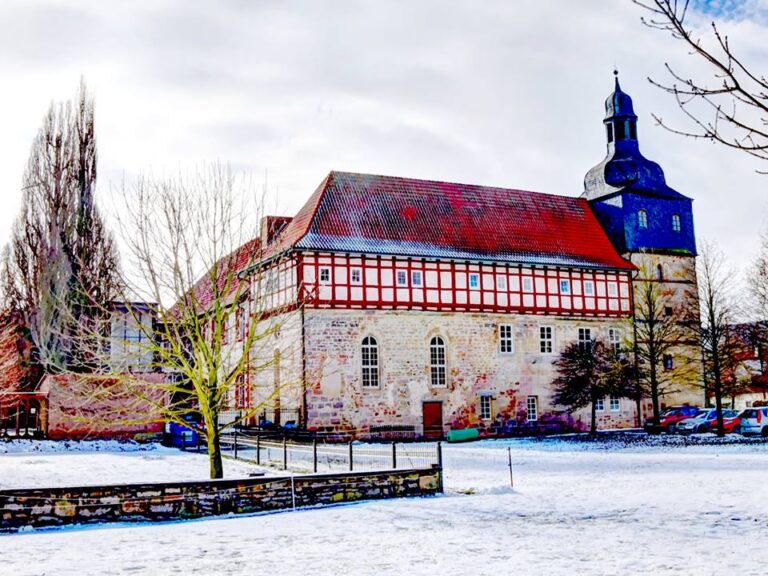
Burg Bodenstein is a preserved medieval hilltop fortress in Germany, above Wintzingerode in the city of Leinefelde-Worbis, Thuringia. Probably first established as a border post between Saxon and Frankish territories, it later became the center of a territorial lordship and is described as the best-preserved castle in the Eichsfeld.
Early Saxon and Northeim connections
During the rule of the early Saxon emperors of the Liudolfing dynasty, the site was probably dynastic family property. Henry I, known as Henry the Fowler, is traditionally associated with enlarging its defenses against Hungarian raids. Henry was the tenth-century Saxon king regarded as the founder of the Ottonian imperial dynasty, and the Liudolfings and Ottonians were the same ruling family.
Under the Salian emperor Henry IV, Bodenstein belonged to Otto of Northeim, a powerful eleventh-century Saxon nobleman who led aristocratic opposition to the emperor. A Bodenstein family later took its name from the castle. Probably a side branch of the Northeims, it became influential in the region and founded Beuren monastery in the Leine valley. Its influence declined during the thirteenth century.
Welf and Honstein overlordship
The lordship passed to the Welfs in 1275. Duke Henry I sold the castle to the Counts of Honstein in 1293, and an agreement redeemed it in 1322. The Welfs transferred it to the Honsteins again in 1327. In 1337, the Honsteins sold the castle to Hans of Wintzingerode, Otto of Rusteberg, Berthold of Worbis, and Heinrich Wolf. The transaction included the associated rights and revenues, including high and low jurisdiction, high and low hunting rights, and mining rights. The Honsteins remained feudal overlords until their line ended in 1593.
The Lords of Wintzingerode are first mentioned in 1209 and may themselves have descended from the Lords of Bodenstein. Their relationship with the Counts of Honstein grew closer in the fourteenth century when Dietrich of Wintzingerode married Bertrade, a Countess of Honstein. By 1448, the Wintzingerodes had bought out their co-owners and become the castle’s sole owners.
On 9 June 1448, Count Heinrich of Hohnstein enfeoffed the family with Schloss Bodenstein, its rights, services, jurisdiction, and patronage. The grant also covered the Bodenwald and the villages and farms of Wintzingerode, Wintzingen, Rappolderode, Tastungen, Wehnde, Kampe, Wildungen, Segel, Huchelheim, Kaltohmfeld, Warmohmfeld, and Ritterbach. The Wintzingerodes retained the castle and lordship until 1945.
Reformation and the conflict of 1574
Large parts of the castle were destroyed in 1525 during the campaign of Thomas Müntzer, a radical preacher and leader associated with the German Peasants’ War of 1524 to 1525. The damaged buildings were rebuilt in a contemporary form. From 1530, the Lords of Wintzingerode officially introduced the Reformation, the movement that challenged Roman Catholic authority and created Protestant churches, in their territories. This brought them into conflict with the Honsteins and the Electorate of Mainz.
The conflict intensified after the Bleicherode Treaty of 1573, when Count Volkmar Wolf of Honstein transferred the overlordship of Bodenstein to Mainz. Berthold XI of Wintzingerode considered the transfer a breach of feudal loyalty and declared the castle and lordship his free property. In 1574, a force of 2,000 men captured Bodenstein and imprisoned him.
Berthold’s execution was also connected with an earlier dispute involving his cousins at Scharfenstein. In the previous year, he had shot Arnold Geilhaus, a partisan and associate of those relatives. Despite the castle’s extensive defenses and without a formal examination of the evidence, Berthold was sentenced to death and beheaded on 19 September 1575. The castle and lordship then passed to his hostile cousins, Hans and Bertram of Wintzingerode. Their heirs lost the pledged lordship of Scharfenstein in 1582.
Territorial and ecclesiastical center
After the Counts of Honstein became extinct in 1593, Welf claims to overlordship and territorial authority, together with Welf protection, prevented a forced Catholic Counter-Reformation at Bodenstein. The Counter-Reformation was the Catholic response to the spread of Protestantism. The outcome of the Thirty Years’ War further strengthened Protestant confession and the Wintzingerodes’ position in the lordship.
Until 1803, the Wintzingerodes exercised all territorial rights there as the only non-princely family in the Holy Roman Empire to hold such rights without being an imperial estate. An imperial estate had direct representation and political standing within the Empire, while the Wintzingerodes held territorial rights without that status. Their exercise of episcopal authority, powers over church governance and discipline normally associated with a bishop, made the small lordship an ecclesiastical center for Protestants in the Lower Eichsfeld.
Bodenstein also served as the seat of a medieval judicial district. It initially covered settlements on the Ohm Mountains plateau, Kirchohmfeld, and Kaltohmfeld, as well as the deserted settlements of Seegelrode and Huchelheim. Wintzingerode, Wehnde, Tastungen, and other abandoned settlements were later added. The original court location is uncertain. A court at Kaltohmfeld is recorded in 1448, and a hearing beneath the linden tree there took place in 1545. From the sixteenth century, the district, then called the Wintzingerode court, was recorded alternately at Bodenstein and Adelsborn. From the mid-eighteenth century, the court was located at Wintzingerode. The location of its execution site or gallows is unknown.
A chapel was added to the castle in 1668. In the late eighteenth century, Landgravine Dowager Philippine of Hesse-Kassel, a niece of Frederick the Great, stayed at Bodenstein for extended periods. In 1794, she entered a morganatic marriage with her long-serving chief chamberlain and castle owner, Georg Ernst Levin of Wintzingerode. A morganatic marriage was legally recognized, but the spouse and children generally did not receive the higher partner’s dynastic rank or inheritance rights. Philippine secured Georg Ernst Levin’s elevation to Imperial Count before the marriage.
Collections and changing states
After Philippine’s death in 1800, Georg Ernst Levin von Wintzingerode inherited one-fifth of her family’s property, formerly belonging to the extinct Margraves of Brandenburg-Schwedt, as well as her estate inventory. The inherited material included objects associated with Frederick the Great and his siblings. Bodenstein was subsequently filled with paintings, porcelain, furniture, metalwork, miniatures, and other collections.
Georg Ernst Levin later served as Württemberg’s prime minister and entered the service of Jérôme Bonaparte from 1806. Jérôme, Napoleon Bonaparte’s younger brother, was king of Westphalia from 1807 to 1813. As ambassador in Paris from 1807 to 1814, Wintzingerode acquired further gifts and collections connected with the Bonapartes, including objects formerly associated with Marie Antoinette, queen of France from 1774 until the monarchy was abolished in 1792.
In 1803, the lordship was incorporated into the Kingdom of Prussia. After Prussia’s defeat at Jena and Auerstedt, the Eichsfeld and Bodenstein belonged to the Kingdom of Westphalia from 1807 to 1813, returning to Prussia in 1815. During the unrest of spring 1848, Count Heinrich Levin of Wintzingerode fled to Göttingen because of the threat posed by insurgents.
From 1914, Gisela, Countess of Wintzingerode, administered the Bodenstein fideicommiss for her underage son after her husband, Hans Count of Wintzingerode, was killed at the beginning of the First World War. A fideicommiss was an inherited estate legally bound to remain within a family line. During the Nazi period, Gisela became strongly involved in the Confessing Church, a Protestant movement that opposed the subordination of German churches to Nazi ideology. Bodenstein became a center of ecclesiastical resistance to the Nazi church struggle associated with the later state bishops Hanns Lilje, Hugo Hahn, and Ludolf Hermann Müller.
Dispossession and church ownership
In 1945, the Wintzingerode family was dispossessed without compensation and expelled during the land reform. Plans by Thuringian heritage authorities to establish a state museum failed as the castle’s inventory increasingly disappeared. The remaining culturally valuable objects were removed and stored in the Poet’s Rooms of Weimar City Palace before being distributed among museums, libraries, and archives.
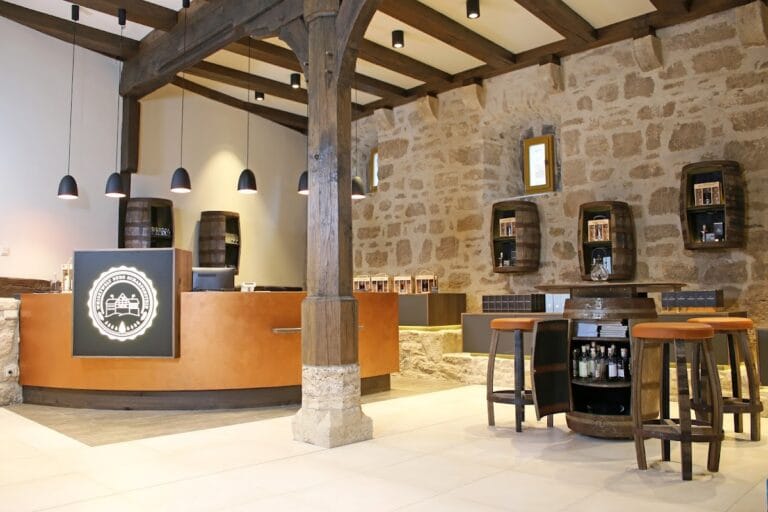
Through her church contacts, Gisela von Wintzingerode asked the Protestant Church of the ecclesiastical province of Saxony to take responsibility for the castle. After initial hesitation, the church accepted in 1948. Burg Bodenstein is now used by the Evangelical Church in Central Germany as a family recreation and meeting center. It also accommodates regional cultural events, concerts, cabaret evenings, political discussions, and overnight stays.
Remains
Hilltop fortress
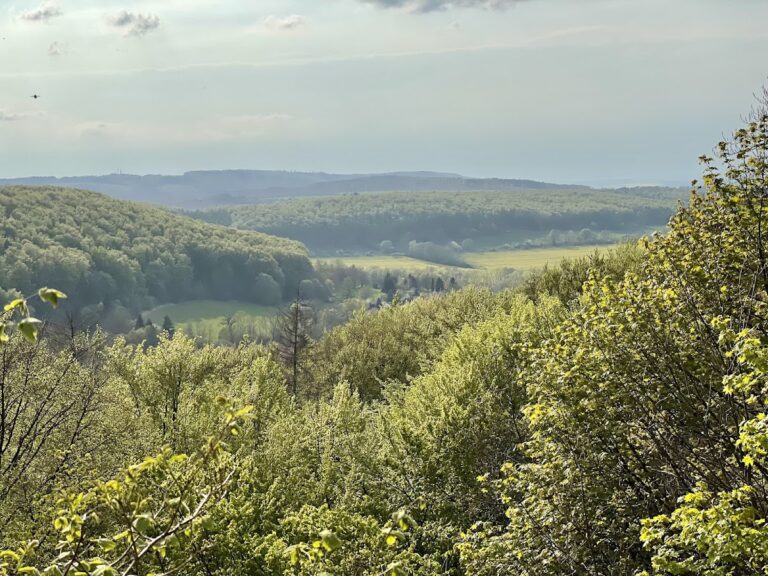
Burg Bodenstein occupies a hilltop in the Ohm Mountains of the northern Eichsfeld, above Wintzingerode. The village and the Unstrut-Hahle cycle route lie in the valley below. The castle stands at approximately 343 metres above sea level, with hills and forests to the northeast and flatter terrain to the southwest. A 482-metre elevation lies about 1.1 kilometres to the north.
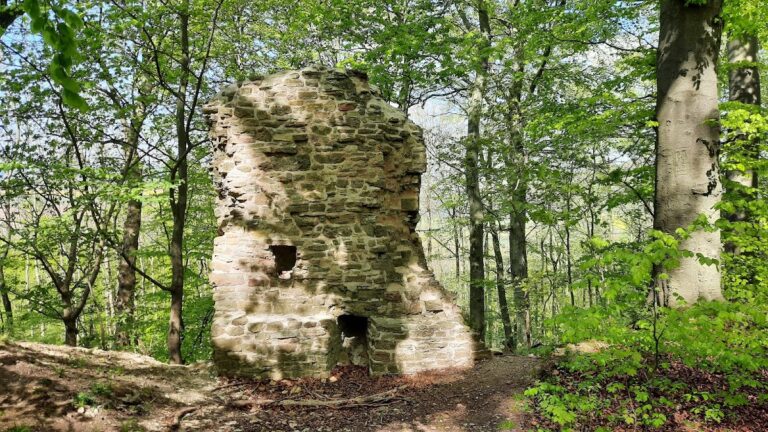
The early fortification was substantially rebuilt, and the newer castle was constructed from natural stone. The surviving complex preserves the character of a medieval hilltop fortress, while much of its visible form reflects rebuilding after the destruction of 1525. That reconstruction produced a castle shaped by the architectural requirements of its own period rather than a single uninterrupted medieval phase.
Chapel and interior features
The chapel added in 1668 remains part of the castle complex. Its lords’ gallery, also called the hunting room, contains stained-glass windows made around 1835 by Heinrich Friedrich Wedemeyer, a glass painter from Göttingen. A baptismal angel is also preserved in the chapel interior.
Aristocratic collections
The castle once contained an extensive aristocratic collection formed through Philippine of Hesse-Kassel’s inheritance and Georg Ernst Levin von Wintzingerode’s later acquisitions. It included paintings, porcelain and faience, furniture, bronze and goldwork, miniatures, gifts connected with the Bonapartes, objects acquired in Paris, and pieces formerly associated with Marie Antoinette. Much of the surviving inventory was removed after 1945 and dispersed among museums, libraries, and archives.
Family crypt and cemetery
The Counts of Wintzingerode built their family crypt in 1823 in the forest below the castle, together with a small cemetery. Georg Ernst Levin von Wintzingerode commissioned the complex, which is physically separate from the hilltop fortress. Vandalism and storm damage later left it in poor condition, but the crypt and cemetery were restored.