Buštěhrad Castle: A Medieval and Renaissance Fortress in the Czech Republic


Visitor Information
Google Rating: 4.1
Popularity: Low
Google Maps: View on Google Maps
Official Website: www.mestobustehrad.cz
Country: Czechia
Civilization: Unclassified
Remains: Military

History
Buštěhrad is located in the municipality of Buštěhrad in the modern Czech Republic. The site was originally established in the 14th century by medieval Bohemian builders and began as a fortress set at the eastern edge of the village then known as Buštěves.
The earliest recorded mention of the fortress dates back to 1352, at which time the village was under the ownership of the Rokycanský family from Prague. Around 1440, the property was acquired by Jindřich Libštejnský of Kolovrat, who undertook a significant reconstruction of the existing fortress in the late Gothic style. This transformation expanded the fortress into a more formidable castle, preserving much of the earlier medieval stonework, particularly in the primary residential wing known as the main palace.
During the turbulent period of the Hussite Wars in the first half of the 15th century, Buštěhrad played an active political role. In 1450, it endured a siege by forces loyal to Jiří z Poděbrady, who opposed the castle’s owner due to his steadfast Catholic allegiance and resistance to the Hussite movement. Following a truce and Jiří’s ascension as king in 1458, ownership of the castle shifted in the wake of the Hussites’ established dominance in the region.
By 1462, construction and fortifications at Buštěhrad were likely finished, as evidenced by a dated sandstone block embedded in the surviving western gate. The castle’s defenses were adapted to the evolving nature of warfare, incorporating features suited to withstand artillery and early firearms.
The Kolovrat family maintained control of the castle until 1630, when ownership passed through marriage to František Julius, the Saxon-Lauenburg duke. In 1632, during the ongoing Thirty Years’ War, retreating Saxon troops ransacked the castle, setting it ablaze and looting its contents. After this devastation, the castle was never fully restored to its previous condition.
A plague epidemic in 1680 led to a period of depopulation around Buštěhrad. As new settlements grew, inhabitants repurposed the ruined castle as a convenient source of building materials. By the mid-18th century, the castle precinct had been overtaken by residential development, incorporating surviving remains from its Gothic and Renaissance periods into new structures.
In recognition of its historical importance, the ruins of Buštěhrad Castle and the adjoining park were designated a protected national cultural monument of the Czech Republic in 1967.
Remains
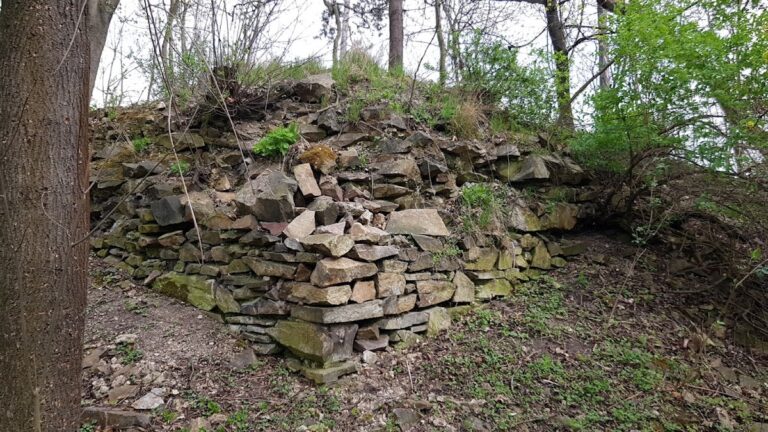
The original layout of Buštěhrad Castle was extensive but remains partially obscured due to later residential construction and urban expansion. The castle’s design took advantage of natural topography, with a steep slope on the northern side serving as a natural barrier. Additional defenses included a moat surrounding the castle on its western and southern flanks, sections of which are still visible today.
On the eastern side, the castle featured a fortified forecourt protected by a large bastion, known in German as a bollwerk, which was a protruding defensive structure allowing flanking fire against approaching enemies. The core of the castle had an approximately rectangular form, with thick walls strengthened by artillery towers and bastions designed to withstand the firearms introduced in the 15th century.
A notable surviving feature is one of these bastions along with the western gate. The gate is distinguished by a five-block sandstone arch that bears a mason’s mark composed of a ruler and compass — tools symbolizing the builders’ craft. This western gate underwent restoration in 1556 and continued to serve as the main entrance for several centuries thereafter.
The earliest core of the castle, referred to as the Old Palace, once stood on the land where modern houses numbered 24 and 25 on Hradní street now stand. Subsequent expansions extended its footprint with additional wings constructed on nearby lots, today corresponding to houses 15 and 130.
The castle also underwent Renaissance-era alterations in the late 1500s, resulting in the addition of a new palace building. Although much of this structure has been incorporated into later construction, fragments persist in the masonry of several houses scattered along Hradní street, including numbers 23, 26, 151, and possibly 379.
Remnants of the castle’s very robust walls survive in some buildings, with masonry walls notably thick and suggesting the former presence of a noble chapel within the fortress grounds.
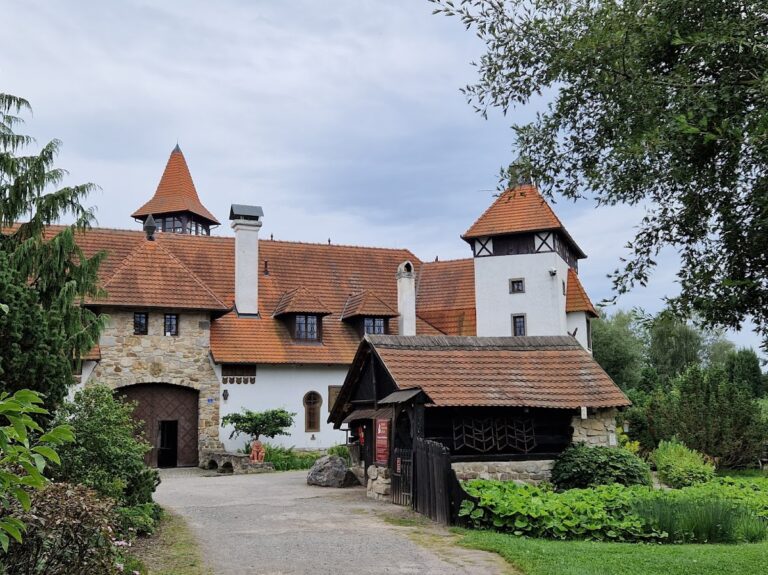
Today, the castle ruins are largely absorbed into the urban fabric of the historic town, where medieval fortification elements are still discernible in patterns of the streets and surviving stonework. Together with the remnants of moats and bastions, these remains provide valuable testimony to the castle’s architectural evolution from a medieval fortress into a Renaissance residence.
Nearby sites