Arechi Castle: A Historic Fortress Overlooking Salerno, Italy



Visitor Information
Google Rating: 4.3
Popularity: Medium
Google Maps: View on Google Maps
Official Website: www.ilcastellodiarechi.it
Country: Italy
Civilization: Unclassified
Remains: Military

History
Arechi Castle stands on Monte Bonadies overlooking the city of Salerno in Italy. The fortress traces its origins to the Byzantine period in the 6th century AD when the general Narses established a military camp, known as a castrum, on the hill during the Gothic War. The area itself showed signs of human presence well before this, with coins dating from the 3rd to 2nd century BC attesting to ancient activity.
In the eighth century, the Lombard Duke Arechi II fortified the castle as part of a larger defensive network guarding Salerno. While the duke’s influence led to the castle’s role as a northern stronghold, his direct modifications to the structure were limited. The surrounding walls descended from the hill to the sea, enclosing the ancient city, which was then known as Salernum. The fortress’s position made it nearly impregnable, and it held out against attacks throughout this period.
During the Norman conquest of southern Italy in the 11th century, Robert Guiscard besieged Arechi Castle in 1077. The castle surrendered only after a prolonged blockade caused starvation, marking one of the rare occasions it fell to an enemy. The Normans reinforced the fortress by raising the walls and constructing a southern loggia. They also added the Bastiglia tower on a northern rocky spur to cover vulnerable areas.
Under the Swabian ruler Frederick II in the 13th century, plans were made to repair the castle, but few visible changes from his reign survive today. The Angevin dynasty that followed carried out extensive renovations, building new structures, cisterns for water storage, and curtain walls featuring arrow slits that were later adapted with gun ports. They also introduced a bathhouse combined with a thermal system supplied by the castle’s cisterns. Documented repairs from 1274 and restorations completed by 1299 confirm active efforts to maintain and modernize the site.
In the 15th century, during the Aragonese period, the castle expanded to its largest extent. Large buildings appeared east of the main courtyard, reflecting use by the local nobility rather than solely by a military garrison. High-quality ceramics and majolica found here suggest a residence of status.
By the early modern era, the fortress had lost much of its military importance and became a summer retreat for the Sanseverino princes. English traveler Thomas Hoby noted the difficulty of reaching the castle before a connecting road was built, indicating its isolated and elevated location. In 1820, the castle was the stage for a failed conspiracy by the Carbonari, a secret society aiming to provoke popular uprising.
Following Italian unification, the castle fell into disuse until its last private owners, the Quaranta Counts of Fossalopara, sold it to the Province of Salerno in 1960. Preservation and archaeological study began in earnest from that point. Since 1991, excavations have clarified the fortress’s development through the centuries, and restoration efforts have continued to protect its structure and history. The castle also inspired the poet Ugo Foscolo, who wrote the tragedy “Ricciarda” during a visit in 1812. In 1992, its cultural significance was recognized with the issue of a commemorative Italian postage stamp. Local folklore preserves tales of secret passages linking the castle to nearby watchtowers such as Forte La Carnale, alongside ghost stories that remain part of its legend.
Remains
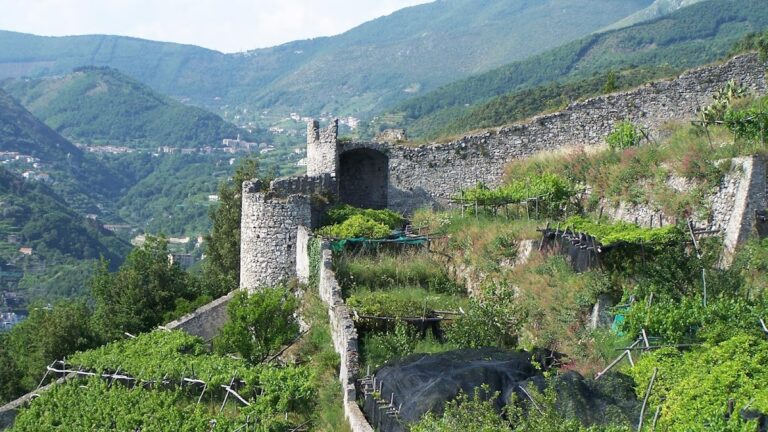
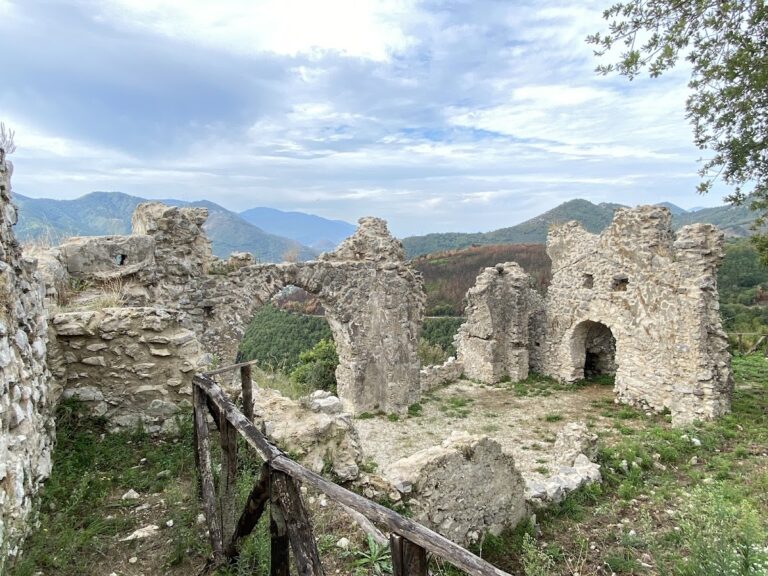
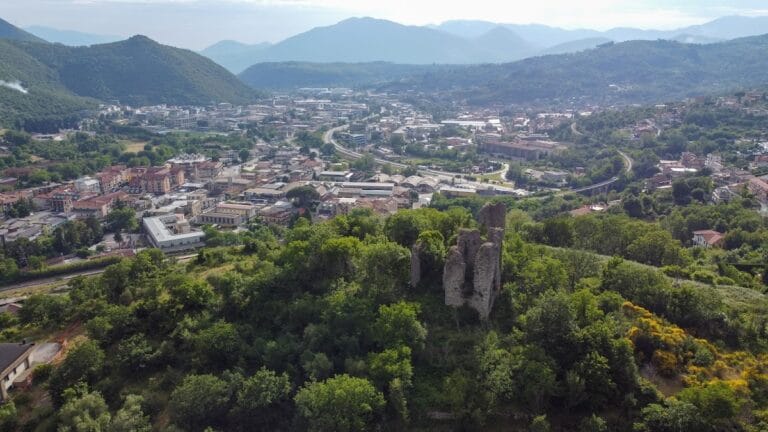
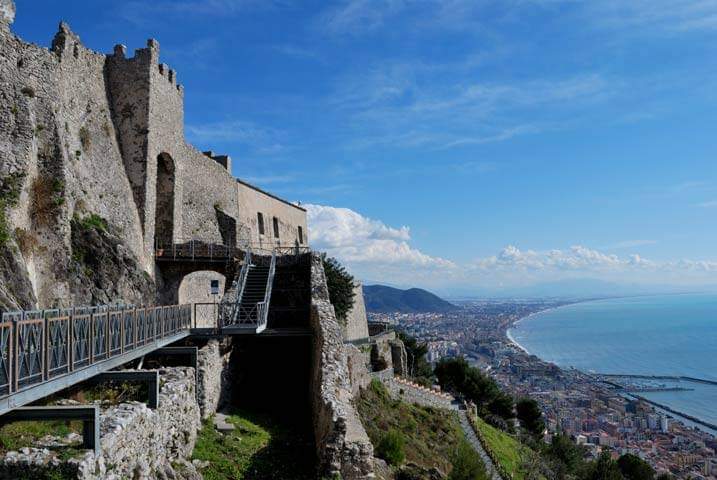
Arechi Castle occupies the summit of Monte Bonadies, the highest point overlooking Salerno. Its layout is characterized by extensive defensive walls enclosing a large courtyard known as the piazza d’Armi. The fortress walls descend the slopes towards the city and the sea, forming a protective circuit. Originally, the hill was left free of trees during the Middle Ages to provide clear visibility against approaching enemies. Today, the hill is wooded, a change from its historic appearance.
The site preserves significant Byzantine remains, including sections of walls constructed in opus quadratum, a technique using large squared blocks of tuff stone carefully placed without mortar. The main tower, called the turris maior, is rectangular and rises five or six floors high. It served as a lookout, offering views of the port and land routes leading to the ancient settlement of Nuceria Alfaterna.
Lombard defenses expanded the fortifications with walls running down the hill to the sea, enclosing ancient Salernum. This arrangement rendered the castle nearly impossible to capture. The Normans later raised these walls in height and added a southern loggia. Some of the original Norman pillars survive embedded within later 16th-century artillery emplacements, indicating adaptations to new military technologies.
On a northern rocky spur stands the Bastiglia tower, constructed by the Normans to cover blind spots in the defense line. It features a semicircular drum wall reinforced to support cannon openings; three such gun ports face strategic directions. This tower suffered structural damage before undergoing restoration in recent times.
The Angevin dynasty contributed several additions, including new buildings, water cisterns, and curtain walls equipped initially with arrow slits that were later converted to accommodate gun ports. They also installed bathing facilities and a thermal system powered by collected water from the cisterns. These features remain visible within the castle complex.
The main courtyard is bordered on the east side by substantial Aragonese-period buildings, reflecting the castle’s residential use during that era. Near the entrance, rooms from the modern period served as a summer residence for the Sanseverino princes. These spaces show the transition from purely military to residential functions.
Restoration works beginning in the 1980s and intensifying after 2000 have addressed structural conservation and visitor accessibility. The floor of the ditch surrounding the castle has been paved, vaulted gun ports and rooms used by fusiliers (soldiers armed with early firearms) have been restored, and eroded stone facings near the turris maior have been repaired. An elevator installed inside a preexisting cistern now allows access to intermediate levels, aiding visitors with disabilities.
Beneath the terrace in front of the main tower lies a hypogeum, an underground vaulted chamber. Originally a single large space later divided into smaller sections, it shows traces of canalization suggesting it once served partly as a water cistern. The space was also used as a prison. Frescoes depicting Saint Catherine of Alexandria and Saint Leonard, protector of prisoners, remain on the rear wall, illustrating the religious dimension of this chamber.
The castle museum houses finds from extensive archaeological excavations. These include nearly 400 ceramic fragments spanning from the 7th and 8th centuries through to the 15th century, featuring varied styles such as red-band decorated ware, spiral patterns, lead-glazed tableware, early majolica (tin-glazed pottery), and graffito ceramics with vegetal and geometric motifs.
Glass artifacts mainly date from the 12th to 15th centuries, encompassing thin, often undecorated vessels such as bottles, goblets, and small ampoules. A notable piece is a 13th-century colorless glass goblet decorated with polychrome enamel and applied glass beads.
Metal objects found at the site range from common items like nails, locks, knives, rings, hairpins, and buckles to horse fittings. Weapons recovered include arrowheads, crossbow bolts, and lances dating from the 12th century onward. Of particular interest is a gilded bronze spur from the early 1300s, reflecting the high status of some castle occupants.
Coin hoards discovered during restoration reveal the castle’s historical connections. These include silver deniers minted in Rouen (late 11th to early 12th century), gold tari from Sicily (Palermo or Messina) issued by Norman kings Roger and Tancred, and a mixed collection of silver and copper coins from various Italian mints dated between 1392 and 1534. Some coins show signs of re-striking, indicative of metal shortages at the time.
Nearby sites