Castle and Mount of Santa Bárbara, Tudela: A Historic Fortress in Spain


Visitor Information
Google Rating: 4.3
Popularity: Very Low
Google Maps: View on Google Maps
Official Website: www.castillosnet.org
Country: Spain
Civilization: Unclassified
Remains: Military

History
The Archaeological site of Castle and Mount of Santa Bárbara is located in Tudela, Spain, and was originally established by Muslim builders in the early 9th century. Constructed between 803 and 804 by Amrùs ben Yusuf, a general of the Emir of Córdoba Al-Hakam I, the fortress occupied a commanding position on the Mount of Santa Bárbara, valued for its steep natural cliffs and strategic oversight of the nearby Ebro River.
Under Muslim rule, the castle served as a central stronghold in a shifting political landscape. It initially came under the control of the Banu Qasi, a powerful local family who made Tudela the capital of their territories. Eventually, the site belonged to the Tuyibíes dynasty as part of the Taifa of Zaragoza and later became the seat of an independent Taifa of Tudela. This period solidified the fortification’s role in regional governance and military defense.
In 1119, Alfonso I the Battler captured the castle during the Christian Reconquista, incorporating it into the Crown of Navarre-Aragon. Its importance continued under Navarrese rule, and it was definitively brought into the Kingdom of Navarre during the reign of García V Ramírez, known as “the Restorer.” Following the Christian conquest, the original Muslim alcazaba was transformed into a medieval castle, with significant enhancements attributed to Sancho VII the Strong.
Between 1388 and 1393, King Carlos III the Noble undertook a major redesign, converting the fortress into a royal palace. His works included adding new wings, expansive halls, galleries equipped with chimneys, stained glass windows, and decorating with heraldic shields. Despite these improvements, the castle experienced periods of deterioration by the early 14th century, necessitating repairs documented in 1307, 1339, and 1370.
During the 15th-century Navarrese civil war, the defensive capabilities of the castle were reinforced by deepening its moat. However, in 1516, Cardinal Cisneros ordered the demolition of its towers and the filling of its moats, marking the beginning of structural decline. Nonetheless, the castle still stood in 1521, after which the inhabitants of Tudela dismantled it to reuse its stones for other buildings. This reuse was officially sanctioned by Charles I in 1522. Some parts, like the conditionally stable central tower known as the “Tower of Don Mejón,” were partially repurposed in 1611 for the construction of the Hermitage of Santa Bárbara, which no longer exists today.
The ruins persisted through the centuries and were even fortified again during the first half of the 19th century. Stone from the castle was incorporated into local structures, including the vault supporting the Plaza Nueva over the Queiles River. In the 20th century, the site acquired new significance with the erection of the Monument to the Sacred Heart of Jesus in 1942. Archaeological excavations begun in 1985 uncovered Islamic-period terraces, walls, and artifacts, with ongoing studies led by archaeologist Juan José Bienes continuing to reveal the site’s layered history.
Remains
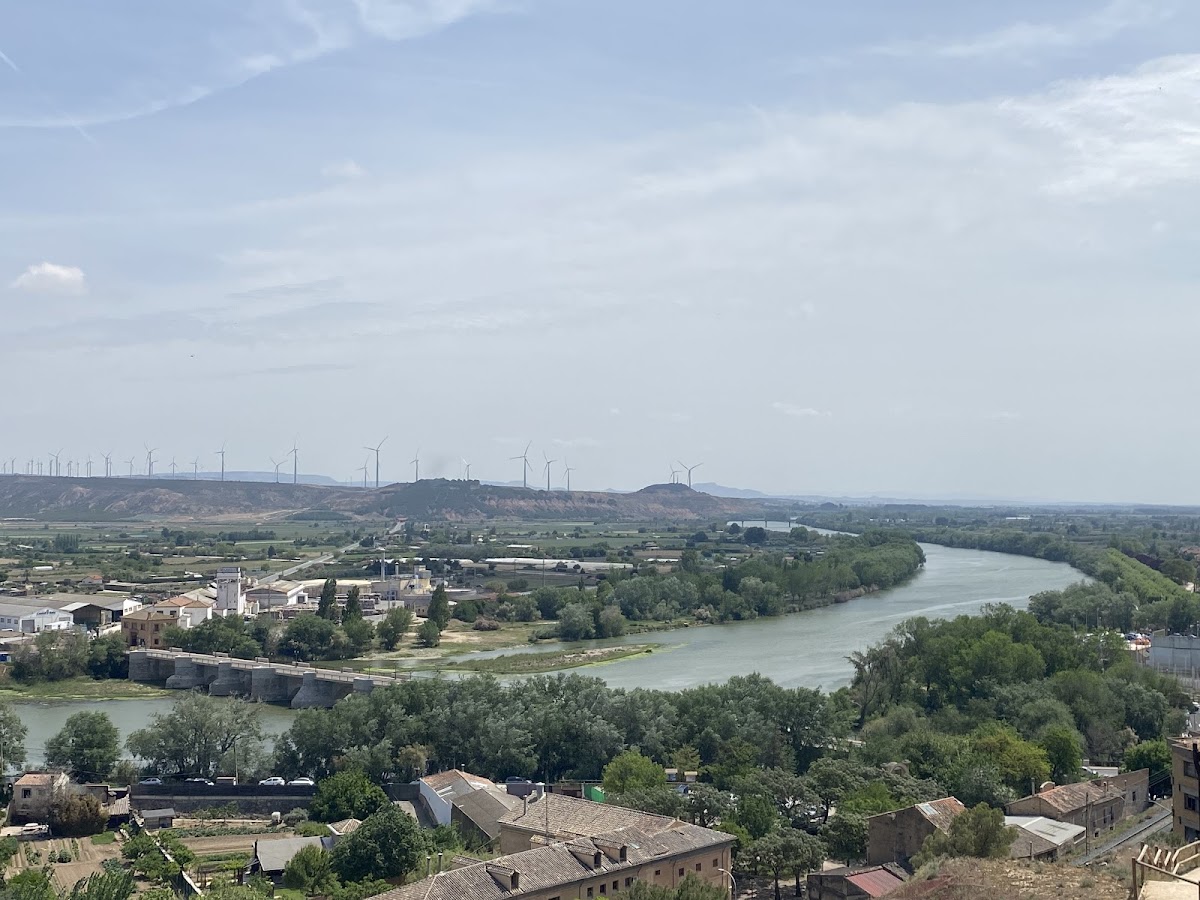
The castle’s remains sit atop the Mount of Santa Bárbara, a site naturally shielded by steep cliffs and bordered on one side by the Ebro River, which acted as a natural barrier enhancing the fortress’s defenses. The fortification once featured a double wall system: an outer wall encircled the lower part of the hill and served as the city’s external enclosure, while an inner wall enclosed the higher sections of the mount, topped by a heavily fortified main tower—referred to in later Christian times as the alcazaba proper. These walls were further protected by natural and artificial moats.
Along the lower outer wall, which bordered much of Tudela’s perimeter, there were numerous towers strategically placed for surveillance and defense. Specifically, nine towers lined the section facing the Ebro River between the nearby bridge and the site of the later Church of the Trinity. Another six towers extended from that point toward the historic Calahorra Gate, which marked the transition between the alcazaba’s outer defenses and the urban city walls. The principal entrance to the fortress faced the city itself, aligned with Tudela’s San Miguel neighborhood, and was later known as the “Ferrenna Gate” during Christian rule.
Excavations have uncovered significant Islamic-period structures within the fortress, including service areas featuring walls made of ashlar (finely cut stone) and rammed earth, known as tapial, a construction technique involving compacted earth. Archaeologists have also revealed several wells and storage pits which would have supported the fortress’s inhabitants. These features remain partially visible and testify to the site’s original function as both a military stronghold and a self-sustaining complex.
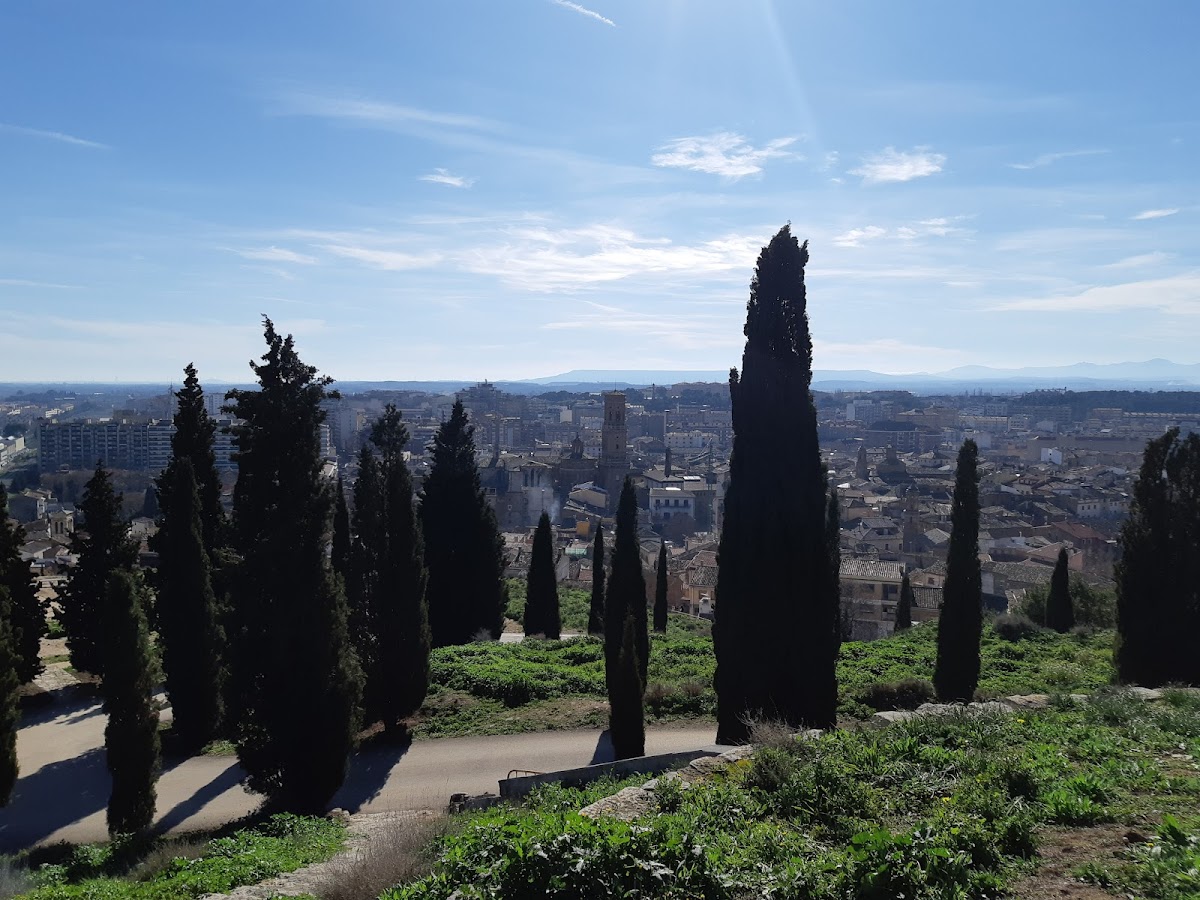
The transformation by King Carlos III left architectural traces characteristic of a royal palace, including a spacious plaza immediately before the main gate, and an important building referred to as the “Porch.” This structure historically functioned as a place where the monarch administered justice. Although much of the castle has been dismantled over time, surviving elements include fragments of defensive walls, cisterns (called aljibes), and underground passageways. These remains are preserved within a park that provides wide views over Tudela, the Ebro River, and the surrounding Mejana plains.
Together, the archaeological features reflect the castle’s evolution from a Muslim alcazaba to a medieval fortress and royal palace, through stages of decline and reuse that shaped its current modest but revealing ruins.
Nearby sites