Wagegg: A Medieval Hill Castle and Baroque Hunting Residence in Germany


Site at a Glance
- Rating
- 4.1
- Popularity
- Very Low
- Country
- Germany
- Primary era
- Medieval
- Eras represented
- Medieval, Early Modern
- Civilizations
- Holy Roman Empire
- Site type
- Military
- Remains
- Castle
On this page8 sections
History
Wagegg is a medieval hill castle in Germany, first mentioned around 1170 and later transformed into a Baroque castle complex with gardens and ponds. It was held by the Lords of Wagegg until 1374, who served as ministeriales, a form of service nobility, to the Prince-Abbey of Kempten. The prince-abbot governed this ecclesiastical principality while also exercising territorial authority.
Medieval lordship
In 1374, the castle and its lordship passed to the Prince-Abbey of Kempten. Ownership then changed several times. Wagegg went to the Lords of Schellenberg and later by inheritance to the Lords of Eisenburg. In 1466 it passed to Archduke Sigismund of Austria, and in 1469 to the Lords of Laubenberg.
Peasants seized the castle in 1525. The Prince-Abbey of Kempten reacquired Wagegg in 1580, but after 1581 the medieval stronghold increasingly deteriorated. A castle mill associated with the estate was known as Vögelesmühle.
From fortress to hunting residence
Beginning in 1642, the complex received provisional repairs so that the prince-abbots could use it as a hunting lodge. From 1715, the site was expanded into a lavish Baroque castle with gardens and ponds, changing the character of the earlier medieval complex.
French forces plundered Wagegg in 1796. During secularization, the early nineteenth-century transfer of church property to secular states, the castle was pledged to the Kingdom of Bavaria in 1806. It was sold for demolition in 1807, and the final side wing was demolished in 1851. The forestry office acquired the grounds in 1906. An associated works yard was demolished in 1908, while a nearby hunting lodge built in 1761 survived until its demolition in 1967.
Emergency measures secured the ruin in 1976. Wagegg is designated as an architectural heritage monument in Bavaria.
Remains
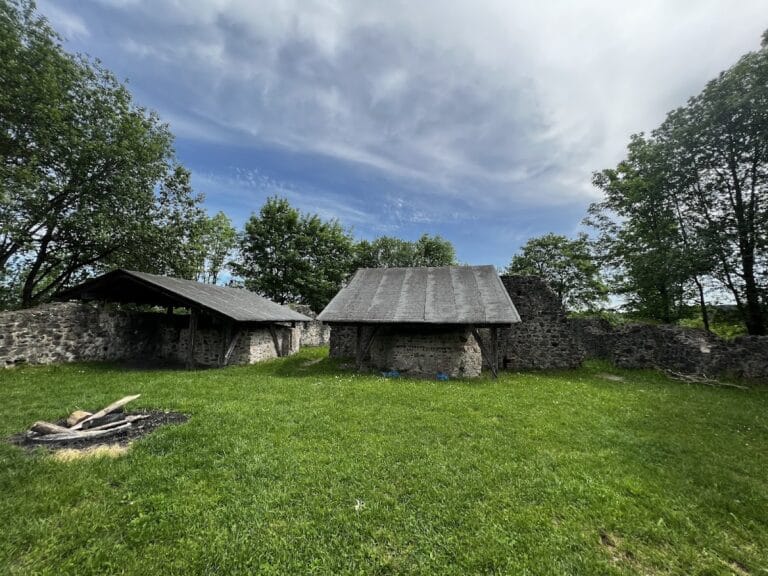
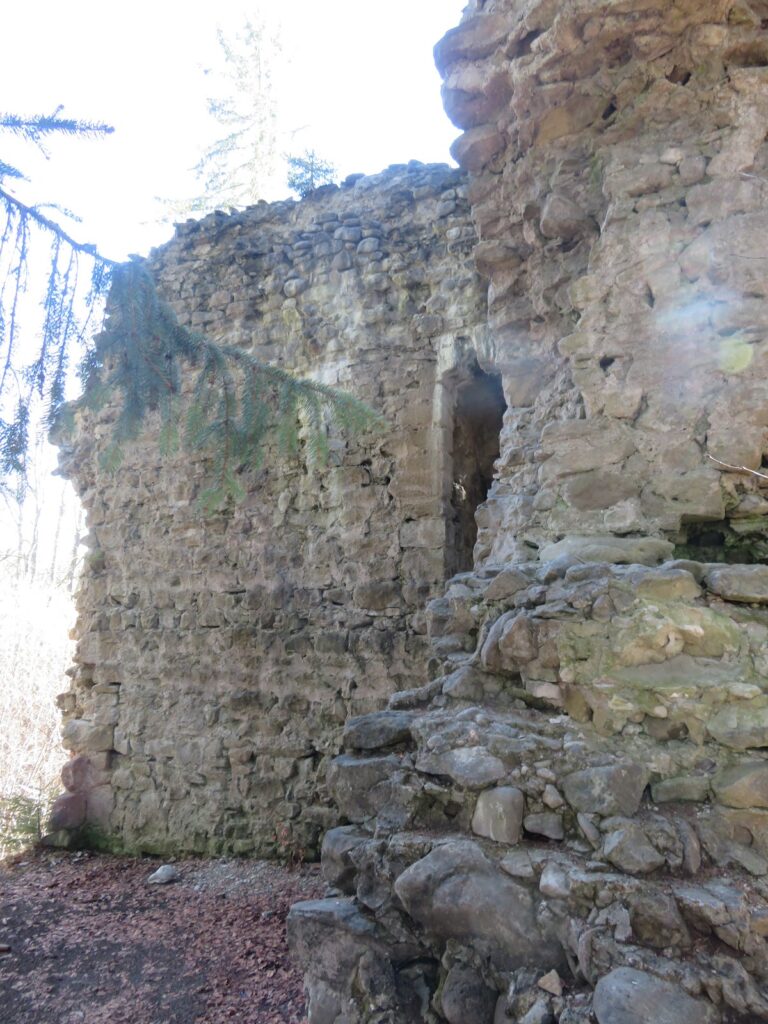
Wagegg occupies a hill at about 814 metres above sea level. The medieval castle and its later Baroque development now survive mainly as a large mound, fragments of masonry, and the former entrance gate. Rocks within the main castle mark the position of the former keep, while a small cave lies on the eastern side of the mound.
Surviving castle structures
Castle mound and keep site
The large mound forms the principal surviving feature of the hill castle. Rock outcrops within the main castle indicate where the keep stood. The mound also preserves the physical setting of the later castle complex, whose gardens and ponds belonged to the Baroque expansion.
Entrance gate
A large stone gate remains at the entrance to the former castle. An inscription survives on the gate, preserving a visible element of the complex’s historical fabric.
Rock features and access structures
A reinforced path leads to the ruin, and stairs within the site reach a viewing platform on the rock. North of the castle mound, a rock face is designated as the geotope “Nagelfluh rock face at the castle site north-northeast of Wagegg,” listed as Geotop no. 780A015. Nagelfluh is a conglomerate formed from rounded stones cemented together, a rock type characteristic of parts of the Alpine foreland.