Amphipolis Archaeological Park: A Historic Urban Center in Central Macedonia, Greece
Table of Contents


Visitor Information
Google Rating: 4.3
Popularity: Very Low
Google Maps: View on Google Maps
Country: Greece
Civilization: Byzantine, Greek, Roman
Remains: City

Context
The Archaeological Park of Amphipolis is situated near the contemporary town of Amphipolis in Central Macedonia, Greece. The site occupies a commanding position on a hill and adjacent terraces along the right bank of the Strymon River, overseeing the surrounding valley. This location provided control over the river corridor, fertile plains, and access to the nearby Pangaion foothills, known for their rich mineral resources.
The landscape encompasses diverse topographic features, including riverine environments, upland zones, and a coastal plain extending toward the Aegean Sea. Archaeological stratigraphy at Amphipolis documents continuous human presence from the Neolithic period through the medieval era. The city’s classical foundation as an Athenian colony in 437 BCE initiated a sequence of occupation phases, including Macedonian, Hellenistic, Roman, and Byzantine periods, each leaving distinct cultural and architectural imprints.
Modern archaeological inquiry began in the nineteenth century and intensified with systematic excavations in the twentieth and twenty-first centuries. These investigations have revealed extensive urban remains, funerary monuments, and infrastructure, preserving much of the ancient city’s layout and fabric. Today, the site functions as a protected archaeological park, facilitating ongoing research and public engagement with its multifaceted historical legacy.
History
The Archaeological Park of Amphipolis embodies a complex historical trajectory shaped by its strategic location in Central Macedonia. Founded as an Athenian colony in the mid-5th century BCE, Amphipolis emerged as a significant military and economic center, contested during the Peloponnesian War and subsequently integrated into the Macedonian kingdom. Its prominence persisted through Hellenistic, Roman, and Byzantine periods, reflecting evolving political dominions, administrative roles, and religious transformations. Archaeological and epigraphic evidence document the city’s adaptation to shifting regional powers until its decline in the early medieval period.
Classical Period and Athenian Colony (5th century BCE)
Amphipolis was established in 437 BCE by Athens to secure control over the fertile Strymon valley and the valuable gold mines of the Pangaion hills. The city’s initial fortifications, including walls extending approximately 7.5 kilometers, date to this foundation phase and demonstrate significant investment in urban defense. Although Athens exercised political dominance, the population remained ethnically diverse, with Thracian and Macedonian inhabitants alongside Athenian settlers. Amphipolis functioned as an ally rather than a formal member of the Delian League, maintaining a degree of local autonomy.
During the Peloponnesian War, Amphipolis became a strategic focal point. In 424 BCE, the Spartan general Brasidas captured the city, and the subsequent Battle of Amphipolis in 422 BCE resulted in the deaths of both Brasidas and the Athenian commander Cleon. Brasidas was commemorated locally with annual games and sacrifices, reflecting his enduring symbolic association with the city. The toponym “Amphipolis,” meaning “around the city,” likely derives from the Strymon River’s course encircling the settlement on two sides, as noted by Thucydides, though alternative interpretations exist in ancient sources.
Macedonian Rule (4th century BCE)
In 357 BCE, King Philip II of Macedon captured Amphipolis, consolidating Macedonian control over Thrace. Despite a secret agreement with Athens promising the city’s return in exchange for Pydna, Philip fortified his hold and integrated Amphipolis into his expanding realm. The city underwent gradual Macedonianization, adopting the Macedonian calendar, currency, and administrative practices. The local drachma was replaced by the Macedonian gold stater, minted from regional gold deposits.
Under Alexander the Great, Amphipolis attained heightened military and naval significance. It served as a naval base and was the birthplace of three of Alexander’s admirals: Nearchus, Androsthenes, and Laomedon. Alexander assembled his forces here prior to his 335 BCE campaign against Thrace and commissioned the construction of six large temples, each funded with 1,500 talents, underscoring the city’s religious and political importance. Following Alexander’s death, his wife Roxana and son Alexander IV were imprisoned and murdered in Amphipolis. The city remained a strategic fortress and economic hub, situated on the Macedonian royal road and later the Roman Via Egnatia. Epigraphic records, including a military ordinance of Philip V and gymnasium regulations, attest to organized civic and military institutions. Archaeological remains from this period include the gymnasium complex with frescoed villas and the city’s ramparts.
Roman Conquest and Early Imperial Period (2nd century BCE – 1st century CE)
After Rome’s decisive victory over Macedonia at the Battle of Pydna in 168 BCE, Amphipolis became the capital of one of four semi-autonomous republics (merides) established in the former Antigonid kingdom. These entities were progressively incorporated into the Roman province of Thracia. The city is referenced in the New Testament’s Acts of the Apostles as a stop for Paul and Silas during their missionary journeys, indicating its continued regional prominence and the presence of Greek philosophical communities.
Amphipolis sustained significant damage during a Thracian revolt in the 1st century BCE, which destroyed key public buildings including the gymnasium. Under Emperor Augustus, the city underwent reconstruction, restoring its urban infrastructure and public amenities. Archaeological evidence from this period includes the rebuilt gymnasium complex, frescoed villas, and city ramparts, reflecting a revival of civic life and integration into the Roman provincial system.
Late Antiquity and Christianization (4th–6th centuries CE)
During Late Antiquity, Amphipolis experienced economic prosperity alongside religious transformation. The inhabited area contracted to the acropolis, where several Christian basilicas were constructed, featuring intricate mosaic floors and sculptural decoration such as ram-headed capitals. One church exhibits a hexagonal central plan reminiscent of Ravenna’s Basilica of St. Vitalis, indicating architectural influences from the wider Mediterranean world.
The city became a Christian episcopal see under the metropolitan jurisdiction of Thessalonica, with the first recorded bishop documented in 533 CE. Wealthy citizens engaged in euergetism, funding urban and religious building projects that contributed to the gentrification of the city center and its agricultural hinterland. This period marks a shift from Amphipolis’s earlier military and economic roles toward a religious and administrative focus within the Byzantine ecclesiastical framework.
Early Medieval Period and Decline (6th–8th centuries CE)
The late 6th century saw Slavic incursions that disrupted the Amphipolis hinterland, precipitating population decline and a retreat to the fortified acropolis. The original extensive city walls were partially maintained, with building materials from earlier monuments reused. Large cisterns in the upper city were adapted for small houses and artisan workshops, reflecting adaptive reuse amid contraction.
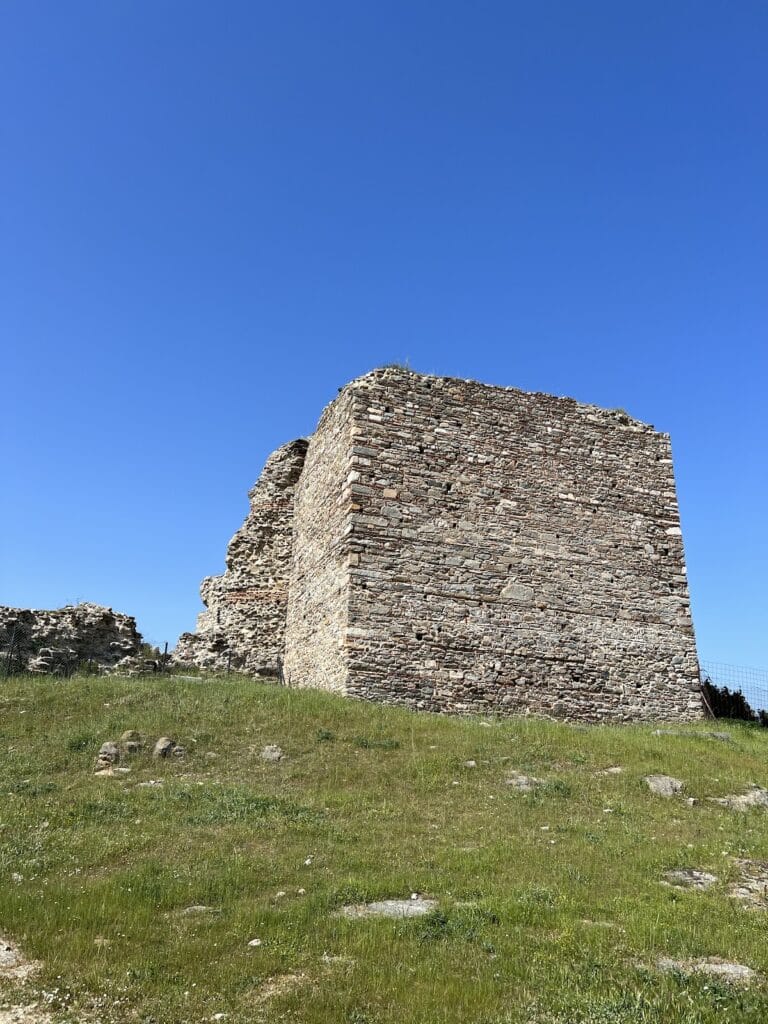
By the mid-7th century, the inhabited area diminished further, and a new inner fortification featuring pentagonal towers was constructed. This wall bisected earlier Roman and ecclesiastical structures, including the acropolis, Roman baths, and episcopal basilica, indicating a significant reduction in the city’s footprint. Amphipolis was likely abandoned in the 8th century; the last known bishop attended the Second Council of Nicaea in 787. The population probably relocated to the nearby port of ancient Eion, later known as Chrysopolis. Some regional activity persisted, including the erection of a Byzantine fortified tower in 1367 to protect monastic lands.
Archaeological Investigations and Modern Research (19th century–present)
Amphipolis attracted scholarly attention from the 19th century, with early descriptions by travelers and archaeologists such as E. Cousinéry, Leon Heuzey, and P. Perdrizet. Systematic excavations commenced after World War II under the Greek Archaeological Society, revealing city walls, necropoleis, basilicas, the acropolis, a river bridge, gymnasium, villas, and tombs. Notably, a silver ossuary containing the cremated remains of the Spartan general Brasidas and a gold crown was discovered beneath the Agora.
In 1977, the excavation of an ancient wooden bridge over the Strymon River uncovered a unique structure used continuously from the 8th century BCE until approximately 1800 CE. The gymnasium complex, with its palaestra, covered stoa, and stone stela inscribed with gymnasium regulations, was also excavated. The monumental Kasta burial mound northeast of Amphipolis, the largest tumulus in Greece, features a 497-meter limestone perimeter wall clad in marble, multiple chambers, sphinx statues, and Caryatid columns. A pebble mosaic depicting the abduction of Persephone by Hades includes figures identified as Philip II and Olympias, linking the tomb to Macedonian royalty. Bone fragments of five individuals, including an elderly woman possibly Olympias, were recovered. Restoration efforts continue, aiming to preserve and reconstruct the monument. Today, Amphipolis is a protected archaeological park with ongoing research illuminating its extensive historical layers.
Remains
Architectural Features
The Archaeological Park of Amphipolis preserves extensive remains of a fortified urban settlement with architectural elements spanning multiple historical periods. The original city walls, constructed in 437 BCE during the Athenian colonial foundation, extend approximately 7.5 kilometers and are built primarily of large limestone blocks in ashlar masonry. The northern section is particularly well preserved, reaching heights up to 7.5 meters. Five city gates survive in varying states of preservation, including a prominent gate adjacent to the ancient wooden bridge over the Strymon River. In the early Christian period, a secondary inner wall was erected around the acropolis, reflecting a contraction of the defended area and a shift in urban focus.
The site’s layout reveals a transition from a broad fortified city to a more compact acropolis-centered settlement during Late Antiquity and the early Byzantine era. This contraction is marked by the construction of a pentagonal tower wall in the mid-7th century CE, which bisects earlier Roman and ecclesiastical structures. The wall enclosed a smaller area, intersecting the episcopal basilica and Roman baths, indicating a reduced urban footprint. The city’s architecture includes civic, religious, and military elements, with visible foundations, earthworks, and reused masonry throughout the park.
Key Buildings and Structures
City Walls and Gates
The city walls date from the 5th century BCE, erected at the time of Amphipolis’s establishment as an Athenian colony. Constructed of large limestone blocks, the walls form a perimeter of about 7.5 kilometers. The northern section is the best preserved, with surviving heights of up to 7.5 meters. Five gates remain visible, including a significant gate adjacent to the ancient wooden bridge. The walls incorporated the bridge as a controlled access point. In the early Christian period, a secondary inner wall was built around the acropolis, reflecting a defensive contraction of the city’s inhabited area.
Ancient Wooden Bridge of Amphipolis
Spanning the Strymon River, the wooden bridge is a unique archaeological feature discovered in 1977. It formed part of the city’s defensive system and controlled access between Macedonia, Chalkidike, and Thrace. Integrated into the city walls and mentioned by Thucydides, the bridge’s hundreds of wooden piles have been carbon-dated, demonstrating continuous use from approximately 760 BCE until around 1800 CE. Its exceptional preservation provides rare insight into ancient infrastructure and regional connectivity.
Gymnasium
The gymnasium complex, originally constructed in the 4th century BCE, served as a center for military training, athletics, and intellectual education. It includes a palaestra—a rectangular courtyard surrounded by colonnades—and adjoining rooms for athletic activities. A covered stoa (xystos) measuring 75 meters long and 7 meters wide allowed indoor training for six runners simultaneously. An outdoor parallel track, the paradromida, was used during favorable weather. A cistern system supplied water to the facility. A stone stela found in the north wing details gymnasium regulations, including the roles of the master and athlete education. The gymnasium was destroyed during a 1st-century BCE Thracian revolt but was rebuilt in the 1st century CE under Emperor Augustus.
Tomb of Amphipolis (Kasta Tomb)
The Kasta burial mound, located northeast of Amphipolis, contains the largest tumulus in Greece. The perimeter wall of the mound measures 497 meters in length and is constructed of limestone covered with marble. The tomb consists of three chambers separated by walls. Two sphinx statues stand outside the entrance, and a sphinx head was found inside behind a broken door, indicating ancient disturbance. The first chamber contains two Caryatid columns in the 4th-century BCE style. A pebble mosaic depicting the abduction of Persephone by Hades is located behind the Caryatids and in front of a Macedonian marble door. The mosaic includes figures identified as Philip II and Olympias, confirming the tomb’s Macedonian royal character. Bone fragments of five individuals were recovered, including a well-preserved skeleton of a woman over 60 years old. The tomb dates to the late 4th century BCE, after Alexander the Great’s death. Restoration work, including reconstruction of materials reused by Romans, is ongoing with completion expected in 2023.
Basilica Churches
Within the acropolis area, four basilicas dating from the 5th to 6th centuries CE have been excavated. These churches feature mosaic floors with intricate designs and architectural sculptures, including ram-headed capitals. One church exhibits a hexagonal central plan reminiscent of the basilica of St. Vitalis in Ravenna. The concentration of these basilicas within a confined area inside the acropolis walls reflects a reduced urban footprint during Late Antiquity. The episcopal basilica, located within the acropolis, was intersected by the mid-7th-century pentagonal tower wall, indicating its inclusion within the contracted fortified zone. The bishopric of Amphipolis is first attested in 533 CE.
Pentagonal Tower Wall
Constructed around the mid-7th century CE, this inner fortification features pentagonal towers and cuts through the acropolis, Roman baths, and episcopal basilica. The wall marks a significant reduction in the city’s inhabited and defended area during the early Byzantine period. Built of stone masonry, it repurposed materials from earlier structures. The wall’s layout indicates a defensive strategy focused on a smaller, more defensible core.
Roman Baths
The Roman baths are located within the city and were intersected by the 7th-century pentagonal tower wall. The remains include foundations and structural elements typical of bathing complexes, though detailed architectural features are fragmentary. Their presence indicates the continuation of Roman urban amenities before the city’s contraction in Late Antiquity.
Necropolis
The necropolis extends beyond the city walls and includes numerous tombs from various periods. Among the finds is a silver ossuary containing the cremated remains of the Spartan general Brasidas, accompanied by a gold crown, discovered beneath the Agora. The necropolis also encompasses the monumental Kasta burial mound with its large Macedonian tomb. Tombs vary in size and construction, reflecting different funerary practices over time.
Lion of Amphipolis Monument
The Lion of Amphipolis is a large funerary monument situated near the city. It is believed to mark the burial site of three admirals of Alexander the Great: Nearchus, Androsthenes, and Laomedon. Parts of the monument were uncovered during World War I by Bulgarian and British troops. The monument consists of a large stone lion sculpture, with surviving fragments of the base and body.
Other Remains
Excavations have revealed various private and public buildings with mosaic floors and frescoes, reflecting the city’s prosperity during the Macedonian and Roman periods. Well-preserved frescoes from a wealthy villa have been documented. The large fortified perimeter of the ancient town was no longer defensible in Late Antiquity, leading to population contraction. Large cisterns in the upper city, originally constructed for water storage, were later adapted for housing and artisan workshops during the city’s decline. Foundations and earthworks of urban structures, including residential quarters and workshops, are visible in several areas of the park.
Archaeological Discoveries
Artifacts recovered at Amphipolis span from the Neolithic through the Ottoman period, with concentrations from Classical, Hellenistic, Roman, and Byzantine times. Pottery includes amphorae, tableware, and storage jars, reflecting local production and trade connections. Numerous inscriptions have been found, including city laws, gymnasium regulations, and dedicatory texts, providing insight into civic and military organization. Coins from Athenian, Macedonian, and Roman issuers have been recovered, illustrating changes in political control and economic integration.
Religious artifacts include statuettes, altars, and ritual vessels associated with pagan and Christian worship. Notably, the silver ossuary and gold crown found beneath the Agora are linked to the Spartan general Brasidas. Mosaics and frescoes from basilicas and villas demonstrate artistic styles and iconography from Late Antiquity and the Roman Imperial period.
Preservation and Current Status
The city walls, particularly the northern section, remain well preserved, with heights reaching 7.5 meters. The ancient wooden bridge is preserved in situ, with hundreds of wooden piles visible and dated through carbon analysis. The gymnasium’s foundations and architectural elements survive, though the superstructure is largely lost. The Kasta tomb is partially restored, with ongoing conservation work focused on stabilizing marble cladding and reconstructing damaged sections. The basilicas within the acropolis retain mosaic floors and sculptural details, though some are intersected by later fortifications.
The pentagonal tower wall and Roman baths survive as foundations and partial walls. The Lion of Amphipolis monument exists in fragmentary form. Other urban remains, including cisterns and residential structures, are preserved as earthworks and foundation outlines. Excavation and restoration efforts continue under the Greek Archaeological Service, with the site protected as an archaeological park. Conservation aims to balance preservation with research, avoiding reconstruction beyond necessary stabilization.