Liternum: Roman Colony and Archaeological Site in Italy
Site at a Glance
- Rating
- 4
- Popularity
- Low
- Country
- Italy
- Primary era
- Classical
- External website
- Open
- Eras represented
- Classical
- Civilizations
- Roman
- Site type
- City
On this page15 sections
History
Liternum is an ancient Roman colony in Italy, near modern Giugliano in Campania, founded in 194 BC for veterans of the Second Punic War. The settlement stood about 8 km north of Cumae beside the ancient Palus Liternina, now Lago Patria, near the mouth of the Clanis River. It was established alongside the colonies of Puteoli and Volturnum, continuing a pattern of habitation that had begun in prehistoric times and later included Oscan-speaking communities.
Foundation and the age of Scipio Africanus
Liternum became associated with Scipio Africanus, the Roman general and statesman who commanded Rome’s forces during the Second Punic War and defeated Hannibal at Zama. After a conflict with the Roman Senate, Scipio withdrew to Liternum in 187 BC. He died there in 183 BC. Seneca the Younger later described his villa and tomb, while ancient tradition disputed whether he was buried at Liternum or in the Scipio family tomb at Rome. A traditional epitaph connected with the tomb expressed his resentment toward an ungrateful country.
Growth under the Roman Empire
Liternum prospered especially under Augustus and during the late first and second centuries AD. The Via Domitiana, a Roman road built under Emperor Domitian to connect the coastal settlements of Campania with routes toward Rome, linked the town with Puteoli, Sinuessa, and other settlements. Liternum became an important station on this coastal route and was elevated to the rank of a prefecture.
The local economy drew on fishing and probably on the fine white coastal sand used in glass production. Shops and craft workshops operated alongside perfume production and ceramic manufacture, reflecting a settlement with both commercial and artisanal activity.
Decline and later religious history
From the fourth century AD, Liternum gradually declined. Flooding, economic deterioration, incursions, and malaria associated with the marshy environment contributed to the abandonment of the town. In 455, the Vandals under King Genseric sacked and destroyed it. The remaining population moved inland, helping form the earliest nucleus of modern Giugliano.
During the Christian period, Liternum may have been an episcopal seat, although that identification remains disputed. The Capitolium, a Roman temple dedicated to Jupiter, Juno, and Minerva, was converted into a church. The relics of Saint Fortunata were later transferred from Liternum to Naples. In the Middle Ages, Benedictine monks cultivated the plain around the abandoned settlement.
Rediscovery and archaeological investigation
Inscriptions found during the late nineteenth century helped identify the ancient settlement. Excavations began around 1930, when Giacomo Chianese was commissioned to search for the villa and tomb associated with Scipio Africanus. Systematic campaigns directed by Amedeo Maiuri continued from 1932 to 1937, followed by further investigations around 1970 and in 1988.
A votive altar to Scipio Africanus was produced during this period of excavation and placed in the park on 15 September 1936. Later work in the necropolis, directed by Simona Formola under the supervision of the Superintendency for the Metropolitan Area of Naples, revealed funerary structures used from the late first century BC to the third century AD. The finds also led to the interpretation that gladiators lived at Liternum and were buried there after their arena careers.
The necropolis has also influenced interpretations of the ancient road system. The alignment of the burials suggests that they may originally have stood beside the Via Domitiana, contributing to the reconstruction of Liternum’s urban layout. The necropolis is protected by the Ministry because of its importance, while the archaeological park and amphitheater became part of the Archaeological Park of the Phlegraean Fields in 2016. The archaeological and natural park lies within the Foce Volturno–Costa di Licola Nature Reserve.
Remains
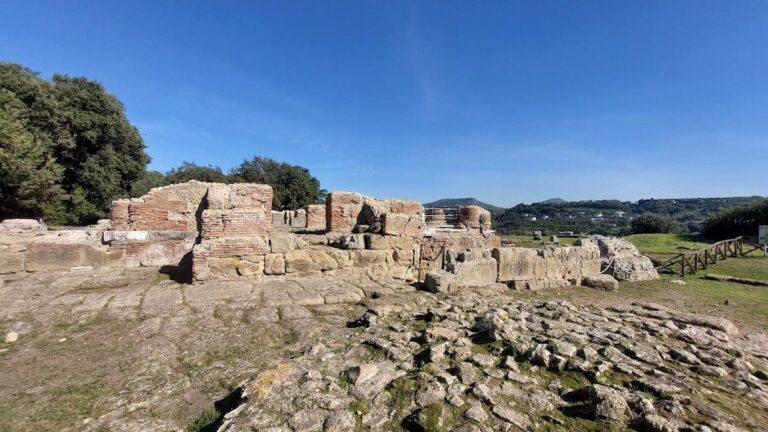
The excavated urban area is organized around a forum measuring approximately 97 by 42 m. Established with the colony, the forum had porticoes on three sides. Its north side contained the Capitolium and basilica, both dating to the second century BC. A paved stretch of the Via Domitiana later crossed the forum from north to south, requiring part of the portico to be rebuilt. The forum area also includes a theater from the late second century AD, together with a temple and bath building dating from the Republican period, approximately the second to first centuries BC.
Civic center and public buildings
Forum and road
The forum formed the principal civic space of the colony. Its three-sided portico, the Capitolium, and the basilica established a formal public center from the town’s foundation. The later road pavement ran directly across this area on a north–south axis, and the rebuilding of part of the portico shows how the imperial road was incorporated into the earlier urban plan.
Theater, temple, and baths
A theater was built in the forum area during the late second century AD. Other excavated structures include a temple and a bath building assigned to the Republican period, between approximately the second and first centuries BC. Together, these remains represent the religious, civic, and bathing facilities of the settlement across several phases of its development.
Amphitheater
Structure outside the city
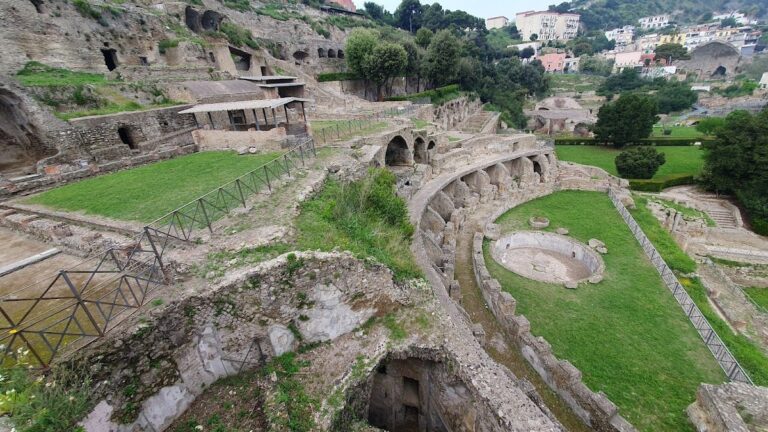
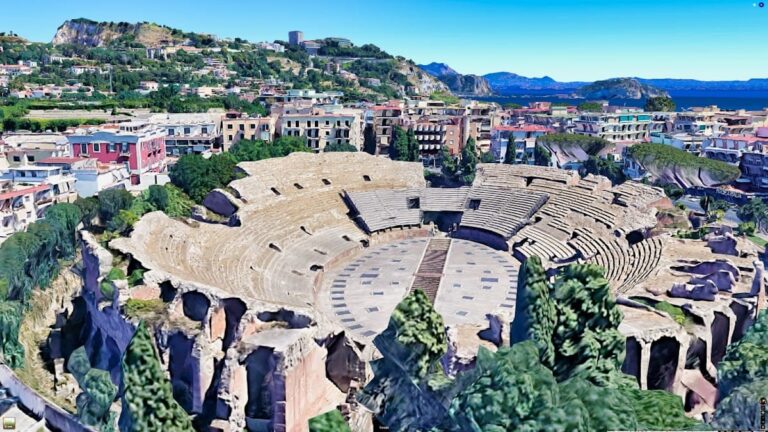
Outside the city walls, near the mouth of the river, are the remains of an amphitheater built during the first century BC. It measured approximately 85–90 by 65–70 m. Alterations and restorations took place during the first and second centuries AD, showing that the building continued to be maintained and used after the original colonial period.
Necropolis and funerary architecture
Burial enclosures and mausoleum
A necropolis associated with Liternum extended outside the city along the lakeshore. An imperial necropolis dating to the second century AD was identified there in the early 2000s. Another excavated funerary area, measuring more than 150 square meters, lies within the forum and amphitheater area. It includes two partly preserved enclosures with white-plastered walls decorated in red. A deep masonry well separates them and probably served ceremonies or cultic rituals connected with funerary practice.
At the center of the funerary complex stands a quadrangular mausoleum built in opus reticulatum, a Roman technique that set small stone or tuff blocks diagonally into concrete to create a net-like surface. Its plastered niches held cinerary urns, indicating that the tomb complex remained in use over an extended period.
Burials and grave goods
More than twenty burials were excavated around the enclosures. They include cappuccino tombs, in which roof tiles were arranged like a pitched roof over the burial, enchytrismos burials, which placed human remains inside large terracotta jars, and brick-built box tombs. Coins, oil lamps, ceramic vessels, and small vases accompanied the burials. These objects help date the funerary area and illuminate the daily practices and cultural customs of Liternum’s inhabitants.
Gladiatorial inscriptions
A well-preserved marble inscription dedicated to a gladiator was found in the necropolis. It belongs to a group of inscriptions from the burial area and provides direct evidence for the presence and commemoration of gladiators at Liternum. Part of the excavated material is preserved in a dedicated room at the Archaeological Museum of the Phlegraean Fields.