Rentina Castle: A Byzantine Fortress Guarding the Via Egnatia in Greece


Site at a Glance
- Rating
- 4.3
- Popularity
- Low
- Country
- Greece
- Primary era
- Medieval
- Eras represented
- Classical, Medieval
- Civilizations
- Byzantine, Roman
- Site type
- Military
- Remains
- Castle
On this page19 sections
History
Rentina Castle is a Byzantine fortress in Greece, first fortified during Late Antiquity, probably in the fourth or fifth century, beside the Rentina River at the western entrance to the Rentina Gorge. The gorge was also known as the Macedonian Tempe. Built to protect the settlement below and control the Via Egnatia, the major Roman and Byzantine road linking Thessaloniki and Constantinople, the castle occupied a position of lasting strategic importance.
The hill had already been inhabited from the Neolithic period through Late Antiquity. It formed part of a settlement associated with the ancient city of Arethusa, which stood at the foot of the hill. Activity in the wider area extended from the third millennium BC to the seventh century AD, then resumed between the ninth and fifteenth centuries.
Late Antique and Justinianic defenses
The first fortress included a citadel and an outer fortified enclosure, together with water reservoirs for a small garrison. Its position allowed the defenders to protect the settlement and monitor movement along the route through the gorge. The fortress may correspond to Artemision, a stronghold attributed to Justinian I, the Byzantine emperor who ruled from AD 527 to 565. The sixth-century historian Procopius of Caesarea mentions Artemision in The Buildings, his account of imperial construction and military infrastructure.
During Justinian’s reign, the earlier defenses were strengthened and raised. A semicircular tower was added, and a large reservoir was built on the acropolis, the strongest elevated part of the fortress. These works reinforced Rentina’s role within the defensive system surrounding a major trans-Balkan road.
Tenth-century reorganization
Rentina was substantially reorganized during the tenth century. Around 900, raids and population movements contributed to the decline and abandonment of Lete, an ancient Macedonian city that later became an episcopal see. The bishopric was transferred to Rentina, which became the seat of the Lete and Rentina bishopric. The settlement’s walls were repaired, towers were rebuilt, and houses and public buildings were constructed or reconstructed.
The settlement developed into a fortified Byzantine community organized around an acropolis and a Lower Town, the inhabited area outside the citadel. A bishop’s basilica was built over an earlier disused cistern, while the settlement expanded along the old wall. Rentina also became the seat of a katepanikion, a Byzantine administrative district governed by a katepan. Charters of Mount Athos monasteries from the thirteenth and fourteenth centuries mention properties, mills, and houses in the surrounding area.
Latin, Nicaean, and Palaiologan rule
After 1204, the fortress was occupied by Latin Crusaders and became one of the strongholds of the Latin Kingdom of Thessalonica. This Crusader state was established after the Fourth Crusade captured Constantinople. Latin control lasted until 1224, when Rentina passed to the Despotate of Epirus, a Byzantine successor state that contested Latin territories in the Balkans. Numerous coins from the period indicate that the Latin garrison was permanently stationed at the fortress.
In 1242, John III Doukas Vatatzes, emperor of the Empire of Nicaea, captured Rentina while advancing toward Thessaloniki. The Empire of Nicaea was another Byzantine successor state formed after the capture of Constantinople. The Latin garrison appears to have abandoned the fortress without defending it, and Vatatzes entered the castle and spent the night there.
Rentina flourished during the Palaiologan period, the era of the Palaiologos dynasty, which ruled the Byzantine Empire from 1261 to 1453. In 1342, during the second Byzantine civil war, John VI Kantakouzenos captured the fortress and installed a garrison. Syrgis, the leader of Serres, later besieged Rentina, captured soldiers and local leaders who had supported Kantakouzenos, and imprisoned and tortured them.
The fortress changed hands repeatedly in the fourteenth and early fifteenth centuries. It passed to the Serbs around 1345, to the Greeks in 1371, to the Turks in 1383, back to the Greeks in 1402, and finally to the Ottomans before 1423.
Ottoman decline and archaeological work
After the final Ottoman conquest, Rentina lost its strategic importance and began to decline. Yürük communities, traditionally pastoral Turkic-speaking groups of Anatolian origin, settled in parts of the Balkans during the Ottoman period. The administrative center shifted to the neighboring settlement of Besiki, now Volvi, and the fortress was gradually abandoned. Coins indicate limited habitation during the sixteenth century, while by the seventeenth century dense vegetation had overtaken the site.
Archaeological work began in 1976 under the direction of Nikolaos K. Moutsopoulos. Excavations were carried out by the Centre for Byzantine Research of Aristotle University of Thessaloniki under the supervision of the Ninth Ephorate of Byzantine Antiquities and continued through later investigations, including work in 2007 and 2008. The research has clarified the social and strategic role of Byzantine castles controlling mountain passes and has contributed to the understanding of daily life in a fortified settlement.
The castle and archaeological site are protected under Greek heritage law and are state-owned. Rentina’s remains preserve evidence of a settlement that developed beside the ancient east-west route, with successive phases extending from Late Antiquity through the Byzantine, Latin, Serbian, Greek, and Ottoman periods.
Remains
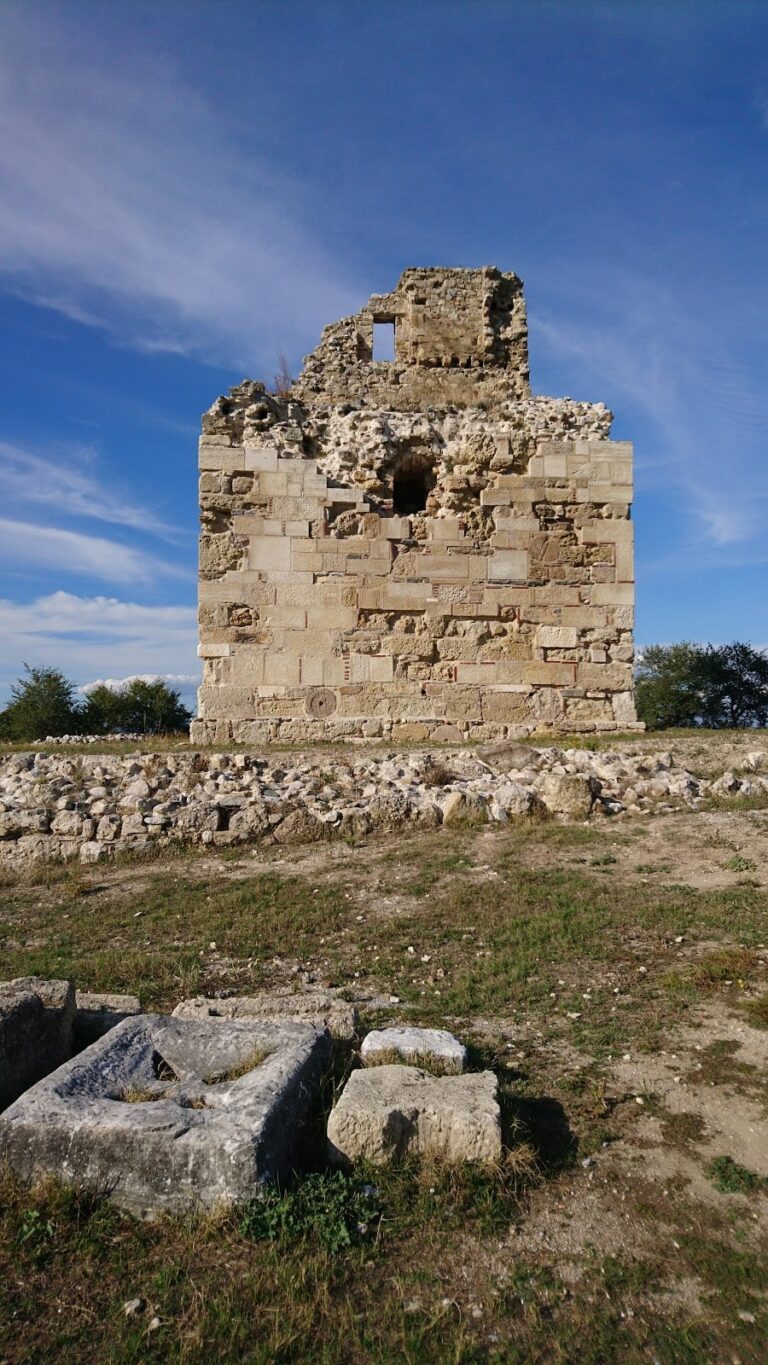
Rentina Castle occupies a hill beside the Rentina River, at the entrance to the Rentina Gorge. Its defenses consisted of an elevated citadel and an outer enclosure covering the southwestern part of the hill, later expanded and altered as the fortress changed function. The surviving archaeological remains include walls, towers, gates, reservoirs, churches, domestic buildings, workshops, burial areas, and traces of earlier occupation.
Citadel, walls, and water systems
Early fortifications
The earliest fortification had a roughly pentagonal citadel and an enceinte, or fortified enclosure, around the southwestern part of the hill. A main gate opened on the western side, while a secondary gate stood on the southern side. A narrow wicket gate was located near the western entrance. Two small underground cisterns supplied water to the defensive garrison. One lay at the base of a tower near the northwestern corner of the wall, and the other was inside the citadel.
Justinianic additions
The original defenses were renewed at least four times. In the Justinianic phase, the walls were raised, a semicircular tower was built at the southern end, and a large reservoir was constructed on the acropolis plateau. The reservoir formed part of the fortress’s water system and supported its use as a defended position controlling the route through the gorge.
Tenth-century enclosure
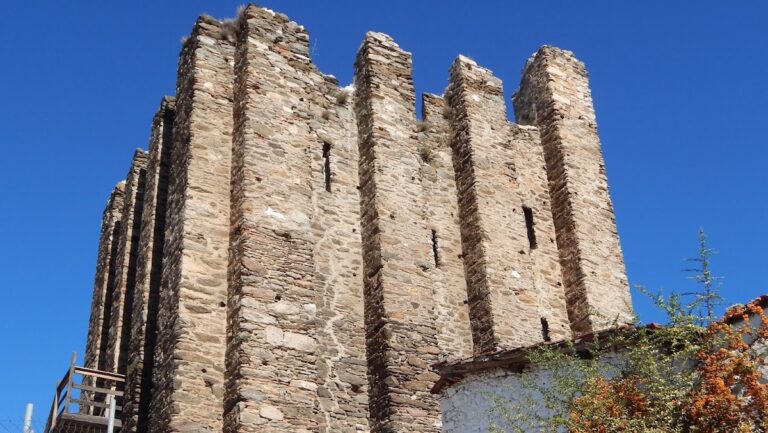
The tenth-century rebuilding strengthened the acropolis and Lower Town walls with rectangular towers at corners and vulnerable points. A triangular eastern wall followed the edge of steep cliffs and enclosed part of the hill. This area served as a place where inhabitants could gather their herds during a siege. The wall’s core was made with overlapping wooden frames set between earth embankments, and carbon-14 analysis dates the timber to around 980.
A partly underground covered passage ran from the base of a tower to an underground cistern. The cistern had a double vestibule covered by domes built from the exterior and collected water from a nearby stream. A concealed stairway connected the citadel tower with the underground reservoirs, providing both access to the water system and a secret escape route.
Later defensive changes
The eastern tower stood on exceptionally steep ground and was abandoned in the twelfth century, together with the two branches of the eastern wall. The eastern side was later defended by two substantial walls descending from the rear of the citadel toward the foot of the hill. These walls were reinforced externally with an added facing, and the southern gate may then have been removed for security.
After 1204, the Latin occupants repaired the northern rectangular tower and the northern outer wall of the citadel. Probably after Vatatzes captured the fortress in 1242, a new citadel was built on the eastern side, where the two strong double walls from the earlier eastern enclosure converged. Nine defensive towers have been identified across the fortress.
Churches and settlement buildings
Episcopal basilica
The tenth-century episcopal basilica formed part of the settlement’s religious and administrative development after the bishopric moved to Rentina. It was built over an earlier cistern, and fragments of wall paintings survive within the excavated remains. Its position among the acropolis and Lower Town structures reflects the expansion of the fortified settlement during the tenth century.
Palaiologan church
At the eastern edge of the fortress stands the remains of a small domed church built during the first half of the fourteenth century. Its plan was cross-in-square, a Byzantine arrangement centered on a dome supported by four structural arms. The church had notable ceramic decoration and belongs to the Palaiologan phase of Rentina’s development.
Domestic and peripheral remains
Excavations have uncovered domestic buildings and workshops within the settlement, as well as a small church and cemetery outside the walls. An Early Christian bath and several funerary complexes add evidence for the range of activities conducted on and around the hill.
Archaeological finds and conservation
Earlier occupation and ancient material
Stratigraphic investigations, especially on the western side of the hill, produced Neolithic tools and other objects, Archaic figurines, and pottery from the Classical, Roman, and Early Christian periods. The finds include at least 2,000 Greek coins, at least 400 high-quality vessels, Greek inscriptions, and weapons. Some inscriptions were later reused as building material.
Byzantine objects
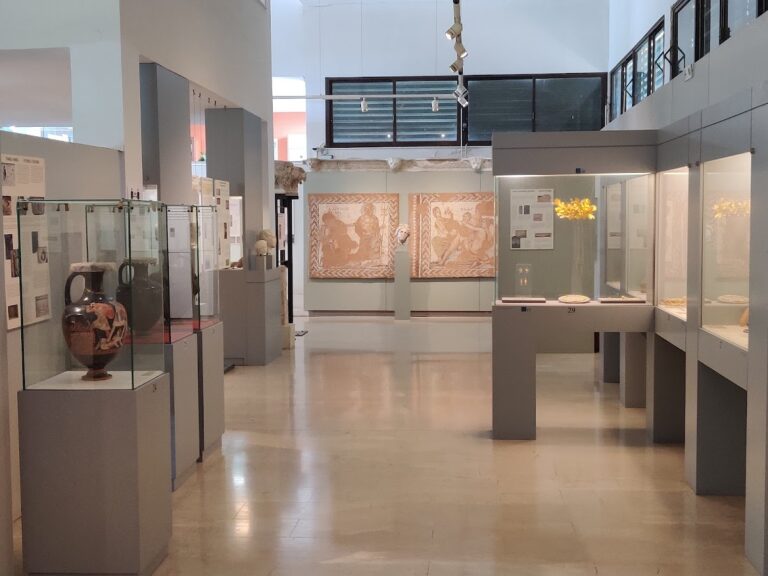
Byzantine discoveries include skyphoi, deep drinking cups with two horizontal handles, and pottery dating from the tenth to the fourteenth centuries. Silver necklaces and other gold and silver jewelry reveal aspects of life within the settlement. An eleventh-century chancel-screen element, a barrier separating a church sanctuary from its main body, was also found. Some objects from the castle are exhibited at the Museum of Byzantine Culture in Thessaloniki.
Recent physical repairs
Heavy rainfall in 2014 and 2015 damaged the castle. Water erosion affected twelve areas in the southwestern section, causing sections of walls built without binding mortar to slide. The damaged areas were subsequently repaired.
Nearby sites