Archaeological Museum of Patras


Visitor Information
Google Rating: 4.7
Popularity: Medium
Google Maps: View on Google Maps
Official Website: www.ampatron.gr
Country: Greece
Civilization: Greek, Roman
Remains: Museum

History
Patras is a city with a long history extending from prehistoric times through the Roman era. The Archaeological Museum of Patras was established to preserve and display artifacts from the region’s extensive past, reflecting the various civilizations that inhabited the area.
The earliest period represented in the museum’s collection dates back to the Mycenaean civilization, which flourished in the late Bronze Age. This era is known for its fortified palaces and rich burial customs, elements that are reflected in the museum’s reconstructed tombs and artifacts. The Mycenaean presence in the Patras region indicates early urban development and complex social structures.
Following the Mycenaean period, the area saw continuous occupation through the Ancient Greek era. During this time, Patras developed as a city with public and private buildings, religious cults, and commercial activities. The museum’s exhibits include items from this period that illustrate daily life, social organization, and religious practices.
The Hellenistic period brought further cultural and political changes after the conquests of Alexander the Great. Patras experienced growth and integration into wider Mediterranean networks. Artifacts from this time show evolving artistic styles and increased interaction with other regions.
Under Roman rule, Patras became an important city within the empire. The museum’s collection features numerous Roman mosaics, reconstructed residences, and tombs, highlighting the city’s urban character and the lifestyle of its inhabitants. The Roman period marks the final phase covered by the museum.
The museum itself was conceived in the late 20th century, with initial plans announced by Culture Minister Melina Mercouri. Construction began in 2004, aiming to open during Patras’ role as European Cultural Capital in 2006. However, the museum officially opened on July 24, 2009, providing a modern space to showcase the region’s archaeological heritage.
Remains
The Archaeological Museum of Patras occupies a large site with 8,000 square metres of interior space on a 28,000-square-metre plot. It houses a diverse collection of artifacts arranged in four thematic sections: Private Life, Public Life, Necropolis, and a rotating exhibition area.
The Private Life section features life-size reconstructions of Roman homes, built using original materials recovered from excavations. This area includes 14 Roman mosaics covering 250 square metres, most displayed vertically to allow detailed viewing. These mosaics illustrate domestic decoration and craftsmanship from the Roman period.
The Necropolis section contains three full-scale tomb reconstructions. Two are Mycenaean, reflecting burial customs from the late Bronze Age, and one is Roman. Each tomb includes skeletons and accompanying jewelry, providing insight into funerary practices and social status.
In the Public Life section, visitors find maps of Roman territories and exhibits related to commerce, social organization, religious cults, and entertainment in ancient Patras. These displays highlight the city’s role within the Roman world and its civic structures.
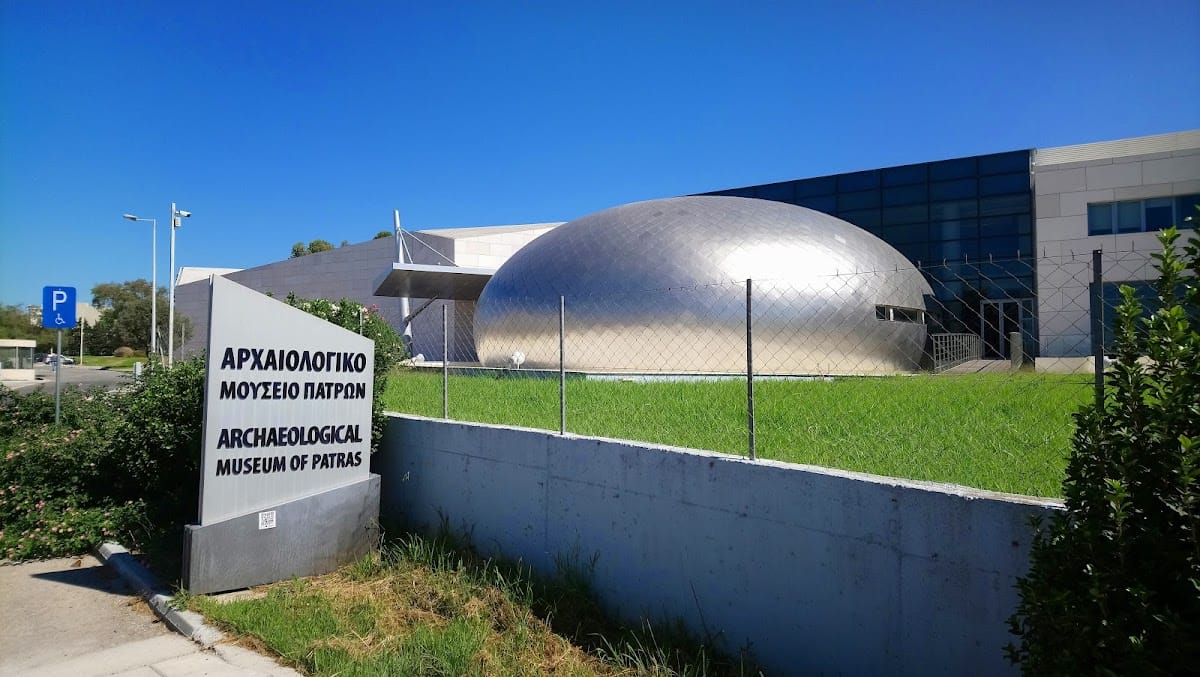
Surrounding the building is a 500-square-metre pool, a metallic dome, and landscaped greenery. Plans exist to develop an adjacent cultural park, complementing the museum’s role as a center for archaeological preservation and education.
Nearby sites