Archaeological Museum of Piraeus: A Collection of Ancient Greek Maritime and Civic Heritage

Site at a Glance
- Rating
- 4.6
- Popularity
- Medium
- Country
- Greece
- Primary era
- Classical
- External website
- Open
- Eras represented
- Bronze Age, Classical
- Civilizations
- Ancient Greek, Minoan, Mycenaean, Roman
- Site type
- Museum
On this page19 sections
History
The Archaeological Museum of Piraeus in Piraeus, Greece, presents the history of the ancient harbour city that served Athens as a naval base, commercial centre, and civic administration hub. Its collections span the Mycenaean era to the fourth century AD, covering approximately the eighteenth century BC through Roman times and drawing chiefly on discoveries from Piraeus, the Attic coast, nearby islands, and associated archaeological sites.
Foundation and early collections
The museum was founded in 1935 on land acquired beside the ancient Theatre of Zea. Its first collection was housed temporarily in a state secondary school. It included funerary monuments from the northern cemetery of ancient Piraeus, finds from excavations conducted by Ioannis Meletopoulos and Iakovos Dragatsis, and objects discovered accidentally during the construction of the modern city.
The older museum building erected in 1935 later became a sculpture repository. A modern extension was added in 1966, and the present two-storey building was inaugurated in 1981. From 1960 onward, the museum served as a principal repository for excavation finds from Piraeus, Salamis, Moschato, Kallithea, Glyfada, Voula, and Vari. Its holdings also expanded through private donations, including the Meletopoulos-Nomides Collection, the Geroulanos Collection, and the Nomides-Valsamakis Collection. In 2022, Ioannis Vasalas’s collection of 40 ancient Greek silver tetradrachms entered the museum.
Ancient Piraeus and the museum collections
The museum’s material reflects the varied functions of Piraeus within the world of ancient Athens. The harbour combined maritime defence, shipbuilding, trade, and civic administration. Objects from sanctuaries and settlements extend the collection beyond the city itself, including material from the sanctuary of Mounichia, the sanctuary of the Mother of the Gods at Moschato, the Minoan sanctuary on Kythera, and the Mycenaean sanctuary at Methana.
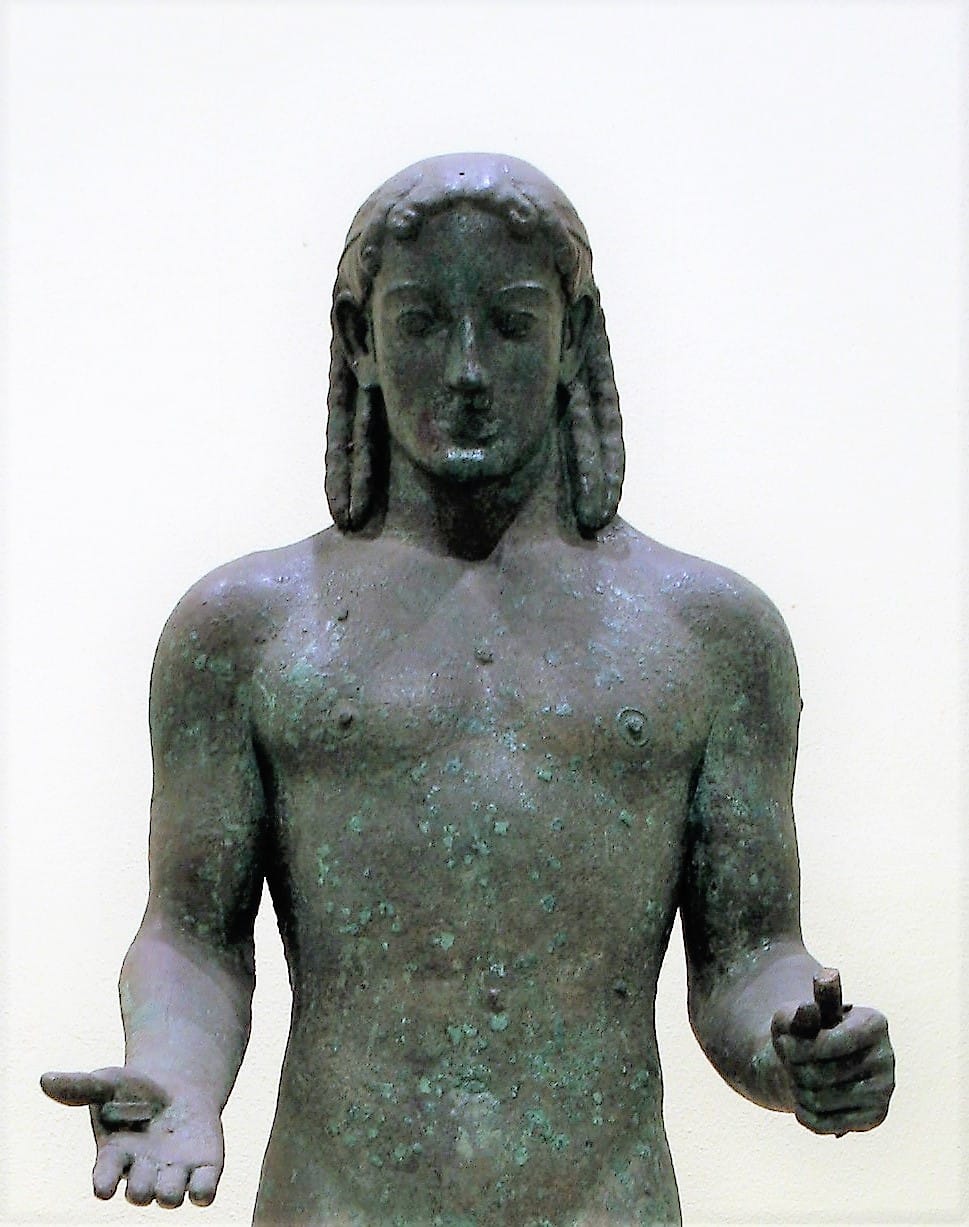
A particularly important group entered the museum after four bronze statues were found together in 1959 in a warehouse near the harbour. The group consists of the Piraeus Apollo, the Piraeus Athena, and two statues of Artemis. The warehouse had been burned during the Roman capture of Piraeus in 86 BC. The statues may have been awaiting export to Italy and may originally have come from Delos, an Aegean island that was an important religious and commercial centre in antiquity.
Modern development and interpretation
Renovation began in 1996, and the permanent exhibition was developed under the direction of Efthimios Mastrokostas, Olga Alexandri, and Vasileios Petrakos. It was later expanded under Georgios Steinhauer. The building was damaged by the earthquake of September 1999. Today, the displays are arranged thematically and chronologically in ten rooms, presenting Piraeus as a naval and commercial centre alongside prehistoric and later pottery, private life, religious practice, funerary monuments, the Piraeus bronzes, and Hellenistic and Roman sculpture.
The museum is administered by the Ephorate of Antiquities of Piraeus and the Islands, a regional Greek archaeological authority responsible for administering and protecting antiquities and archaeological sites. Its activities include conservation, education, lectures, cultural programs, and the study of material from Piraeus, the Attic coast, the Saronic Gulf islands, and Kythera.
Remains
Building and archaeological setting
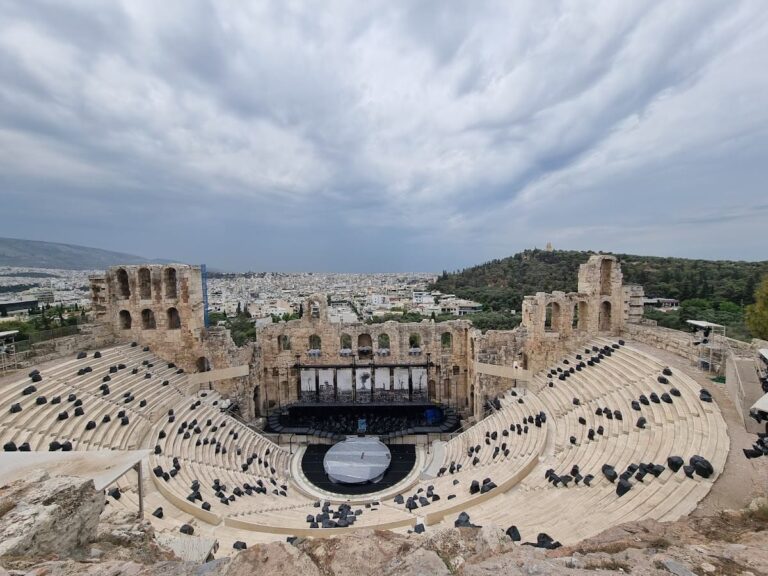
The museum occupies a two-storey building adjoining and framing the ancient Theatre of Zea along its western and southern sides. The building covers 1,394 square metres, including 1,044 square metres of exhibition space in ten rooms. A 350-square-metre basement contains conservation laboratories and the museum repository. The neighbouring older building, covering 330 square metres, functions as a sculpture store.
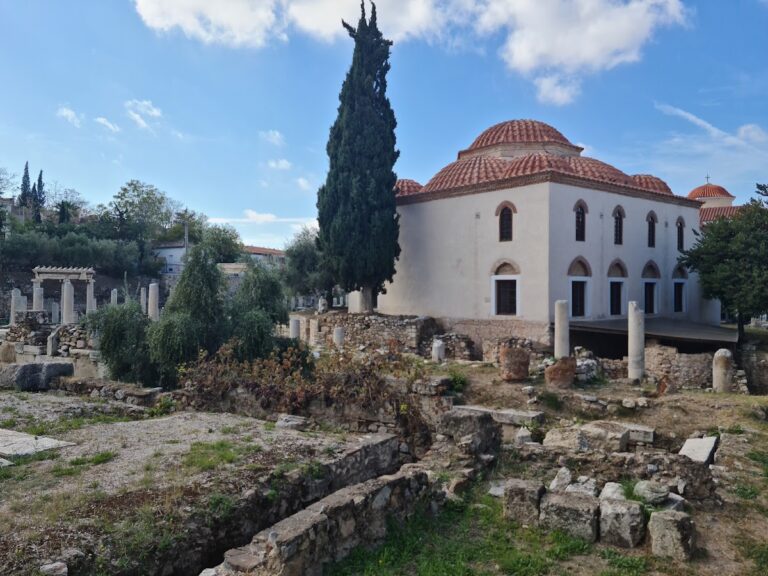
The archaeological area beside the theatre forms part of the museum complex. It includes an open-air presentation of funerary stelae, or carved grave markers, and other objects, together with an open-air sculpture exhibition that has been developed or planned beside the ancient theatre. The arrangement connects the museum’s sculpture holdings with the archaeological setting of the Theatre of Zea.
Harbour, pottery, and religious displays
Naval and commercial material
The entrance display reconstructs ancient Piraeus as both a naval base and a market centre. Commercial administration is represented by a metrological relief from Salamis, a measure for liquids, and a market-control list. In an ancient agora, the public marketplace and civic centre, agoranomoi supervised order and commercial activity, while metronomoi maintained official weights and measures used to check those of traders. Naval warfare is represented by a bronze ram from a trireme, the bronze or metal projection used at the bow of an ancient warship, a marble eye from a trireme, and a stone anchor found in the harbour of Zea.
Pottery and everyday life
The pottery section follows ceramic production from the Mycenaean period through the Hellenistic period by presenting a selected group of vessels. Objects connected with the daily lives of children, women, and men date from the Archaic to the Hellenistic periods, giving the collection a domestic dimension alongside its naval, commercial, and religious material.
Religious objects and sanctuaries
The religious-life section includes a reconstruction of a typical Classical sanctuary and a shrine-like structure containing a cult statue of Cybele, an Anatolian mother goddess whose worship spread through the Greek and Roman worlds. Other objects are associated with the Archaic temple of Zeus on Mount Parnes, the temple of Artemis at Mounichia, and a Minoan sanctuary on the summit of Kythera. Figurines from the Kythera sanctuary and finds from the Mycenaean sanctuary at Methana extend the religious collection across different periods and regions.
Funerary monuments
Classical funerary sculpture
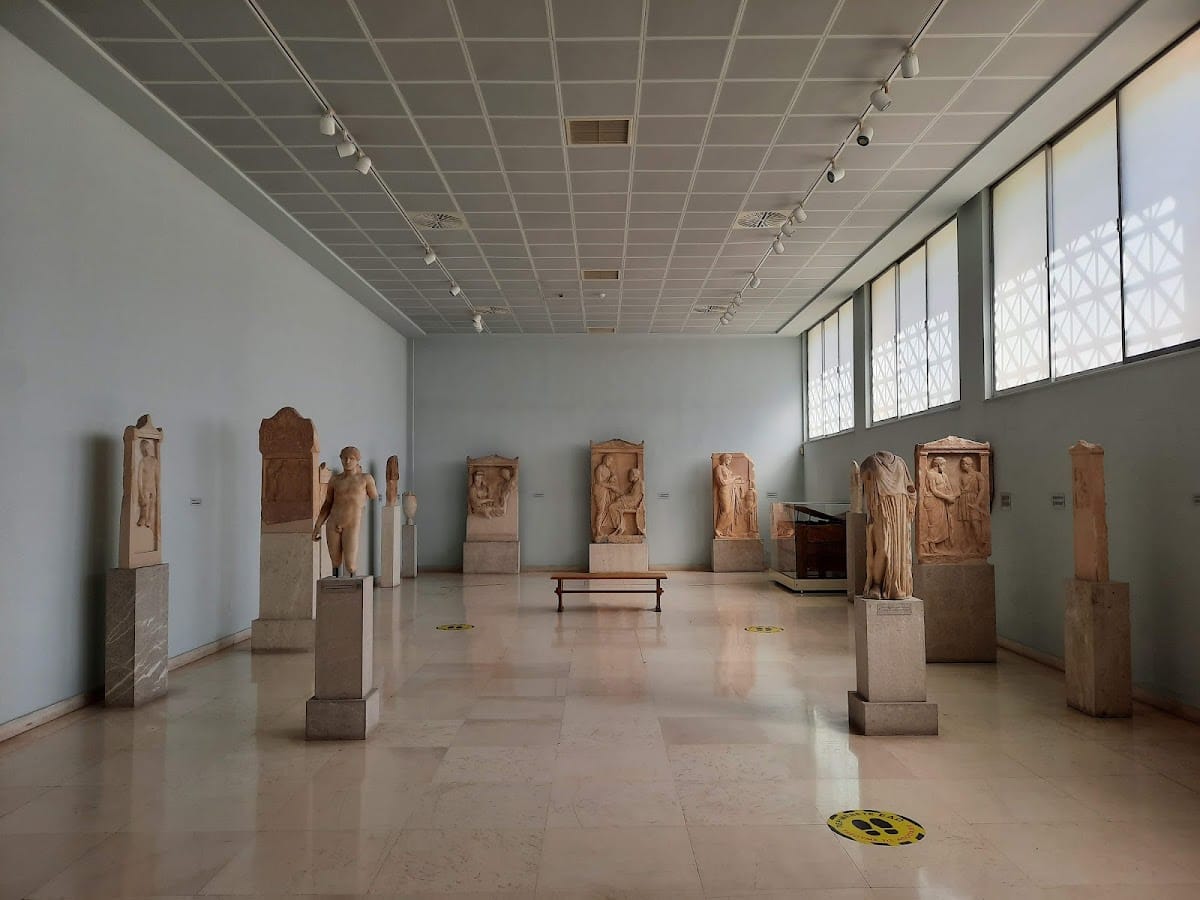
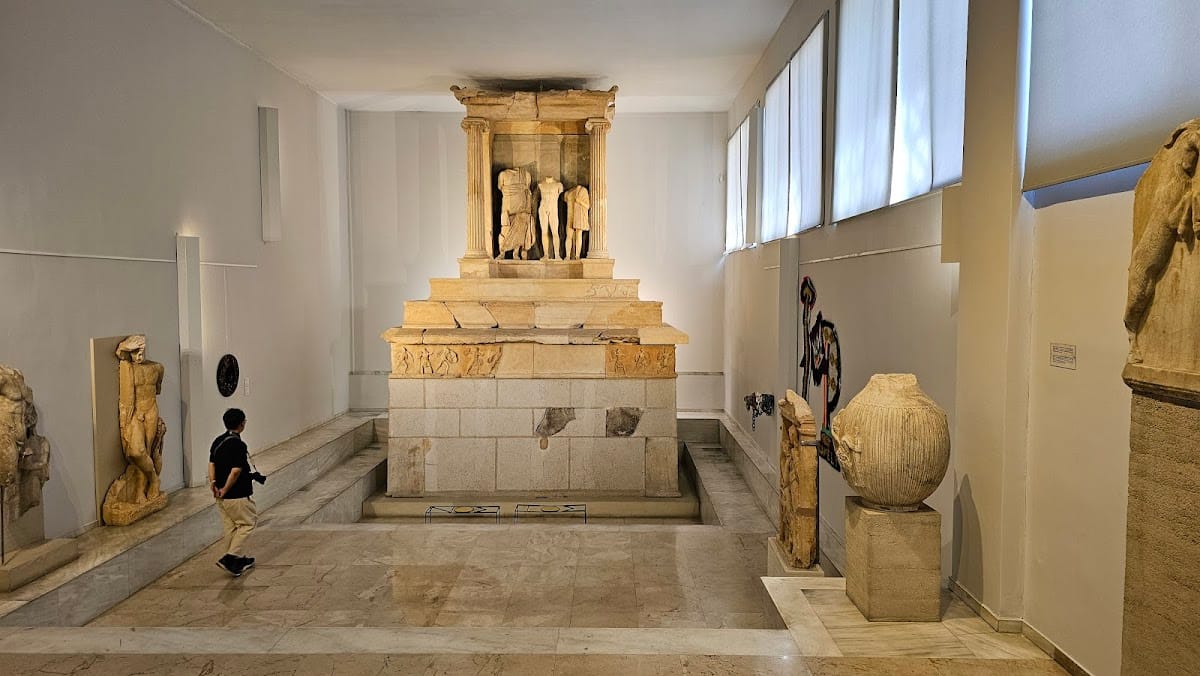
The museum preserves a major group of funerary reliefs and monuments from Piraeus and its northern cemetery. Together they illustrate changing attitudes toward death and developments in Classical art from the fifth to the fourth century BC. The funerary monument of Nikeratos and his son Polyxenos was made by sculptors from Istros on the Black Sea coast and dates to 330 BC.
Other works include a stela showing relatives mourning a woman who died in childbirth while holding her newborn child. A funerary naiskos, a small shrine-like structure, commemorates Aktaios and his wife. It includes a servant holding a pyxis, a small lidded container, and dates from the first half of the fourth century BC.
Theatre-side funerary display
One of the two lions that flanked the tomb of Peithonikos is included in the funerary material displayed beside the theatre. The monument dates to the end of the fourth century BC, placing the sculpture within the period of the museum’s broader presentation of Classical funerary art.
The Piraeus bronze statues
Piraeus Apollo
The Piraeus Apollo is a 1.92-metre bronze kouros, the Archaic Greek type representing a standing youthful male. Some interpretations date it to approximately 520 BC, while Claude Rolley regarded it as a second-quarter fifth-century BC imitation of a statue from the third quarter of the sixth century BC. It was made by indirect lost-wax casting, a process that uses a reusable mould to form a wax model before molten metal replaces the wax and creates a hollow statue. The figure retains traces of objects once held in its hands and is largely intact, with limited corrosion and several cracks on the left leg.
Piraeus Athena
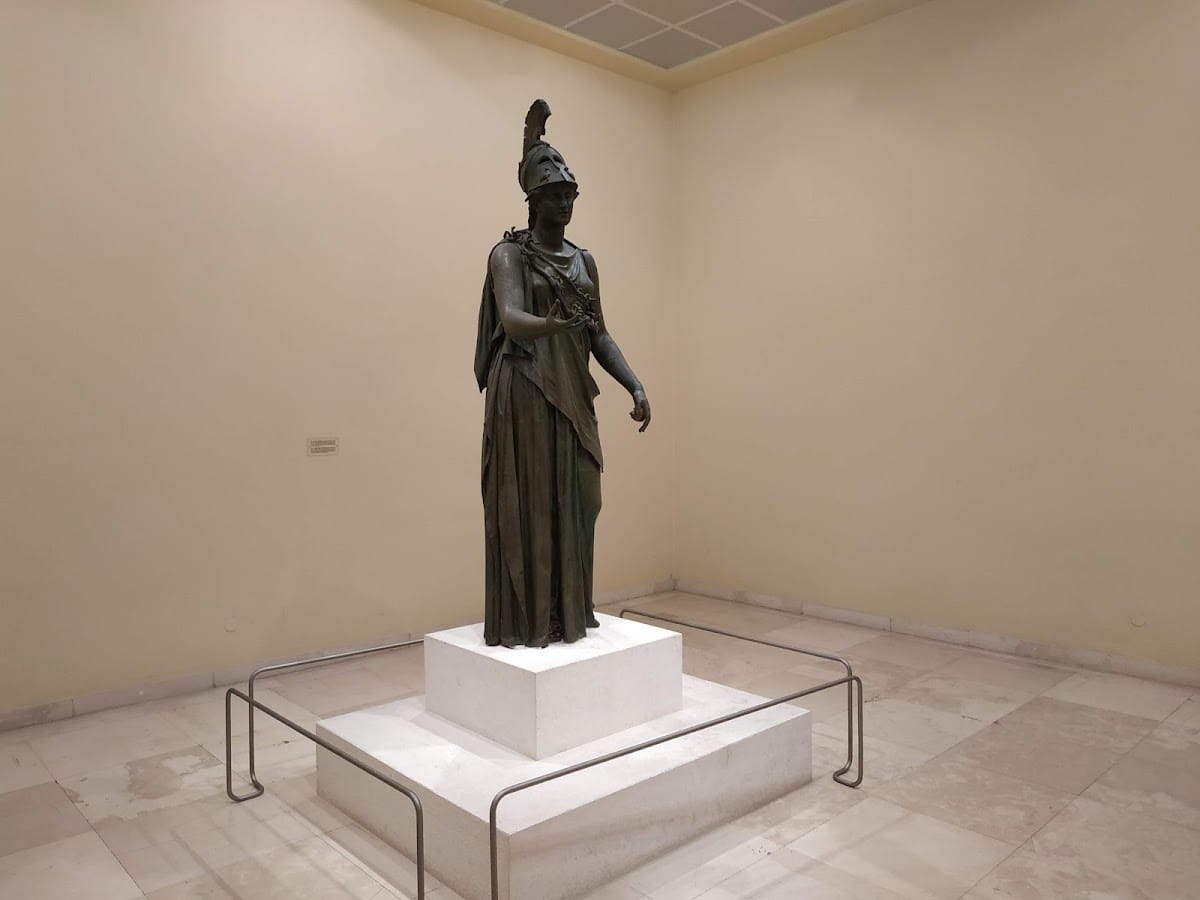
The Piraeus Athena stands 2.35 metres high and was probably a cult image. It is dated approximately to 360 to 340 BC and survives nearly complete and almost intact, although its attributes and part of the left foot are missing. The statue has slight surface corrosion. Athena wears a peplos, a draped Greek garment made from one piece of cloth, and a narrow serpent-decorated aegis, a protective divine covering, with the head of Medusa.
Attachment marks show that the left hand supported a shield and that the right probably held a spear, perhaps with an owl. The raised helmet has a visor decorated with two owls and griffins on either side of the crest, while the irises are inlaid. The statue has been associated with the sculptor Euphranor because of its similarity to the Apollo Patroos, a cult image of Apollo as a paternal or ancestral protector. It may instead be a Hellenistic copy of a fourth-century BC original. Like the Apollo, it was cast by the indirect lost-wax method.
Artemis A
Artemis A, the larger of the two Artemis statues, is 1.94 metres high and has a Hellenistic character. It dates to the middle of the fourth century BC. The statue has sometimes been attributed to Euphranor and is also identified in a museum caption as a work by Praxiteles. Its separately cast sandal straps are missing.
The statue has copper lips, white marble teeth, and bronze eyelashes surrounding eyes with marble and chestnut-wood irises. Its hair is arranged in segmented sections that rise into a crown, a style often described as melon-shaped. A small piece of clay remains in the left hand, where it supported a bow. The quiver is missing, but its attachment points survive on the back.
Artemis B
Artemis B is a smaller bronze figure, 1.55 metres high, dating from the late fourth or early third century BC. It is the least well-preserved of the four Piraeus bronzes, with extensively broken, cracked, and oxidized metal and severe damage to one side of the face. Its quiver survives, as does its elaborate braided hairstyle gathered into a topknot. The pose resembles that of Artemis A, while the style is described as more distinctly associated with Praxiteles.
Hellenistic and Roman sculpture
Hellenistic sculpture is represented by a small number of highly refined works distinguished by grace and delicacy. Roman-period sculpture is displayed separately. The wider sculpture holdings include bronze and marble statues, statuettes, votive and funerary reliefs, ornaments, musical instruments, vessels, and other small objects. Together with the funerary material, these works extend the museum’s physical record from Piraeus and its northern cemetery to the Attic coast as far as Varkiza, the Saronic Gulf islands, and Kythera.