Herdonia: An Ancient Daunian and Roman Municipium in Apulia, Italy
Table of Contents
Visitor Information
Google Rating: 4
Popularity: Low
Google Maps: View on Google Maps
Country: Italy
Civilization: Roman
Remains: City, Civic, Economic, Entertainment, Infrastructure, Military, Religious, Sanitation
Context
Herdonia is situated in the Contrada Cavallerizza area near the modern town of Ordona, within the Apulia region of southeastern Italy. The site occupies a prominent hilltop overlooking the expansive Tavoliere delle Puglie plain, a fertile agricultural zone that has long supported human settlement. This elevated position provided natural defensive advantages and strategic oversight of the surrounding landscape, including river valleys and routes linking the Adriatic coast to the interior of Apulia. Such geographic features positioned Herdonia as a key node within regional communication and trade networks.
Archaeological data indicate that Herdonia’s earliest occupation dates to the Iron Age, associated with the Daunian people, an ancient Italic group indigenous to this part of Apulia. The settlement later evolved into a Roman municipium following the Second Punic War, reflecting its integration into the Roman provincial system. The site’s history includes a notable episode of destruction during the Second Punic War, specifically in 212 BCE, when Hannibal’s forces sacked the city. Although the city was rebuilt and flourished during the Roman Imperial period, it experienced decline in Late Antiquity and was ultimately abandoned by the late Middle Ages. Excavations initiated in the 20th century have uncovered substantial remains, though preservation varies due to agricultural activity and natural sedimentation.
Herdonia’s location within a landscape shaped by both natural topography and human infrastructure underscores its historical significance as a fortified settlement controlling vital routes and fertile lands in southeastern Italy.
History
Herdonia’s historical trajectory exemplifies the shifting political and military landscape of southeastern Italy from the Iron Age through Late Antiquity. Founded by the Daunian people, the site occupied a strategic hilltop that controlled important inland and coastal routes in Apulia. Its fortunes were closely linked to regional conflicts, particularly during the Second Punic War, when it became a contested military site. Under Roman rule, Herdonia developed as a municipium with characteristic urban features. The city declined in Late Antiquity and was abandoned by the late medieval period, with archaeological evidence documenting phases of destruction and intermittent occupation.
Daunian Foundation and Pre-Roman Period (4th–3rd century BCE)
Herdonia originated as a Daunian settlement during the Iron Age, inhabited by an Italic people native to Apulia. The city was established on a hill southwest of present-day Ordona, a location that allowed control over key communication and trade routes traversing the region. Archaeological evidence confirms continuous occupation throughout the 4th and 3rd centuries BCE, during which Herdonia maintained its Daunian cultural identity while experiencing increasing influence from Greek colonists and neighboring Italic groups. The settlement functioned primarily as a fortified tribal center without formalized civic institutions, reflecting the social and political organization of the Daunian communities.
Greek and Roman Republican Period (3rd century BCE)
In the 3rd century BCE, Herdonia came under Greek influence before its incorporation into the Roman sphere amid Rome’s expansion in southern Italy. The city’s strategic position gained particular significance during the Second Punic War (218–201 BCE), a conflict that dramatically altered control over Apulia. Following Rome’s defeat at the Battle of Cannae in 216 BCE, Herdonia shifted its allegiance away from Rome. In 212 BCE, the site was the location of the First Battle of Herdonia, where Hannibal’s Carthaginian forces decisively defeated the Roman army commanded by Praetor Gnaeus Fulvius Flaccus. This defeat effectively eliminated Roman military presence in Apulia for a period, as documented by ancient historians such as Livy.
Herdonia’s importance during this period was further underscored by its position on major Roman roads, including the Via Minucia (later reconstructed as the Via Traiana) and the Via Aurelia Aeclanensis (also known as Via ad Herdoniam). These routes connected the Adriatic coast with inland Apulia, facilitating military logistics and commercial exchange, and establishing Herdonia as a transportation hub within the Roman road network.
Roman Imperial Period
After the conclusion of the Second Punic War, Herdonia was incorporated into the Roman state as a municipium, granting its inhabitants a degree of local self-government under Roman law. This status reflects the city’s integration into the provincial administration of Apulia and Calabria. Archaeological excavations have revealed extensive urban infrastructure dating primarily to the late Republican and Imperial periods, including defensive walls, two temples, a basilica, a forum, a market area, public baths, and a small amphitheater. These structures illustrate Herdonia’s development along typical Roman municipal lines, with designated spaces for civic administration, commerce, religious worship, and entertainment.
The forum functioned as the civic and commercial nucleus, flanked by two temples that attest to organized religious activity. The basilica and market area highlight Herdonia’s administrative and economic roles within the province. Public baths and the amphitheater indicate the presence of social and recreational facilities common in Roman towns. The city’s urban layout and architectural remains conform to Roman planning principles, emphasizing orderly public spaces and fortified boundaries.
Late Antiquity and Decline
During Late Antiquity, Herdonia underwent significant decline amid the broader political instability and transformations affecting the Italian peninsula. The city suffered destruction in the 7th century CE, which contributed to the disruption of its urban continuity. Archaeological evidence shows that some occupation persisted on the acropolis into the early Middle Ages, with medieval remains indicating limited reuse or habitation. However, by the 15th century, the site was definitively abandoned as resident families relocated to the nearby town of Ordona.
The precise causes of Herdonia’s decline remain a subject of scholarly debate, with hypotheses including warfare, economic contraction, and environmental factors. The city’s disappearance aligns with wider patterns of urban contraction in Apulia during the transition from antiquity to the medieval period.
Archaeological Rediscovery and Excavations (20th–21st century)
The archaeological site of Herdonia was rediscovered in the 20th century, with systematic excavations commencing in November 1962 under the direction of archaeologist Joseph Mertens. Over a thirty-year campaign, excavations uncovered approximately 20% of the ancient Roman settlement, revealing key urban features such as fortifications, temples, the forum, basilica, market, baths, and amphitheater. These findings have been instrumental in reconstructing the city’s historical development and urban character.
Excavations were interrupted around 2000 due to disputes over land ownership. Subsequently, the Italian Ministry of Culture acquired the site in two phases (2014 and 2022), facilitating plans for renewed archaeological investigations. Artifacts recovered from the site are exhibited in the Herdonia Archaeological Museum, contributing to scholarly and public understanding of the city’s significance. The archaeological area includes visible remains such as a Roman bridge over the ancient Carapelle riverbed, underscoring Herdonia’s role in regional infrastructure.
Daily Life and Importance by Period
Daunian Foundation and Pre-Roman Period (4th–3rd century BCE)
During its initial occupation, Herdonia was inhabited by the Daunian people, whose cultural practices shaped the settlement’s early character. The population was likely organized into kinship-based groups led by local elites who controlled agricultural lands and trade routes. Men primarily engaged in farming, hunting, and defense, while women managed domestic responsibilities. Housing consisted of simple stone or mudbrick structures with courtyards used for food preparation and storage.
The settlement’s elevated position enabled control over regional trade and communication. The economy was based on cereal cultivation and pastoralism, supplemented by artisanal crafts such as pottery and metalworking. Production was predominantly household-based, with limited evidence of specialized workshops. The diet comprised locally grown grains, olives, and fruits, alongside livestock products. Clothing likely included woolen tunics and cloaks, consistent with Italic traditions, though direct textile evidence is absent. Religious practices centered on indigenous Italic deities, with rituals conducted in open-air sanctuaries or simple shrines. Herdonia functioned as a fortified tribal center without formal civic institutions.
Greek and Roman Republican Period (3rd century BCE)
In the 3rd century BCE, Herdonia experienced increased Hellenic influence prior to its integration into the Roman sphere. Urbanization intensified, and the population became ethnically diverse, incorporating Daunian, Greek, and Italic elements. Social stratification emerged alongside the introduction of Roman political structures, as evidenced by inscriptions mentioning magistrates such as praetors.
Economic activities expanded beyond subsistence agriculture to include trade facilitated by Herdonia’s location on major Roman roads, notably the Via Minucia (later Via Traiana) and Via Aurelia Aeclanensis. Local markets likely offered olive oil, wine, ceramics, and textiles, with imports arriving via land routes. Occupations diversified to include merchants, artisans, and soldiers, reflecting the city’s strategic military importance during the Second Punic War.
Diet remained centered on cereals, olives, and wine, with archaeological evidence indicating consumption of fish and game. Clothing styles evolved to incorporate Roman fashions, including wool and linen tunics and cloaks. Domestic interiors began to feature mosaic floors and painted walls, reflecting Hellenistic and Roman aesthetic influences. Religious life became syncretic, combining local Italic cults with Greek and Roman deities, as suggested by the temples uncovered in later excavations. Herdonia’s civic role during this period was marked by its contested military significance, culminating in the Carthaginian victory in 212 BCE that temporarily disrupted Roman control.
Roman Imperial Period
Following its formal incorporation as a Roman municipium, Herdonia’s population included Roman settlers, local Italic descendants, and freedmen, organized into social strata ranging from elite landowners and magistrates to artisans, merchants, and slaves. Inscriptions attest to civic officials such as duumviri responsible for municipal governance.
The economy was characterized by intensified agriculture focusing on grain, olives, and vineyards, supported by small workshops producing pottery, textiles, and metal goods. The presence of a forum, basilica, market, and public baths indicates a diversified urban economy centered on commerce, administration, and social life. The amphitheater suggests organized public entertainment and communal gatherings.
Dietary remains confirm consumption of bread, olives, wine, and fish, with imported luxury foods likely accessible to the elite. Clothing adhered to Roman norms, including tunics, togas for male citizens, and stolas for women. Domestic architecture featured multi-room houses with courtyards, mosaic floors, and frescoed walls, reflecting Roman tastes and social differentiation.
Religious practices were institutionalized in two temples dedicated to Roman and possibly local deities, with rituals and festivals reinforcing civic identity. Although direct evidence of education and cultural life at Herdonia is limited, it likely paralleled other municipia in Apulia, encompassing basic literacy, public readings, and religious instruction. Herdonia’s status as a municipium underscored its integration into the Roman provincial system as a regional administrative, economic, and religious center.
Late Antiquity and Decline
In Late Antiquity, Herdonia experienced demographic decline and urban contraction amid regional instability. The population decreased, with archaeological evidence indicating occupation largely confined to the acropolis. Social complexity diminished, with fewer public officials and reduced economic specialization. Households likely became more self-sufficient, focusing on subsistence agriculture and localized crafts.
Economic activity contracted, public buildings were abandoned, and livelihoods became ruralized. Dietary patterns shifted toward simpler foods dominated by cereals, legumes, and locally raised livestock. Clothing and domestic decoration became more modest, reflecting diminished wealth and altered social priorities.
Religious life adapted to the Christianization of the region, though direct evidence at Herdonia is limited. The 7th-century destruction and subsequent partial reuse of the site suggest intermittent habitation, possibly by small communities or monastic groups. Herdonia’s civic functions ceased, with no evidence of formal municipal governance. By the 15th century, the site was abandoned as inhabitants relocated to Ordona, ending its historical continuity.
Archaeological Rediscovery and Excavations (20th–21st century)
Modern archaeological investigations have revealed significant information about Herdonia’s urban fabric and social organization. Excavations have uncovered fortifications, religious buildings, and public spaces that illuminate the city’s civic and economic functions. Artifacts such as pottery, coins, and inscriptions provide insights into material culture, trade connections, and administrative structures. These findings enable a reconstruction of Herdonia’s evolution from a Daunian tribal center to a Roman municipium and its eventual decline in Late Antiquity.
Remains
Architectural Features
Herdonia’s ancient settlement is located on a hill southwest of modern Ordona and is enclosed by city walls dating to the 1st century BCE. Constructed primarily of local stone masonry, these fortifications define the urban perimeter and include rectangular towers and gates, though only fragments survive above ground. The city’s layout centers on a forum complex surrounded by civic, religious, and commercial buildings. Most excavated structures date from the late Republican through Imperial periods, reflecting phases of construction and reconstruction following the Second Punic War.
The architectural remains predominantly represent public and religious functions, with residential and industrial areas remaining largely unexcavated or insufficiently documented. After Late Antiquity, the city’s extent contracted, with medieval occupation limited to the acropolis. Preservation varies across the site, with some buildings protected by sediment burial and others exposed to agricultural disturbance.
Key Buildings and Structures
City Walls
The city walls, constructed in the 1st century BCE, enclosed Herdonia atop the hill. Built of ashlar and rubble masonry, the walls incorporate rectangular towers at intervals and controlled access through several gates. Surface traces of these fortifications remain visible in the surrounding fields, marking the ancient urban boundary.
Forum
The forum, dating to the 1st century BCE, constitutes the central civic space of Herdonia. Excavations have revealed a rectangular open area flanked on its eastern side by two temples. These temples, also from the 1st century BCE, rest on stone podiums and include cellae (inner chambers). The forum is bordered by the basilica and market buildings, forming a complex of interconnected public spaces. Its layout reflects Roman urban planning principles, emphasizing administrative and religious functions.
Temples
Two temples adjacent to the forum date from the late 1st century BCE. Both rest on raised podiums and feature cellae and pronaoi (porches). Excavations have uncovered foundations and partial wall remains constructed in local stone with mortar. No inscriptions or decorative elements conclusively identify the deities worshipped, but these temples represent the principal religious structures within the urban core.
Basilica
The basilica, built in the 1st century BCE near the forum, functioned as a civic building. Its remains include stone foundations and partial walls outlining a rectangular hall. Although details of the interior layout are fragmentary, the basilica likely contained a nave and aisles. Some ruins remain visible on site, indicating the building’s substantial size and central role within the city’s administrative district.
Market
The market area, situated adjacent to the forum and basilica, dates to the 1st century BCE and has been partially excavated. Ruins include stone foundations and wall fragments outlining spaces for commercial activity. The market formed Herdonia’s economic center, with structures arranged around courtyards and access routes connecting to the forum.
Public Baths (Thermae)
A complex of public baths was constructed in the 1st century CE within the city walls. Excavations have revealed remains of heated rooms, including a caldarium (hot bath) and frigidarium (cold bath), equipped with hypocaust systems for underfloor heating. The baths were built using stone and brick, with surviving wall sections and floor mosaics. These facilities provided sanitation and social spaces for the inhabitants.
Small Amphitheatre
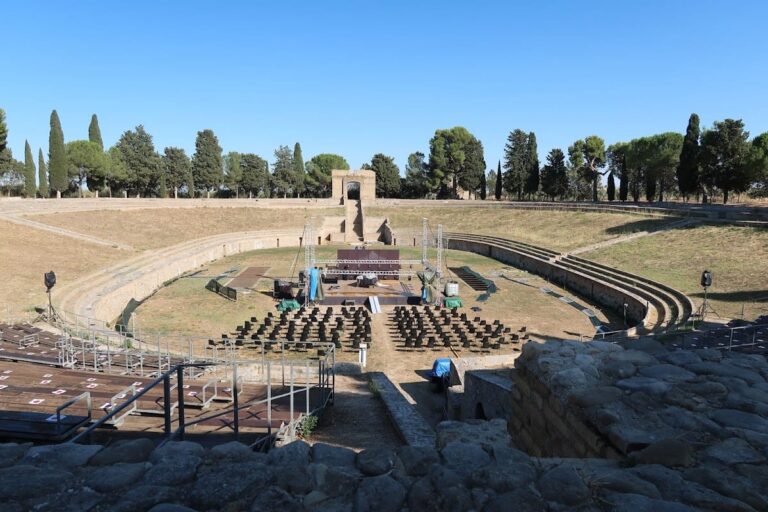
A modest amphitheatre dating to the 1st or 2nd century CE lies within the city walls. Its remains include partial seating tiers and the arena outline. The structure likely hosted local entertainment events. Surface traces of the amphitheatre are visible in the surrounding fields, though detailed architectural features and seating capacity remain incompletely documented.
Acropolis
The acropolis, located near the modern railway line, contains remains of medieval constructions dating from the early Middle Ages. These include stone foundations and wall fragments indicating limited reuse of the site after the city’s decline. From the acropolis, ruins of a Roman bridge crossing the ancient Carapelle riverbed are visible, linking the elevated area to the surrounding terrain.
Roman Bridge
Ruins of a Roman bridge span the ancient Carapelle riverbed near Herdonia’s acropolis. Constructed in the 1st century BCE, the bridge formed part of the infrastructure connecting the city to regional roads. Stone piers and partial arches survive, illustrating Roman engineering techniques used to facilitate transport across the river valley.
Roads
Herdonia was intersected by the Via Minucia, which was rebuilt and renamed the Via Traiana in the early 2nd century CE. The city also connected to the Via Appia via the Via Aurelia Aeclanensis, also known as Via ad Herdoniam. These roads formed a network linking Herdonia to the Adriatic coast and inland Apulia. Archaeological surveys have identified road traces and alignments near the site, confirming its role as a transportation hub.
Other Remains
Additional surface traces include fragments of the city walls and the small amphitheatre visible in cultivated fields. Some medieval ruins are present on the acropolis, reflecting post-Roman occupation. The site also contains remains of other unexcavated or partially excavated structures, including possible domestic and economic buildings, though these have not been systematically studied.
Archaeological Discoveries
Excavations at Herdonia have yielded a range of artifacts spanning from the Iron Age through Late Antiquity. Pottery assemblages include locally produced Daunian ceramics from the pre-Roman period and Roman tableware and amphorae from the Republican and Imperial eras. These ceramics were recovered from domestic contexts, refuse deposits, and public building layers.
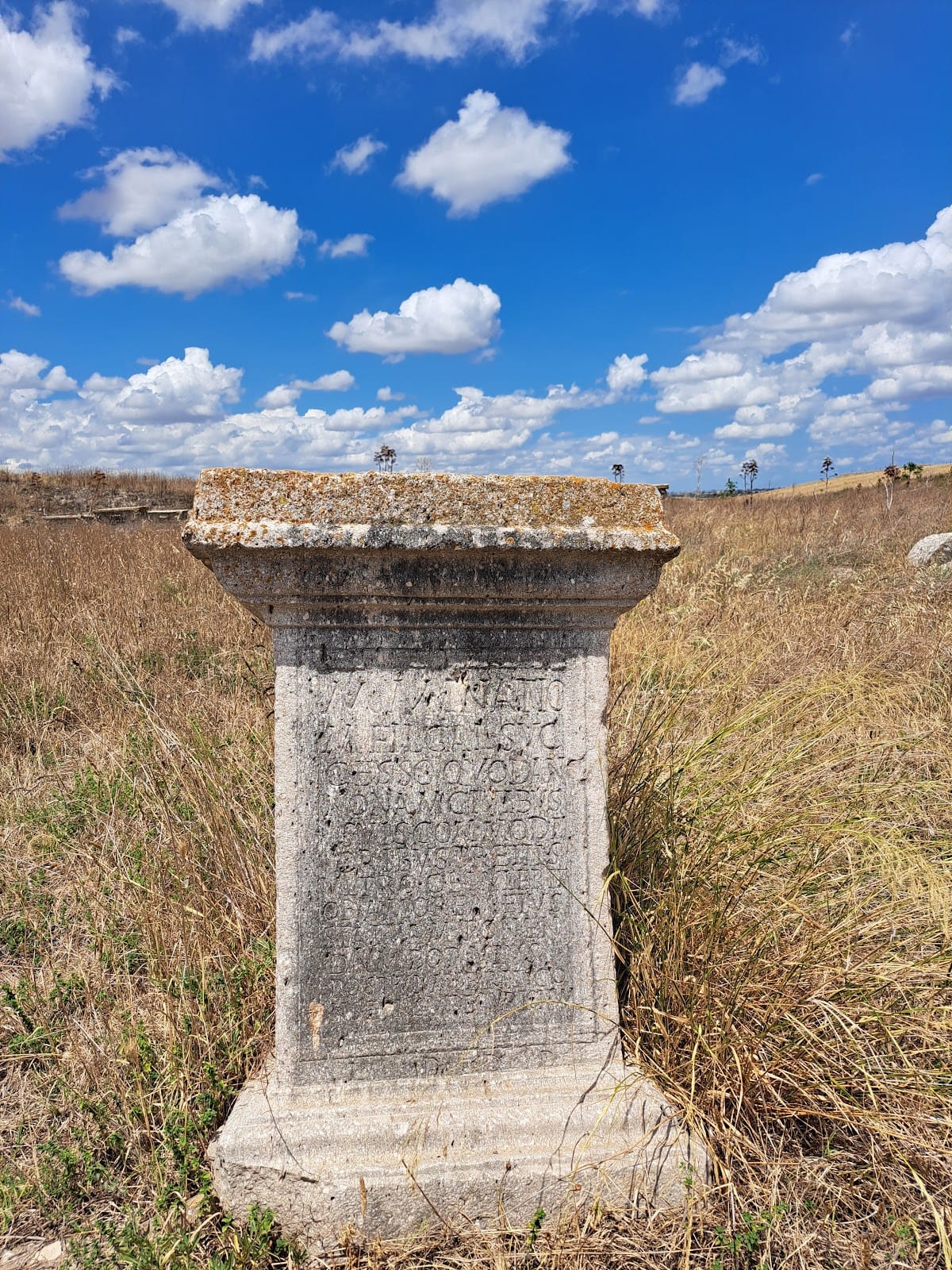
Inscriptions found at the site are primarily dedicatory and funerary, dating to the 1st and 2nd centuries CE. They provide names of local magistrates and religious dedications, confirming Herdonia’s civic status as a municipium. Coins recovered span from the late Republic through the 4th century CE, including issues from Julius Caesar, Augustus, and later emperors, indicating sustained economic activity.
Tools and domestic objects such as lamps, cooking vessels, and agricultural implements have been found in residential areas and workshops. Religious artifacts include small statuettes and altars associated with the temples near the forum. Collectively, these finds illustrate aspects of daily life, economic production, and religious practice within the city.
Preservation and Current Status
The preservation of Herdonia’s ruins varies across the site. The city walls survive in fragmentary form, with some sections stabilized but largely collapsed. The forum, temples, basilica, and market buildings retain foundational remains and partial walls, though above-ground structures are mostly lost. The public baths preserve some hypocaust systems and wall segments, while the amphitheatre is visible only as surface traces and partial seating remains.
Medieval constructions on the acropolis survive as low stone walls and foundations. The Roman bridge over the Carapelle riverbed remains in ruinous condition, with piers and arches partially intact. Agricultural activity has damaged some areas, while others benefit from burial under sediment, aiding preservation. Conservation efforts by the Italian Ministry of Culture have focused on site stabilization and protection, with ongoing excavation campaigns planned following recent land acquisitions.
Unexcavated Areas
Approximately 80% of Herdonia’s ancient urban area remains unexcavated. Large portions of residential quarters, workshops, and peripheral districts are known only from surface surveys and geophysical studies. Some areas are inaccessible due to modern land use or ownership disputes, limiting archaeological investigation.
Future excavation plans aim to explore these unstudied sectors, contingent on funding and conservation policies. The site’s complex stratigraphy and partial preservation require careful management to balance research with protection. No extensive excavation of necropolises or burial grounds has been reported, though such features may exist beyond the current urban perimeter.