Concordia Sagittaria: Roman Colony and Early Christian Episcopal Centre in Italy


Site at a Glance
- Rating
- 4.5
- Popularity
- Very Low
- Country
- Italy
- Primary era
- Classical
- Eras represented
- Classical
- Civilizations
- Roman
- Site type
- City
On this page18 sections
History
Concordia Sagittaria in Italy is the Roman colony of Iulia Concordia, founded in 42 BC at the intersection of the Via Annia and Via Postumia. The settlement belonged to Regio X Venetia et Histria, the Roman administrative region covering northeastern Italy, and developed within the road network that connected the northern Adriatic territories.
Roman foundation and late imperial military role
The colony’s position at two major Roman roads shaped its urban development. Its later name, Sagittaria, refers to a substantial weapons factory established in the early fourth century AD. The factory was particularly associated with arrow production and appears in the Notitia Dignitatum, a late Roman administrative register listing imperial offices and military establishments. The presence of Roman troops and a decorated dagger discovered near the Roman bridge during nineteenth-century investigations also reflect Concordia’s military importance in the later Roman period.
Christian centre and destruction
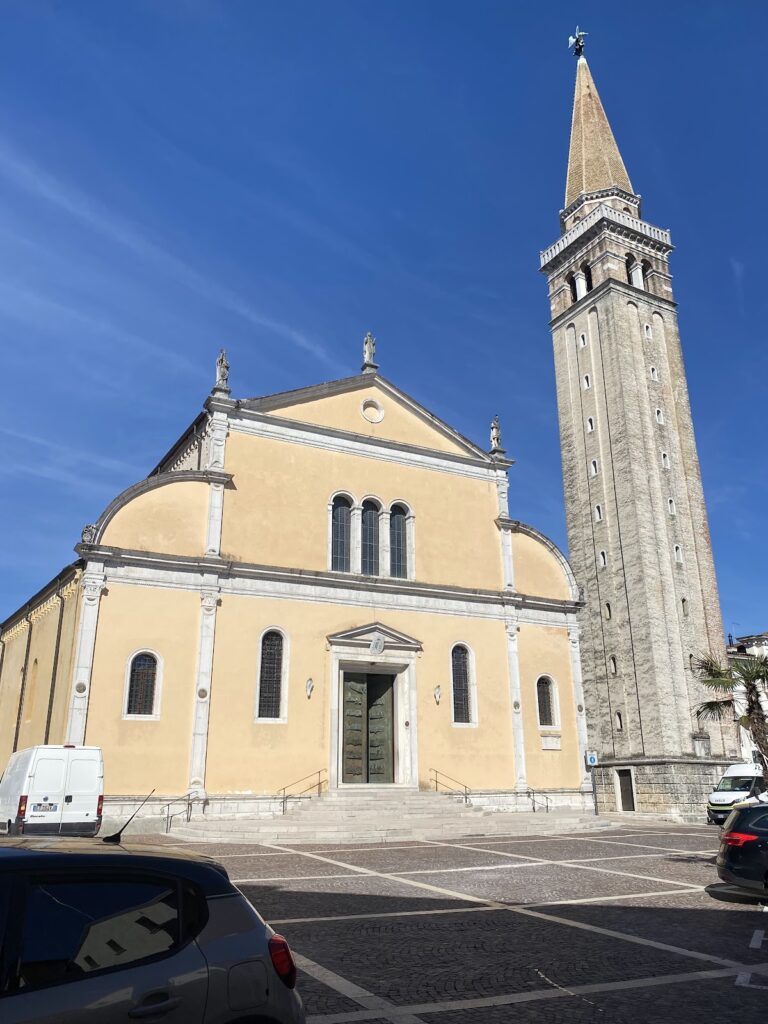
Concordia became a Christian episcopal seat around the end of the fourth century, with the diocese dated to approximately 380. Its early Christian complex developed around a trichora martyrum, a three-lobed memorial structure associated with martyrs or their veneration, built around 350. The Basilica Apostolorum followed in 389, while a cemetery with sarcophagi was established beside the memorial.
Attila, the fifth-century ruler of the Huns, took and destroyed the city in 452 during the late Roman period. Urban life was later restored in connection with Concordia’s continuing role as a bishopric. The settlement retained the historic dignity of a cathedral see, although the bishops moved their residence to Portogruaro in 1586 and later to Pordenone in 1974.
Medieval and modern political history
After the decline of the Western Roman Empire, Concordia came under the Lombard duchy of Cividale. It later formed part of the March of Friuli and then belonged to the Patriarchate of Aquileia, a major medieval ecclesiastical principality and church jurisdiction governing Friuli and nearby territories. In 1420, Concordia was annexed with Friuli by the Republic of Venice. In 1838 it was separated from Friuli and incorporated into the province of Venice.
Archaeological interpretation
Research has revealed the extent and variety of the ancient settlement, including warehouses, houses, baths, wells, roads, fortifications, and other urban remains. The remains beneath the cathedral form one part of a continuous archaeological route through the historic centre, connecting evidence from the Roman bridge, theatre, private houses, public baths, city walls, and early Christian basilica.
The cathedral archaeological area is managed within the state cultural-heritage system. Its entrance hall explains the ancient territory, the development of the basilica area, and the importance of the Via Annia. A permanent exhibition in the municipal palace presents recent discoveries and evidence for the daily life of Concordia’s ancient inhabitants.
Remains
The surviving remains extend through several parts of the historic centre. Beneath the cathedral, a section of the urban Via Annia lies beside Roman warehouses and the early Christian complex. Further archaeological areas preserve streets, gates, domestic buildings, a theatre, baths, city walls, wells, and the bridge through which the road entered the ancient city.
Cathedral archaeological area
Via Annia and Roman warehouses
Beneath the cathedral is a paved section of the Via Annia, a Roman road that entered the city and continued along its principal east-west urban axis. Within Concordia this route corresponded to the Decumanus Maximus, while the Forum stood alongside it. The Forum remains are no longer visible, but the road survives beside extra-urban warehouses dating from the first centuries of the Roman Empire.
Basilica Apostolorum
The Basilica Apostolorum was a three-aisled early Christian church built in 389. Its surviving floor includes a mosaic pavement with geometric designs, and the basilica retains a raised presbyterial bench, the area associated with the clergy and liturgical leadership. In front of the church was a large quadriporticus, a four-sided colonnaded court, with a central well.
Trichora martyrum and episcopium
Beside the basilica stands the trichora martyrum, an early Christian memorial structure with three apses or lobes, dated to approximately 350. A burial area containing sarcophagi lay beside it. The remains of an episcopium, the residence or administrative complex of a bishop, are also preserved next to the basilica.
Streets, gates, and public buildings
Eastern gate and northern gate
The archaeological route extends northward to Via Faustiniana, where one of the eastern city gates is visible at the meeting point with a minor east-west street. At the intersection of Via Mazzini and Via Claudia stood the northern gate. Nearby, trachyte paving blocks have been arranged to reconstruct part of the Cardo Maximus, the principal north-south street of the ancient city.
City walls and baths
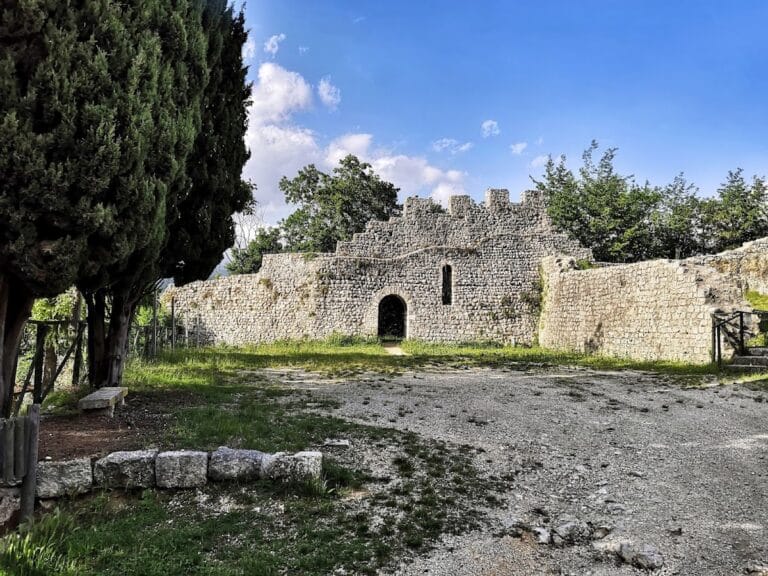
A section of the Roman city walls survives in a separate archaeological area together with the remains of a Roman-period bath complex. These structures form part of the wider evidence for Concordia’s fortified urban boundary and public facilities.
Domus dei Signini and Roman theatre
Two excavation areas lie near the intersection of Via Claudia and Via 8 Marzo. One exposes part of the ancient settlement, including the Domus dei Signini, a Roman house. The other occupies the former site of the Roman theatre, whose original semicircular perimeter is represented by a boxwood hedge.
Roman bridge
At the western entrance to the ancient city, along Via San Pietro, are the remains of the Roman bridge over which the Via Annia crossed into Concordia. The bridge belongs to the Roman period, although its more precise date is uncertain. The decorated dagger found nearby during nineteenth-century investigations uses agemination, a technique in which contrasting metals are inlaid to create ornament.
Domestic remains and excavated objects
Via dei Pozzi Romani and Parco dei Signini
The area of Via dei Pozzi Romani and Parco dei Signini includes a Roman house, wells, and further remains of the ancient settlement. Together with the excavated streets and public buildings elsewhere in the centre, these features illustrate the range of spaces that made up Roman Concordia.
Objects from the ancient territory
The entrance display includes a bronze-sheet disk found at Musile di Piave and dated to the period of Romanization. It also contains a small terracotta lion from the first century AD, discovered during excavations in Via Fornasatta. The lion may have decorated a garden fountain belonging to a Roman house.