Trajan’s Arch at Canosa di Puglia: A Roman Triumph Monument


Site at a Glance
- Rating
- 4.4
- Popularity
- Very Low
- Country
- Italy
- Primary era
- Classical
- Eras represented
- Classical
- Civilizations
- Roman
- Site type
- Civic
- Remains
- Arch
On this page6 sections
History
Trajan’s Arch at Canosa di Puglia, Italy, is a Roman triumphal arch from the first half of the second century, built on the route of the ancient Via Traiana. The road connected the Roman network through southern Italy. The monument is also known as Porta Romana, Porta Varrone, or Porta Varrense.
Trajanic and Hadrianic Dating
The arch is generally associated with the reign of Trajan, the Roman emperor who ruled from AD 98 to 117. A proposed date of AD 109 connects its construction with the building of the Via Traiana between AD 108 and 110. Other interpretations place it during the reign of Hadrian, Trajan’s successor, who ruled from AD 117 to 138. Its precise date therefore remains uncertain.
The name Porta Varrone or Porta Varrense comes from a traditional scholarly attribution to Gaius Terentius Varro, a Roman consul defeated at the Battle of Cannae in 216 BC. This association explains the alternative name but does not establish the arch’s construction history.
Restoration and Reconstruction
The monument underwent several restorations during the nineteenth century and was restored again in 1911. Extensive modern reconstruction is incorporated into the structure, shaping the form in which the arch survives today.
Remains
Arch Structure
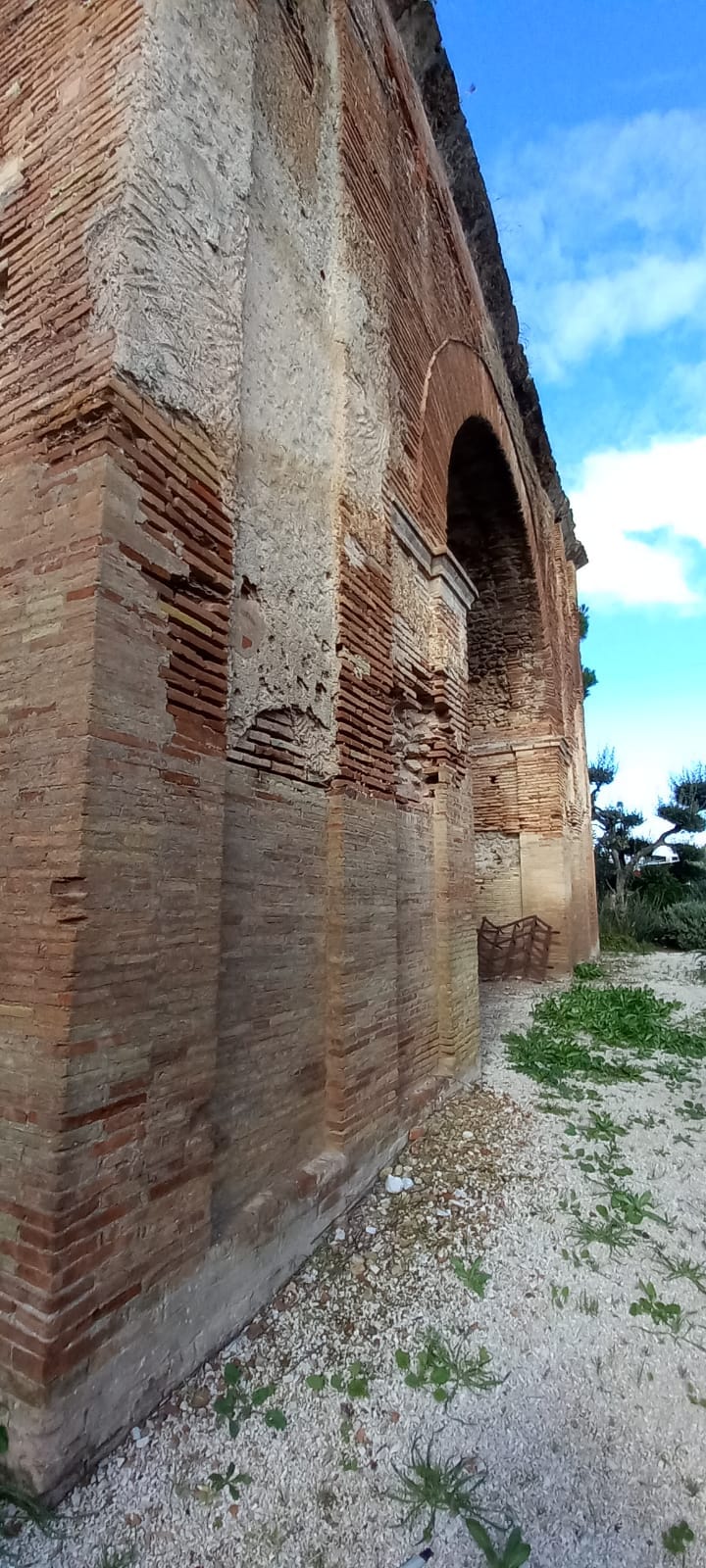
The monument consists of a single arched opening and was built in brick, probably with a facing of marble. It is now partly buried. Its original height was probably about 13 metres, while the structure measures approximately 12 metres wide and 5 metres deep. Shallow upright projections, known as lesenes, stand at the outer corners of the supporting piers and at the centre of the front face of each pier. These features probably carried an entablature, the horizontal architectural element placed above columns or pilasters.
Relief Fragments
A marble historical relief, probably showing a Dacian, has been attributed to the arch’s decoration. The Dacians were an ancient people of the lower Danube region who fought Rome during Trajan’s reign. The relief was found among reused architectural materials in the crypt of the Church of Santa Maria de Russis and is preserved in the Diocesan Museum in Trani. A second marble fragment from the arch’s frieze depicts a military scene and was reused at Castel del Monte. Both fragments date to Trajan’s reign.