Balneario Termas Romanas: A Historic Roman Thermal Spa in Spain

Site at a Glance
- Rating
- 4.3
- Popularity
- Very Low
- Country
- Spain
- Primary era
- Classical
- External website
- Open
- Eras represented
- Classical, Early Modern, Modern
- Civilizations
- Crown of Castile, Roman, Spanish
- Site type
- Sanitation
- Remains
- Baths
On this page10 sections
History
Balneario Termas Romanas is a historic thermal spa in Baños de Montemayor, Spain, developed around springs used by Roman communities and soldiers. The waters were already emerging in the second century BC, when they formed an aquatic lagoon, and the site later became part of the thermal landscape beside the route now followed by the N-630. Its position corresponds to the Ruta de la Plata, the major Roman north-south road linking Asturica Augusta with Augusta Emerita across the Iberian Peninsula.
Roman springs and religious use
The springs served both therapeutic and religious purposes. Roman soldiers, officials, and the Hispano-Roman population, the communities and culture formed through the interaction of local people with Roman institutions, used and venerated the waters. Altars dedicated to the Nymphs, supernatural female beings associated with natural places such as springs, together with Latin inscriptions, coins, votive offerings, and other Roman remains, point to a sacred dimension alongside the treatment of illness. The complex has been tentatively associated with Cáparra, an important Roman settlement in western Hispania.
The springs were gradually adapted for public use. Roman water-collection chambers survived within the later complex, and excavations in 1894 uncovered further Roman remains that reinforced the antiquity of the baths. The surviving installations and finds connect the present spa with a long history of collecting, distributing, and using the mineral waters.
Early modern expansion
Regulations governing the northern Cáceres baths were reformed in 1630 under Juan Luis de Silva y Ribera, Marquis of Montemayor. During the seventeenth century, Bishop Juan de Porras y Atienza promoted an expansion that included a large nave. These changes placed the Roman thermal installations within a building complex that continued to adapt to the use of the springs.
Community administration and nineteenth-century growth
Baños de Montemayor appointed its first spa director, Francisco Martínez, in 1817. In 1833, the municipalities of Montemayor and Béjar transferred their rights over the mineral-water spring to local residents. The residents formed an administrative board known as the Protective Board of the Establishment, creating a communal system that later became associated with Probaños.
Nineteenth- and twentieth-century building campaigns extended the spa. A major municipal expansion added ground-level rooms and connected them with vaulted spaces at the level of the Roman thermal chamber. In 1890, cast-iron railings were installed around the enclosure, and several marble bathtubs were acquired. One bathtub, decorated with Mudéjar carving, was considered to possess considerable artistic value.
Hotel development and changing control
A hotel bearing the spa’s name was built beside the complex in the early 1910s. The spa was later leased to Alejandro Lerroux, a prominent politician of the Radical Party, who promoted both the spa and the hotel. He subsequently transferred the holding to Ferrero y Compañía. After that company was dissolved in 1944, Miguel Ferrero Pardo, later civil governor of Cáceres, and his heirs continued to administer the spa and hotel for the rest of the twentieth century.
In 1951, while serving as civil governor of Cáceres, Miguel Ferrero Pardo ended the 1833 arrangement with the residents’ administrative board and transferred control to the municipal government of Baños de Montemayor as the residents’ representative body. A residents’ board was re-established by popular vote in 1990 under the name Probaños. A second spa building was then begun.
Archaeology and rehabilitation
Excavations in 1998 uncovered Roman pieces and marble bathtubs. The finds are displayed in the spa museum, and some of the bathtubs continue to be used for treatments. The complex was declared a Historical-Artistic Monument by the Government of Extremadura and became a Site of Cultural Interest in 1995.
Baños y Salud S.L., part of the Valencian group Balnearios de Valencia S.L., managed the spa for a decade and continued under an extension intended to last until the end of 2016. Non-payment problems during the extension led Probaños to initiate eviction proceedings, completed in November 2014, and the management company subsequently entered insolvency proceedings. Local residents assumed management in 2015. The complex has since been rehabilitated while continuing to use its mineral-medicinal waters and present a recreated Roman therapeutic circuit.
Remains
Thermal buildings and spring installations
The complex now consists of two buildings on opposite sides of the N-630. The historic building stands on the right when travelling toward Salamanca, while the more modern building, converted into a museum, stands on the left. The buildings preserve Roman and later elements created through the continuous reuse of the thermal springs.
The waters emerge through two nearby springs called Columna and Arqueta. They are classified as sulphurated, sodium-bearing, and oligometallic, with a recorded emergence temperature of 43°C. Their stated therapeutic applications include rheumatological conditions, osteoarthritis and arthritis, and respiratory ailments. They are also described as toning and beneficial to the skin.
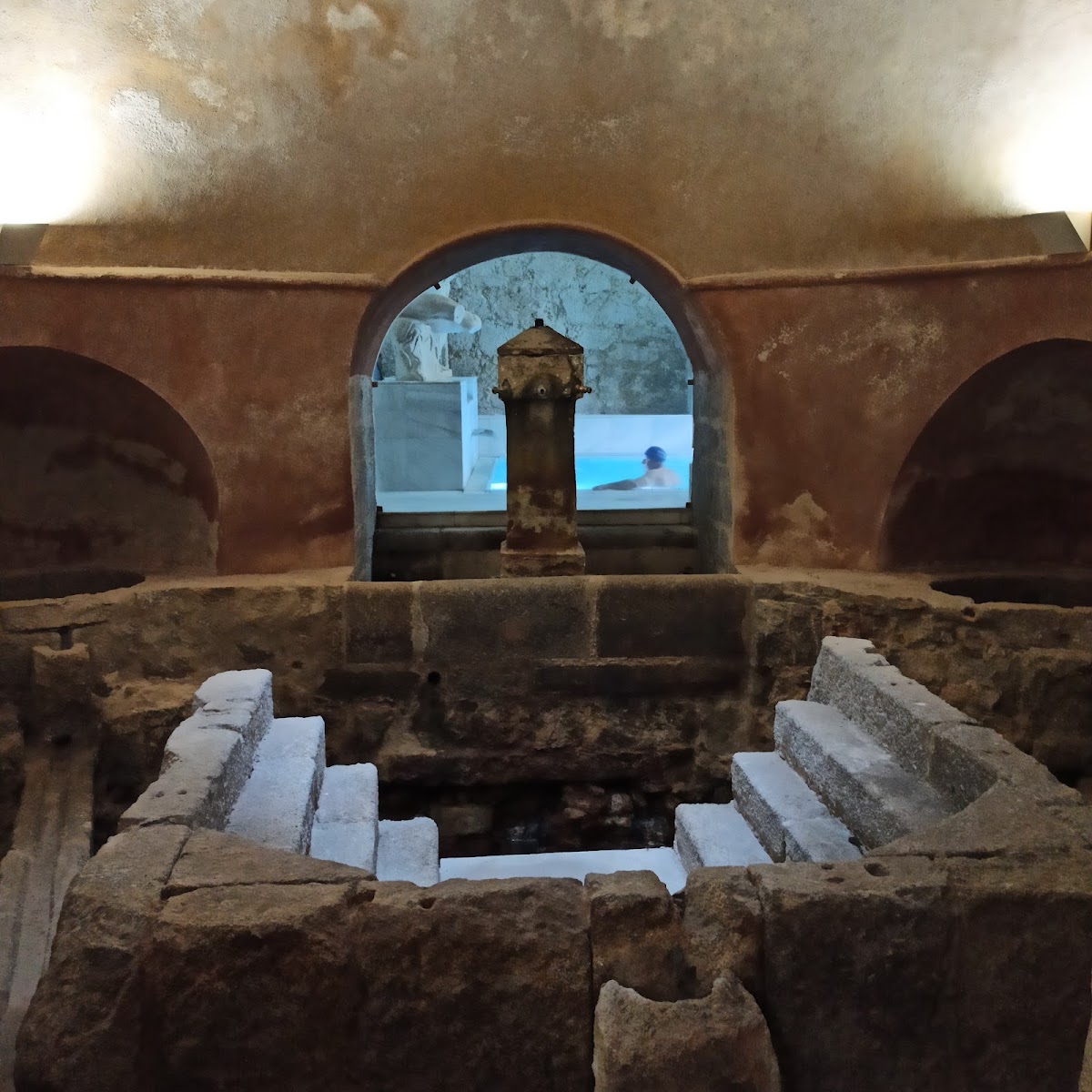
The spring chamber is circular and covered by a vault with an opening overhead for light. The upper portions of recessed, round-headed niches remain visible, while their lower sections lie below the current floor. At the centre, a brick chamber approximately 1.5 metres high protects the pool that receives the water for distribution.
A hollow reached from the top of the brick chamber contains part of a column shaft and an octagonal basin with eight small openings. Together, these elements form part of the Roman thermal installation associated with the therapeutic use of the waters. Other Roman remains preserved or displayed in the complex include a primitive bath, water-collection chambers, bathtubs, basins, coins, altars, Latin inscriptions, votive objects, and water-collection basins.
Historic building and later additions
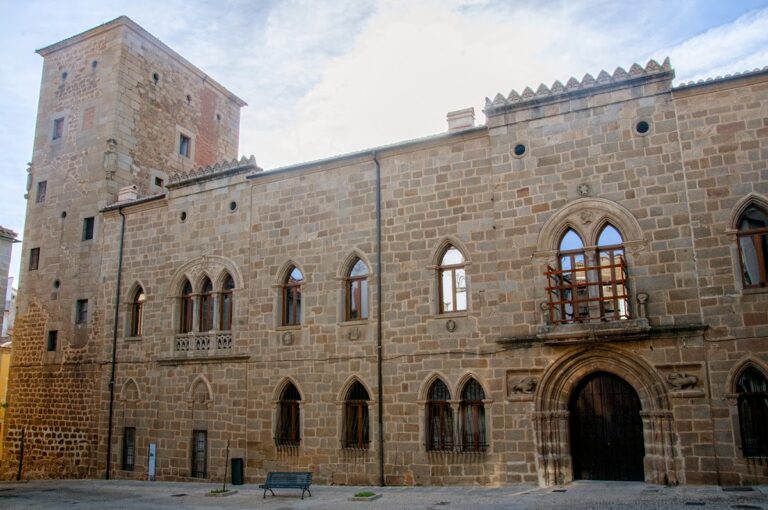
The main facade of the historic building is arranged in three connected sections. The first rises two storeys, with a centred entrance on the ground floor and four balconies above, each with a very shallow round arch. Moulded cornices, half-round profiles, and right-angled elements separate and finish the levels. The smaller second section has square openings.
The lower part of the third section is built from carefully cut ashlar. Two rendered masonry turrets with ashlar quoins rise at its sides, giving this portion a defensive appearance. A staircase connects it with the hotel, and its handrail is supported by highly decorative balusters. The lateral facade has two storeys without cornice divisions and contains five openings framed in stonework.
The nineteenth-century extension included a ground-level room supported by six metal columns. A granite staircase leads from this room to spaces at the level of the Roman thermal chamber. Those rooms have groined vaults and connect with a larger vaulted space. The large nave added during the seventeenth-century expansion has a continuous barrel vault with lunettes.
Collections and recreated Roman circuit
The enclosure retains the cast-iron railings installed in 1890. Marble bathtubs acquired during the late nineteenth century form part of the spa’s later furnishings, including the tub with Mudéjar carving. Roman-period marble pieces and bathtubs recovered during the 1998 excavations are displayed in the museum, while some bathtubs remain in use for treatments.
Rehabilitation added swimming pools supplied by the mineral waters. A Roman circuit was also installed in an ancient cistern, recreating earlier therapeutic applications and uses of the springs within the surviving thermal complex.