Horsford Castle: A Norman Motte-and-Bailey Castle in Norfolk

Site at a Glance
- Rating
- 3.9
- Popularity
- Very Low
- Country
- United Kingdom
- Primary era
- Medieval
- External website
- Open
- Eras represented
- Medieval
- Civilizations
- Norman
- Site type
- Military
- Remains
- Castle
On this page8 sections
History
Horsford Castle is a Norman medieval castle site in the United Kingdom, established at Horsford in Norfolk after the Norman Conquest of England from 1066 onward. It was built on heathland by Walter de Caen, who used the new stronghold as a political demonstration of control over the surrounding grazing lands and created a deer park around it.
From Anglo-Saxon landholding to Norman control
Before the conquest, Horsford belonged to the Anglo-Saxon landholder Eadric Cild. William the Conqueror, the Norman duke who became king of England after the conquest, granted the land as a fief to Robert Malet, lord of Eye. Malet was later expelled after supporting opponents of King Henry I, and the lordship of Horsford passed to Walter de Caen.
Walter de Caen established the castle’s motte, a raised earthwork that commonly supported a medieval fortification. Its position on the heathland expressed the new lord’s authority over the surrounding lands, while the associated deer park extended the estate beyond the castle itself.
The FitzWalter connection
Walter’s son, Robert FitzWalter, served as Sheriff of Norfolk from 1115 to 1129. On the return journey from a pilgrimage to Rome, Robert and his wife were attacked, robbed, and imprisoned by bandits. They were released after praying to Saint Faith of Agen, a Christian martyr and saint also known as Saint Foy. Robert subsequently founded a monastery near the castle in her honour.
Abandonment and protection
Horsford Castle was probably abandoned in the mid-fifteenth century. Its archaeological importance is reflected in its status as a Scheduled Monument, a heritage site protected under United Kingdom law because of its archaeological or historical importance.
Remains
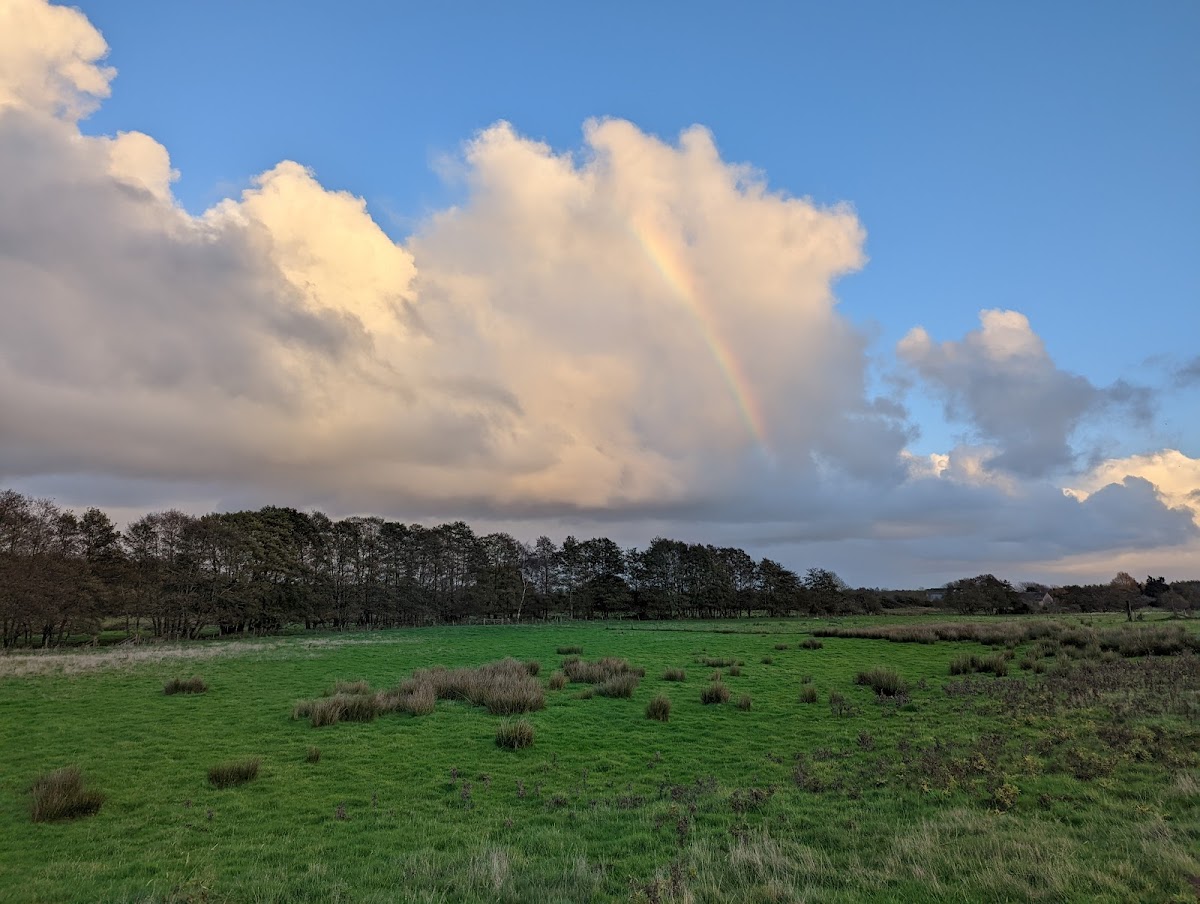
Horsford Castle was arranged as a motte-and-bailey earthwork on heathland. The motte had a base measuring approximately 77 by 32 metres and stood about 2.3 metres high, while the adjoining bailey, an enclosed area for associated buildings and activities, measured approximately 72 by 32 metres. The site lies at about 23 metres above sea level in generally flat terrain that is now largely agricultural, and the surviving remains are represented by a low mound in a field east of Horsford village.
Castle earthworks
Motte
The motte formed the raised earthwork of the castle and measured approximately 77 by 32 metres at its base. It was established by Walter de Caen on the heathland as part of the castle’s early Norman arrangement. The surviving mound is about 2.3 metres high and forms the principal visible remnant of the abandoned site.
Bailey
The castle bailey measured approximately 72 by 32 metres and stood beside the motte as the enclosed area associated with the stronghold. Together, the two earthworks defined Horsford Castle’s basic motte-and-bailey layout. The castle site is now ruinous, with the remains situated in a field east of Horsford village.