Caister Castle: A Fifteenth-Century Moated Fortress in England


Site at a Glance
- Rating
- 4.4
- Popularity
- Low
- Country
- United Kingdom
- Primary era
- Medieval
- External website
- Open
- Eras represented
- Medieval
- Civilizations
- English
- Site type
- Military
- Remains
- Castle
On this page10 sections
History
Caister Castle is a fifteenth-century moated fortress and residence in the United Kingdom, at West Caister near Caister-on-Sea in Norfolk. Built for the English soldier and landowner Sir John Fastolf, it is regarded as one of England’s earliest brick buildings and remains a Grade I-listed monument, the highest level of statutory protection for a building of exceptional historic or architectural interest.
Fastolf’s foundation
The Fastolf family had held the West Caister and Caister Hall estates since 1363. Construction of the castle began in 1432 on the site of an earlier manor and chapel. Fastolf financed the work with money from the ransom of a French knight whom he had held prisoner. The building was complete by 1436 or before 1440, while 1446 is also associated with its official opening and a visit by the Duke of Norfolk. The construction cost approximately £6,046.
Fastolf intended the castle to become a large chantry, a religious foundation supporting prayers and services for the souls of its founder and relatives. Disputes over his estate prevented that plan. Fastolf died childless and intestate, meaning without a valid will, in 1459. Much of his money endowed Magdalen College, Oxford, while ownership of the castle passed into the dispute surrounding the Paston family.
The Paston inheritance dispute
John Paston, Fastolf’s legal adviser and close confidant, claimed the inheritance and ordered additions to the castle in 1468. The resulting dispute involved the Duke of Norfolk, John de Mowbray, and Sir William Yelverton, an English lawyer and judge.
In August 1469, Norfolk besieged Caister Castle to enforce his claim of ownership. John Paston the Younger defended it with approximately 30 men. After two months, the defence failed. A long-serving Paston servant was killed by a crossbow wound, and the castle was captured and severely damaged before it was eventually returned to the family. The episode belongs to the Wars of the Roses, the fifteenth-century civil conflicts caused by rival claims to the English throne from the houses of Lancaster and York.
The castle features prominently in the Paston Letters, a major collection of fifteenth-century family correspondence. The letters record household affairs, property disputes, and the Pastons’ efforts to preserve and improve their social position during a period of political conflict.
Decline and later changes
The Pastons occupied Caister Castle until about 1599, when they built a more comfortable residence nearby. After 1600, most of the castle became ruinous, although the tower survived. The Pastons sold the property to William Crow, a City of London upholsterer and money lender, in 1659. It later passed by marriage to the Bedingfield family.
During the eighteenth century, parts of the castle were demolished and their materials reused in other buildings. Neglect and the removal of stonework and fittings further changed the remains. Around 1776, the Reverend David Collyer removed a newel staircase, a spiral stair built around a central post, containing 122 stone steps from the tower, and incorporated it into his house at Wroxham. The inner moat was filled between 1842 and 1893, while its south-eastern side was widened to form a lake. Charles Hamblen-Thomas owned the castle in 1952.
During the 1960s, the Caister Castle Motor Museum was established in the south-west grounds, giving part of the historic site a modern museum function alongside its surviving remains.
Remains
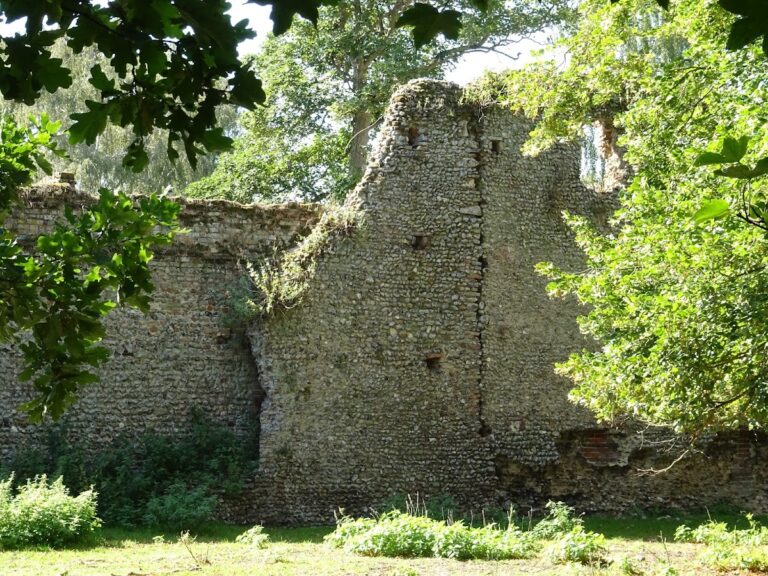
Caister Castle has a rectangular plan and was originally enclosed by a moat. Its surviving fabric is dominated by a tower that rises through five storeys to approximately 100 feet, or 33 metres. The rest of the fortress survives largely as ruins, while the present water feature incorporates the widened south-eastern side of the former inner moat. The castle stands beside Caister Hall, a fifteenth-century building erected by the Paston family.
Fortress and surviving fabric
Moated enclosure
The rectangular fortress was surrounded by a moat, creating a defended boundary around the residence. Part of the former inner moat was later filled, and its south-eastern side was enlarged into a lake. This water feature remains part of the present physical setting of the castle.
Surviving tower
The tower remains intact and extends through five storeys to about 100 feet, or 33 metres. Its spiral staircase was removed in the eighteenth century, but the tower itself survives as the principal standing part of the castle and can be climbed.
Former contents and associated buildings
An inventory made after Fastolf’s death gives evidence of the castle’s former domestic, military, and religious contents. It lists silver plate, equipment for the chapel, clothing and tapestries, armour, and furnishings belonging to several named rooms and chambers. Caister Hall, standing beside the castle, was built by the Paston family in the fifteenth century.
Motor museum
The Caister Castle Motor Museum occupies a purpose-built building in the south-west grounds. Its collection includes veteran, vintage, classic, sports, and touring automobiles and motorcycles, together with bicycles, horse-drawn vehicles, pedal cars, agricultural equipment, and other transport-related objects.
A local legend says that a carriage driven by a ghost once travelled around the castle courtyard during the fifteenth century.