Castle of Maur: An Administrative Seat and Museum in Switzerland
Site at a Glance
- Rating
- 4.8
- Popularity
- Very Low
- Country
- Switzerland
- Primary era
- Medieval
- External website
- Open
- Eras represented
- Medieval, Early Modern, Modern
- Civilizations
- Holy Roman Empire, Swiss
- Site type
- Domestic
- Remains
- Manor House
On this page7 sections
History
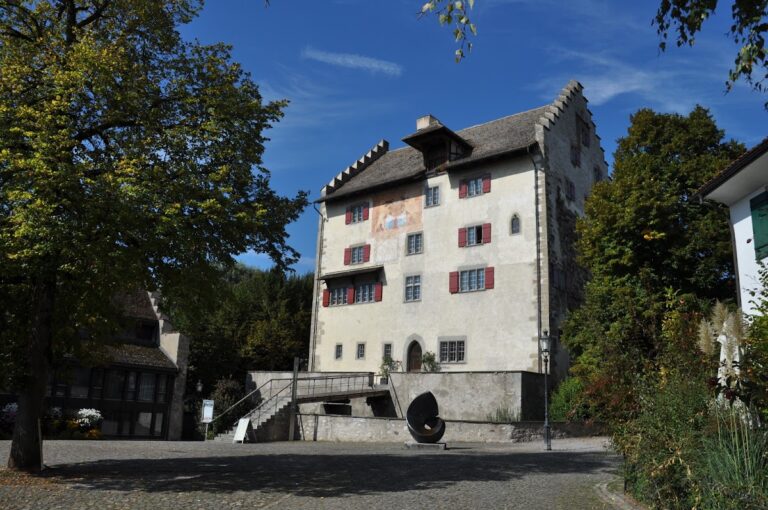
Castle of Maur is a historic castle in Maur, Switzerland, built around 1250 as the administrative seat of the Fraumünster Abbey in Zurich. Its local administrators, the Meier von Maur, exercised lower jurisdiction, meaning authority over minor civil and criminal matters, from the neighboring Meierhof. The castle therefore formed part of the abbey’s system for managing its estates and local rights.
From abbey administration to private ownership
The castle later became the freehold property of the Meier von Maur. During the fifteenth century, it was separated from the Meierhof, with which it had previously formed one property. In 1460, Junker Johannes Engelhard of Zurich acquired the whole property. The title Junker was a contemporary honorific for a gentleman or minor nobleman. After fifteen years, Engelhard sold the property to Junker Georg Grebel of Zurich, who transferred it on 1 May 1592 to Felix Hottinger of Maur.
Ownership subsequently passed through the Aeppli, Burkhard, Kramer, Füßli, Ziegler, and Nüscheler families. From 1652 to 1775, high jurisdiction belonged to the Greifensee bailiwick, an administrative territory governed by a bailiff for a higher authority. Blood jurisdiction, which concerned serious crimes carrying severe penalties, including death, remained with the Kyburgs until it passed to Zurich.
David Herrliberger and the judicial estate
David Herrliberger acquired the castle in 1749. A Swiss copper engraver and publisher, he expanded the building in 1750 and made it both his residence and publishing site. He also held authority as judicial lord, a local landholder with specified court powers. His authority was limited, however, and his autocratic administration created tensions with the village population and with the superior bailiff of Greifensee.
In 1775, Herrliberger sold the castle and the judicial authority for 8,000 gulden to Hans-Jakob Zollinger, a farmer from Uessikon. The judicial authority itself passed to Zurich. Around 1800, the building was enlarged and converted into a manor house, and an additional stairwell was constructed around 1850.
Municipal ownership and museum use
The municipality of Maur has owned the castle since 1962. Comprehensive renovation in 1974 and 1975 prepared it for conversion into a museum. Since 1976, the building has permanently presented the Herrliberger Collection together with part of the holdings of the Mühle local museum. The Salomon Cabinet and the Kunstkammer, an exhibition room for art and other culturally important objects, are used for temporary exhibitions. The castle is classified as a Class B Swiss cultural property of regional significance.
Remains
The castle stands in the village of Maur on the lowest terrace of the Pfannenstiel beside Lake Greifen, in a position somewhat higher than the village. Its complex includes a court and a masonry residential tower that formed the original core. Later additions and alterations give the building its present manor-house character while retaining the earlier tower within the compound.
Original tower and court
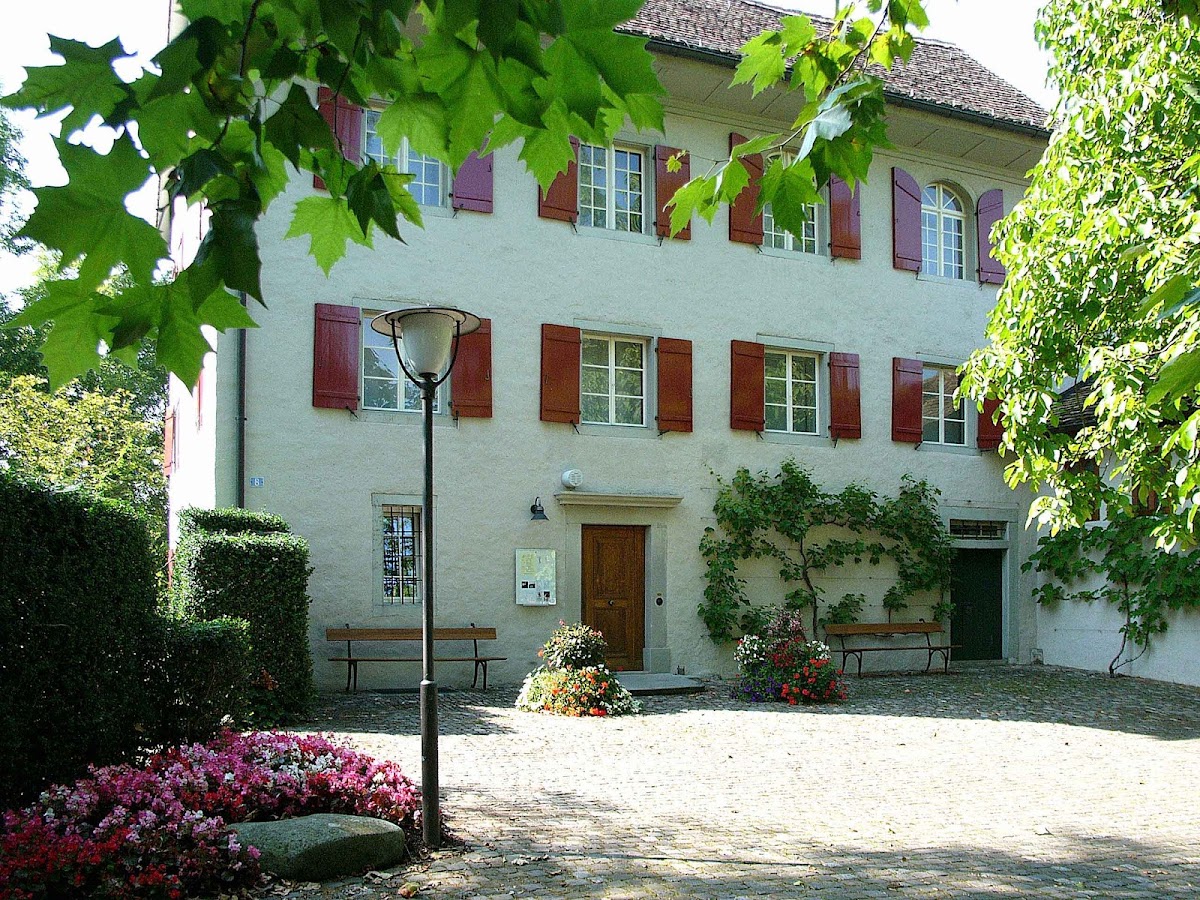
The first structure was a square residential tower measuring 8.9 metres on each side. Its foundations are 1.40 metres thick and consist of rounded stones with dressed blocks at the corners. The court lies within the castle complex. At the entrance, an atelier on the left is used by an artistic blacksmith, adding a present-day working space to the historic arrangement.
Later building work and museum interiors
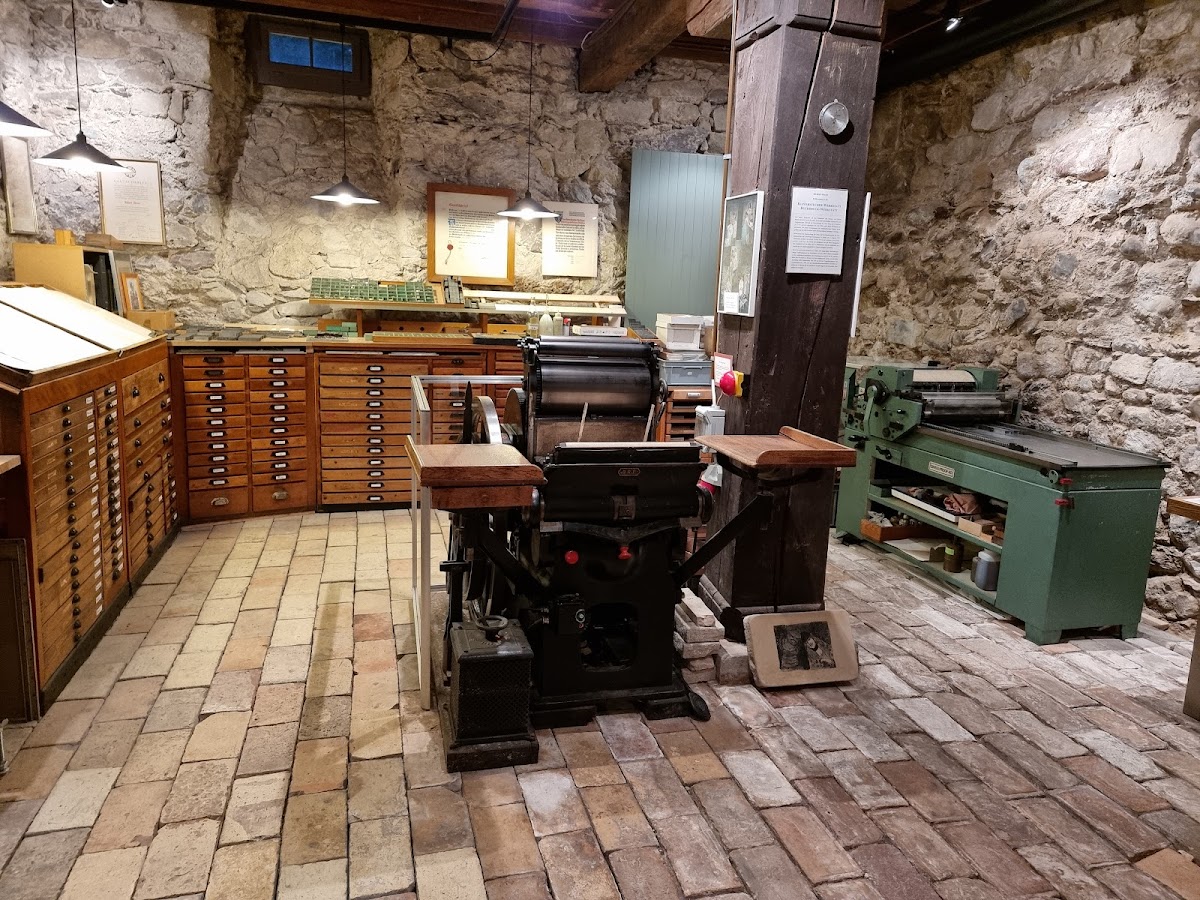
An addition enlarged the castle in 1750. Further enlargement and remodelling around 1800 transformed it into a manor house, while a stairwell addition followed around 1850. The cellar contains installations representing a copper-engraving workshop and a book-printing workshop, linking the interior presentation to Herrliberger’s work as an engraver and publisher.
The permanent museum displays combine the Herrliberger Collection with part of the Mühle local museum’s holdings. The Salomon Cabinet and the Kunstkammer provide spaces for temporary exhibitions, allowing the restored building to function both as a historic structure and as a museum complex.