Campo de Ebro Rock-cut Hermitage: A Visigothic Christian Sanctuary in Spain

Site at a Glance
- Rating
- 3.7
- Popularity
- Very Low
- Country
- Spain
- Primary era
- Medieval
- Eras represented
- Medieval
- Civilizations
- Visigothic
- Site type
- Religious
- Remains
- Chapel
On this page5 sections
History
The Campo de Ebro Rock-cut Hermitage, also known as the rock-cut Church of San Miguel, is a small Christian sanctuary in Campo de Ebro, Spain, with probable Visigothic origins. The Visigoths, a Germanic people who ruled much of the Iberian Peninsula from the fifth to the early eighth century, are traditionally associated with the hermitage’s beginnings.
Early Christian origins
The site may have begun as an ancient pagan temple before being converted into a small Christian church around the sixth century. The structure was then carved directly into the natural rock over a broad period between the sixth and tenth centuries. Its dedication to San Miguel, or Saint Michael, connects the building with the Christian tradition honoring the archangel.
Later uses and protection
At the beginning of the twentieth century, the hermitage was used as a school. During the Spanish Civil War, it provided refuge for local inhabitants. In 1985, it was declared an Asset of Cultural Interest and protected as a historic monument.
Remains
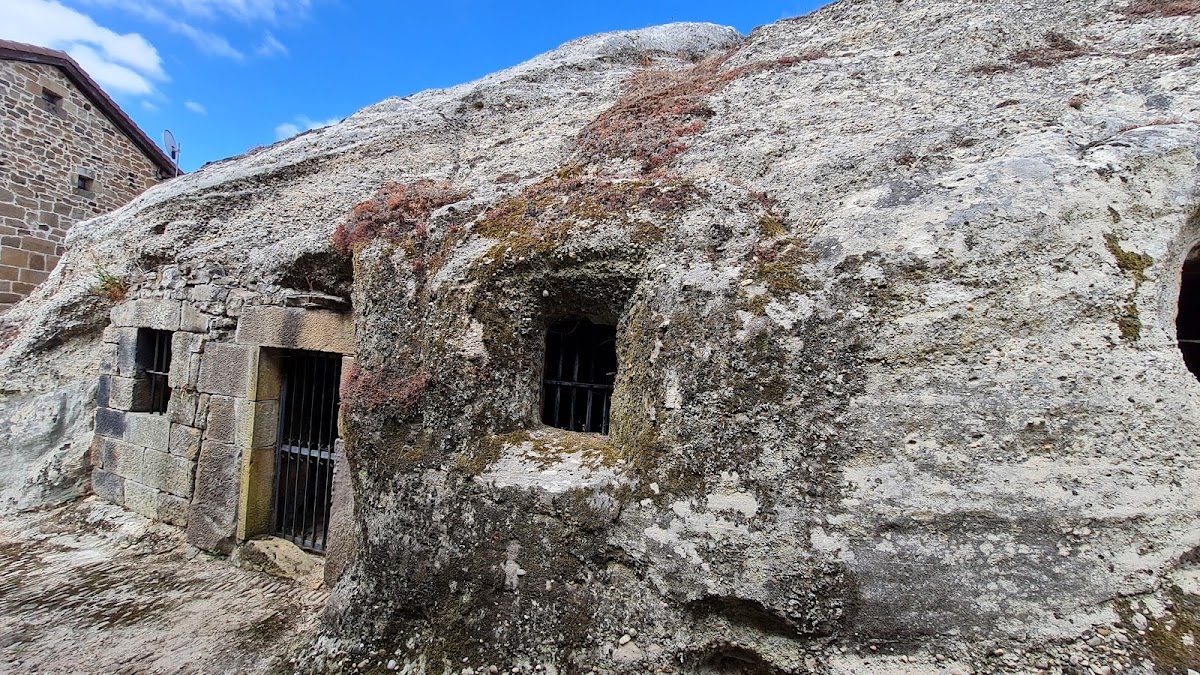
The hermitage is a small monolithic, rock-cut structure excavated directly into the natural stone. Rather than being assembled from separately laid masonry, it was formed from one continuous mass of rock. Its compact interior follows a simple plan, with a single rectangular nave leading to a quadrangular apse.
Interior plan
The rectangular nave forms the main space of the hermitage, while the quadrangular apse provides its concluding end. Together, these carved spaces preserve the basic arrangement of a small Christian church within the natural rock.