Burg Schönrath: A Historic Lowland Castle in Germany
Site at a Glance
- Rating
- 4
- Popularity
- Very Low
- Country
- Germany
- Primary era
- Early Modern
- Eras represented
- Medieval, Early Modern
- Civilizations
- Duchy of Berg, Holy Roman Empire
- Site type
- Domestic
- Remains
- Manor House
On this page7 sections
History
Burg Schönrath is a historic lowland castle in Lohmar, Germany, whose main complex was built during the fifteenth and sixteenth centuries on medieval foundation walls. First recorded in the thirteenth century, it served as a knightly seat and later became the centre of a free-noble estate in the regional countryside.
Medieval Lords and Noble Ownership
The castle appears in historical records under forms including huis schonraedt and schoinrait. In the thirteenth century, it belonged to the Lords of Schönrode, members of the regional landed nobility. Ownership later passed through the families of Landsberg, Nesselrode, and Quadt. During the fifteenth century, the Lords of Plettenberg acquired the castle.
After Wilhelm von Plettenberg died, the property and its estates were divided among his heiress daughters. In 1563, Diederich von Heyden, the son of Elisabeth von Plettenberg, paid off his brothers-in-law and brought Burg Schönrath into the von Heiden family. The castle remained with that family for slightly more than a century.
The Estate in the Late Seventeenth Century
On 4 October 1695, descendants of the von Heiden family gave up their properties in the Berg region as they turned toward Brandenburg. Burg Schönrath and its associated lands were sold to Baron Ernst von Erlenkamp for 30,000 Reichstalers.
At that time, the estate included nine farms and two watermills. Its annual dues consisted of grain, livestock, foodstuffs, raw materials, transport services, and money. The grain payments included 119 Malter of rye, 80 Malter of oats, and 2 Malter of barley. A Malter was a historical grain measure whose value varied by region and period. The obligations also included six calves, 32.5 pigs, one sheep, fodder for seven cattle, eight sacks of coal, 32 pounds of flax, 100 eggs, 150 chickens, four pounds each of pepper and ginger, six pounds of sugar, four measures of butter, carting services, and 82 Reichstalers and 256 Stüber in cash. A Stüber was a small historical currency unit used in the German lands.
Decline and Destruction
Over the following two centuries, the free-noble estate declined as its associated farms were gradually sold to commoners. Burg Schönrath itself changed hands several times, with the Scharrenbroich family holding it from 1855 to 1925.
The main castle was no longer inhabited by the nineteenth century, although its chapel reportedly remained in use until about 1835. The complex was gradually dismantled during the 1920s. In January 1928, the main castle was blown up, and its building material was reused in road construction. The outer bailey continued as an agricultural holding, and its buildings are now privately owned. Burg Schönrath is designated as an architectural heritage monument in North Rhine-Westphalia.
Remains
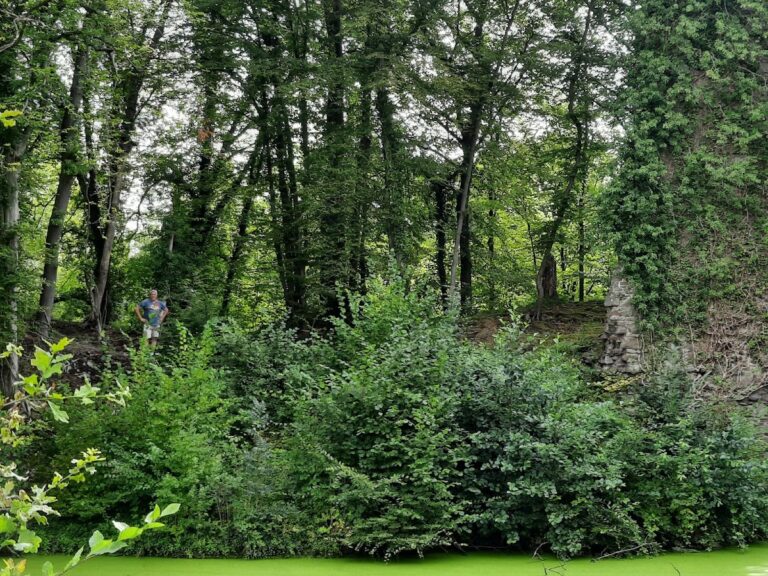
Burg Schönrath stands at about 140 metres above sea level in a gently sloping spring hollow beside a small stream that flows into the Gammersbach. The site lies between Wickuhl, a district of Lohmar, and Rösrath-Rambrücken, near the hamlet of Georgshof or Oberschönrath. Its surviving layout consists chiefly of the agricultural outer bailey, while only small, heavily overgrown wall remains mark the former main castle.
Main Castle
The main castle was constructed in the fifteenth and sixteenth centuries over medieval foundations. It formed an angular complex of three storeys, with substantial alterations carried out in the eighteenth century. Access was from the west across a masonry bridge, and the complex was enclosed by a moat. An octagonal chapel stood within the castle. Today, the main building survives only in small fragments, and the moat has almost entirely silted up. One pond remains as part of the former water system.
Outer Bailey
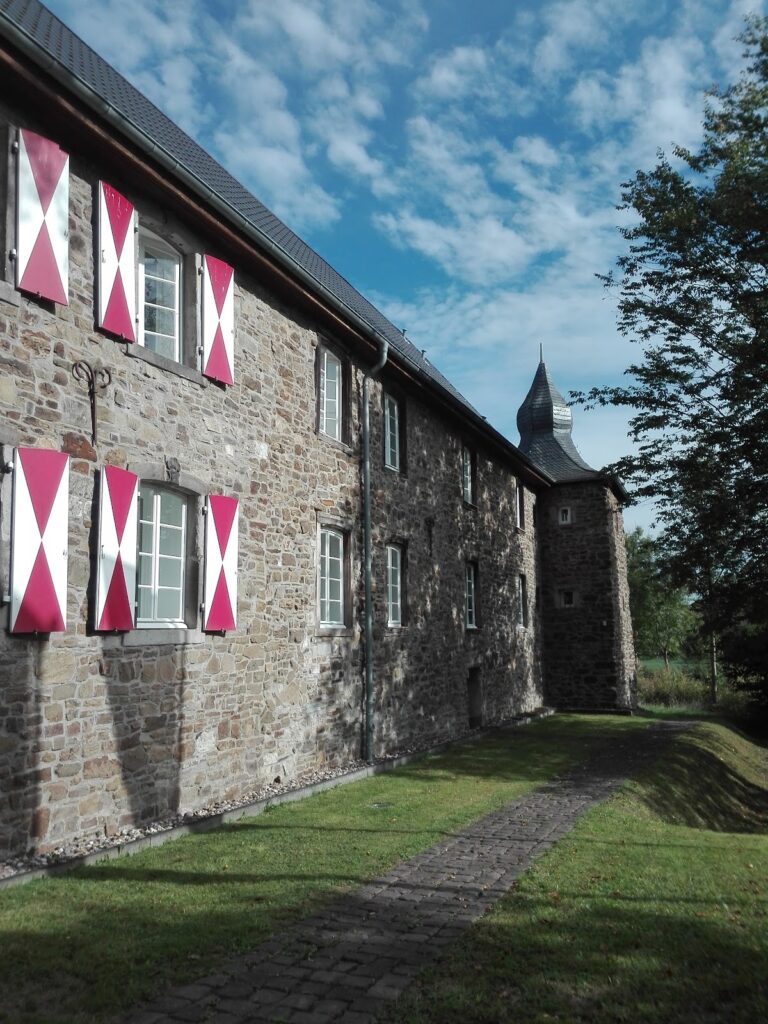
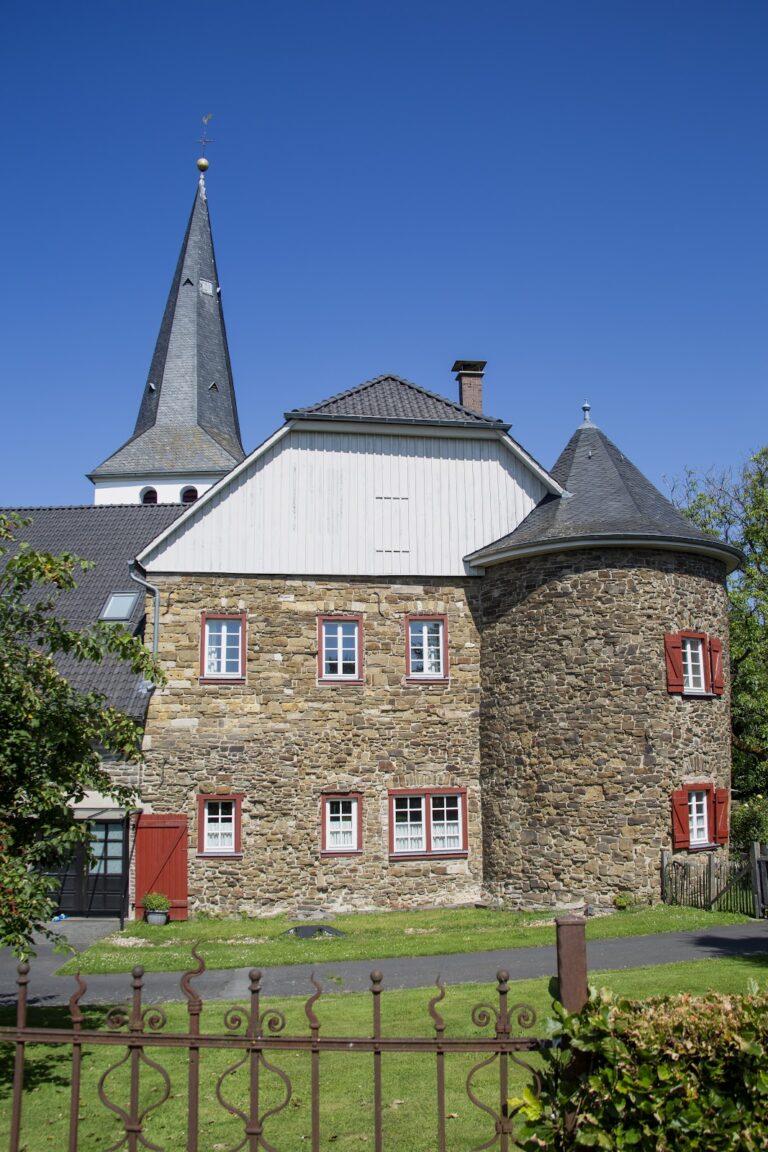
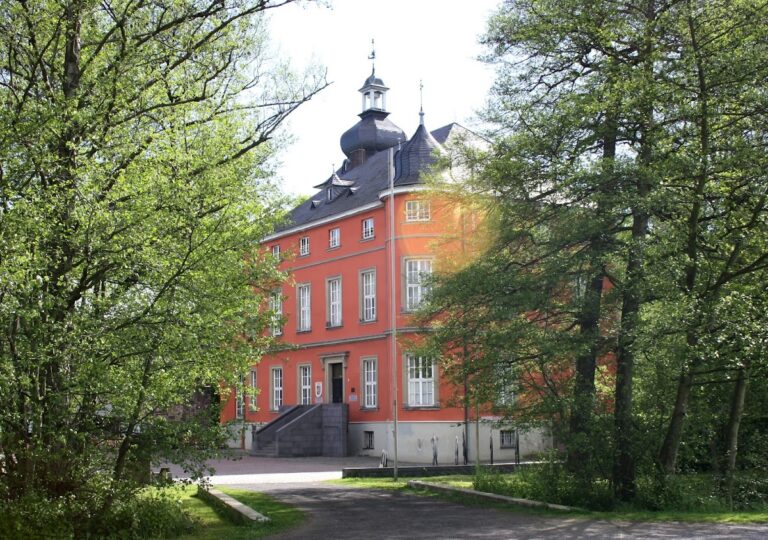
The outer bailey, the outer part of a castle complex used for service, agricultural, and residential buildings, was renewed in the eighteenth century. Substantial parts remain, including a two-storey residential building, stables, and ancillary structures. The buildings continue to form an agricultural property and are inhabited by the owners.
A yew tree beside the entrance to the outer bailey is approximately 300 years old. Its unusually multi-stemmed crown forms a surviving feature of the approach to the agricultural buildings.
Nearby sites