Blankenberg Castle: A Medieval Hilltop Castle Ruin in Germany


Site at a Glance
- Rating
- 4.6
- Popularity
- Medium
- Country
- Germany
- Primary era
- Medieval
- External website
- Open
- Eras represented
- Medieval
- Civilizations
- Holy Roman Empire
- Site type
- Military
- Remains
- Castle
On this page10 sections
History
Blankenberg Castle is a hilltop castle ruin in Stadt Blankenberg, Hennef, Germany, probably built between 1150 and 1180. First mentioned in a document from 1181, it developed within the medieval political world of the Counts of Sayn and later became part of the territory ruled by the Counts and Dukes of Berg.
The Counts of Sayn
In 1152, the Sayn brothers Eberhard I and Heinrich I transferred Sayn Castle and the Sayn estate near Bendorf to the Archbishop of Trier. This followed the siege and destruction of the castle and estate by Arnold II, Archbishop of Cologne. The brothers then lived at Blankenberg. Arnold II permitted them to remain there because they maintained the peace through their military strength.
Transfer to the Counts of Berg
In 1363, Blankenberg Castle, the town, and the surrounding territory passed to the Counts of Berg, the dynasty that later became the Dukes of Berg. The transfer placed the castle within a different ruling territory and connected its subsequent history to the political development of Berg.
War, Demolition, and Later Ownership
During the Thirty Years’ War, the major European conflict of 1618 to 1648, Swedish troops captured Blankenberg Castle and occupied it for several years. The castle was later partly demolished so that it would no longer provide a worthwhile target for other military commanders.
In 1829, Major Friedrich Ernst Theodor von Delitz acquired the castle hill, the ruin, and parts of the old town to establish a winery. The property passed to the manufacturer Richard Grüneberg in 1913. The castle grounds received heritage protection in 1985. Since 2008, the complex has also formed part of the protected historic cultural landscape known as the Lower Sieg Valley: Stadt Blankenberg to Bödingen, which includes the town, the castle, the pilgrimage site of Bödingen with its pilgrimage church, and the intervening Sieg floodplain.
Structural security work and extensive restoration of the ruins were largely completed by 2006. Since that year, the Blankenberg Castle Garden Association has been converting the bastion area into a herb garden with more than 200 medicinal and culinary herbs. The main castle belongs to the city of Hennef, while the outer bailey is privately owned.
Remains
Castle Layout
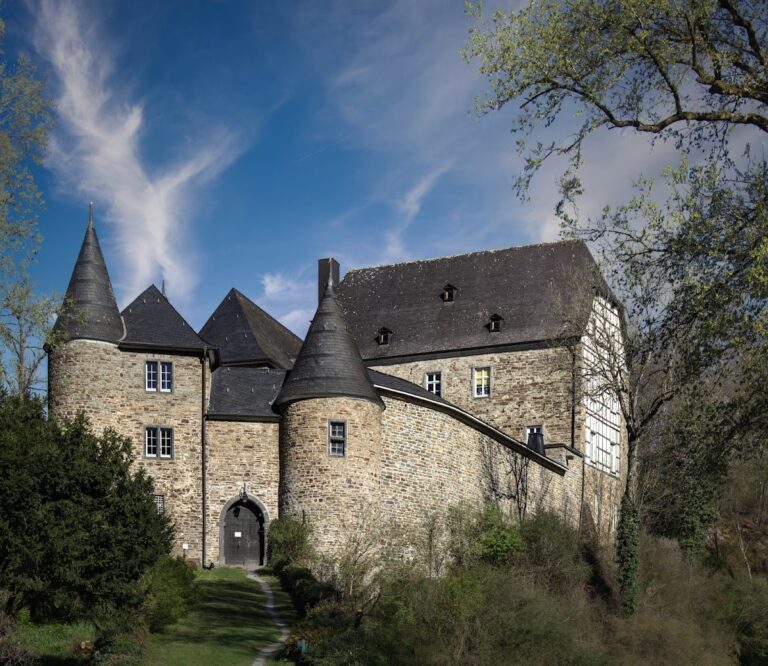
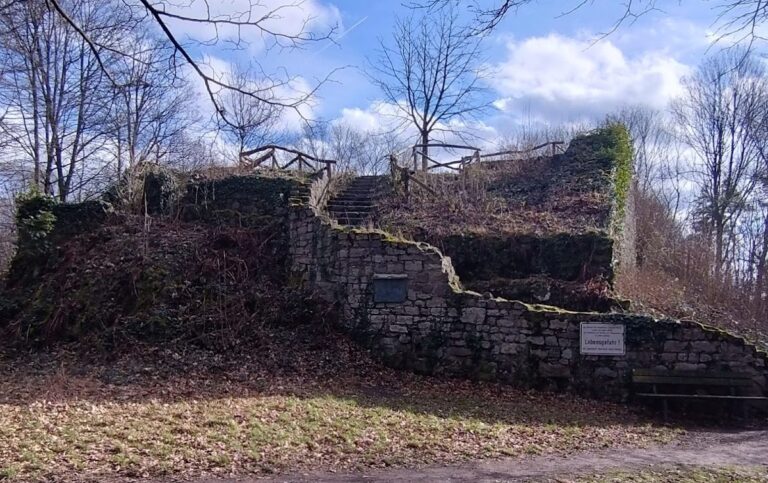
Blankenberg Castle occupies a 152-metre-high ridge above a bend of the River Sieg. Its compact surviving layout consists of an outer bailey, a main castle, four towers, and a town wall. The ruins of the outer bailey and main castle together form the present complex, preserving the division between the castle’s principal fortified areas.
Towers and Fortifications
Round Keep
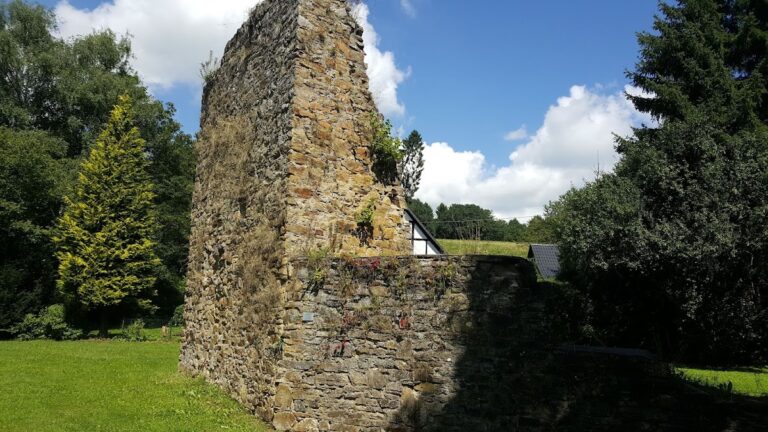
A round keep rises from the centre of the main castle and forms its highest structure. As the principal fortified tower, the keep represents the central vertical element of the surviving main castle.
Southern Bastion Tower
The southern bastion tower, also called St. George’s Tower, is part of the surviving fortifications. A bastion is a projecting defensive work intended to strengthen a fortification’s perimeter. The tower overlooks the Ahrenbach Valley and the Sieg Valley.
Bastion Garden
The bastion area now contains a herb garden created during the post-2006 conversion of the site. It includes more than 200 medicinal and culinary herbs within the surviving fortified setting.