Castell de Cartellà: A Territorial Castle in Spain

Site at a Glance
- Rating
- 4.4
- Popularity
- Very Low
- Country
- Spain
- Primary era
- Medieval
- External website
- Open
- Eras represented
- Medieval, Early Modern
- Civilizations
- Crown of Aragon, Spanish
- Site type
- Military
- Remains
- Castle
On this page10 sections
History
Castell de Cartellà is a medieval territorial castle in Spain, located at Cartellà in the municipality of Sant Gregori, Girona. Its earliest notices date from the eleventh century, when it formed part of the feudal landscape of the region and belonged by the late eleventh century to the domains of the Montcada family.
Feudal origins and lordship
The castle was a castell termenat, a territorial castle associated with jurisdiction over a defined district rather than only with a fortified residence. Early references occur in vassalage agreements between the Montcada and Cartellà families during the feudal revolution. Members of the Cartellà family appear in twelfth-century documents, including Arnau de Cartellà, who witnessed the marriage agreements in 1107 between the count of Besalú and a daughter of Ramon Berenguer III of Barcelona.
The first explicit reference to the castle dates from 1238. In that year, Galceran de Cartellà and his wife, Agnès, appointed a priest to the Chapel of Santa Maria at the castle. In 1242, Guerau V of Cabrera transferred part of the Cartellà estate to his eldest son through his will. The castle therefore formed part of a network of estates, family inheritances, and religious foundations that shaped local authority in the medieval period.
In 1305, James II placed the castles of Hostoles, Puig-alder, Colltort, and Rocacorba under the criminal jurisdiction of Guillem Galceran de Cartellà. After Guillem’s death in 1306, he left them to his granddaughter Beatriu de Cabrenys. Ramon de Xetmar, also known as Xatmar, bought Castell de Cartellà in 1321. The Xatmar family, a lower-noble family from Girona that had prospered through commerce, held the property through the fourteenth century and much of the fifteenth century while acquiring other castles and estates around Girona.
Dynastic change and civil war
The castle later passed to the Milany family through the marriage of Pere de Milany and Ermessenda de Xetmar. The Milany lordship continued into the fifteenth century. In 1430, Ramon Galceran de Pinós i Milany was lord of the castles of Cartellà and Tudela, while Francesc Galceran de Pinós held the lordship in 1448.
Castell de Cartellà became involved in the Catalan Civil War of 1462–1472, a conflict that divided Catalan political forces during a struggle over government and authority. In 1470, troops led by Verntallat occupied the castle. Verntallat was one of the principal leaders of the remences, Catalan peasant tenants involved in conflicts over feudal obligations and personal servitude. The castle was later besieged by troops of the Diputació, the representative governing institution of the Catalan estates.
Agullana residence and agricultural use
Baldiri Agullana acquired the castle at public auction in 1495. During the sixteenth-century conflict between the Agullana and Sarriera families in Girona, the castle served as a refuge for the Agullana family. It was remodelled as a residence during this period, and its defensive structures were reinforced, producing much of the appearance that survives today.
The conflict ended when Joan d’Agullana married Jerònima Sarriera, joining the two families’ substantial properties, including Castell de Cartellà. The Agullana family returned to Girona at the end of the sixteenth century, after which the castle’s use became predominantly agricultural. Further alterations adapted the complex to farming, while parts that were used less often gradually deteriorated.
Repairs and protection
Collapsed roofs required repair in the mid-1990s. In 2014, the owners consolidated the roofs of the west and south wings, which had been covered with temporary metal sheets since the 1990s. Later improvement works began to create a permanent dwelling and accommodation for rural tourism. The repaired castle remains privately owned, retains an agricultural function, and is also used for events.
Castell de Cartellà is protected as a Cultural Asset of National Interest and as a historical monument in the Spanish heritage register under reference RI-51-0006072. The designation is recorded from 1988 onward.
Remains
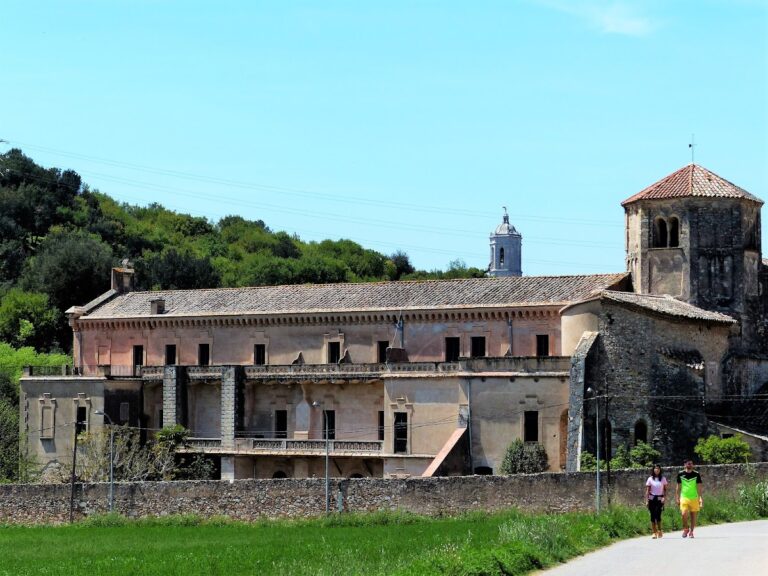
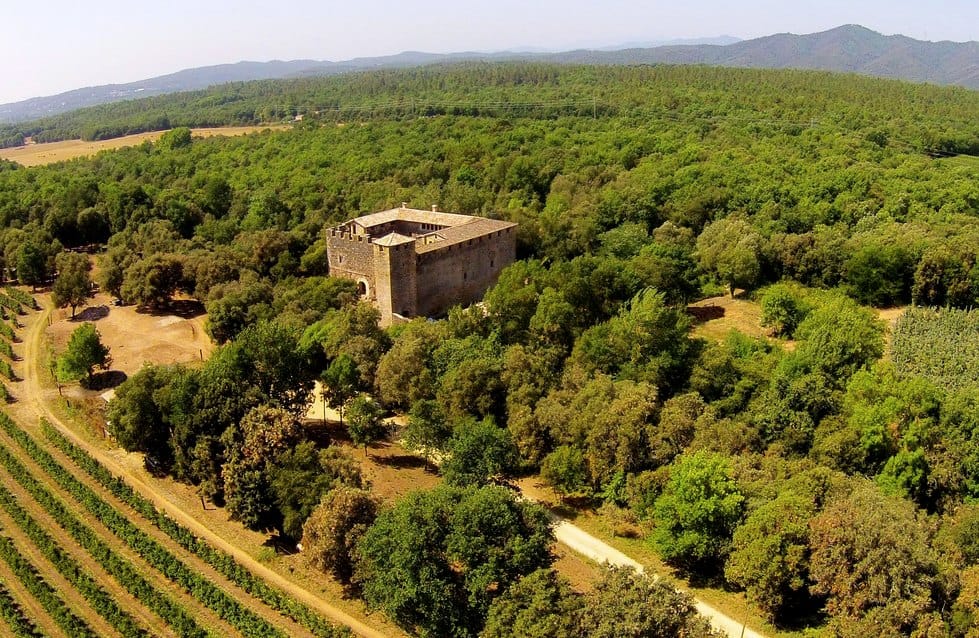
The castle occupies a triangular platform where the Gàrrep and Pedrola torrents meet. The two watercourses served as moats, and a stone bridge over each torrent gave access to the outer enclosure, which contains the chapel. The surviving complex combines a residential castle, later farmhouse adaptations, a central courtyard, a main tower, and crenellated sections. Its form is closer to a Gothic castle-palace than to a purely military fortress.
Castle complex
Courtyard and residential wings
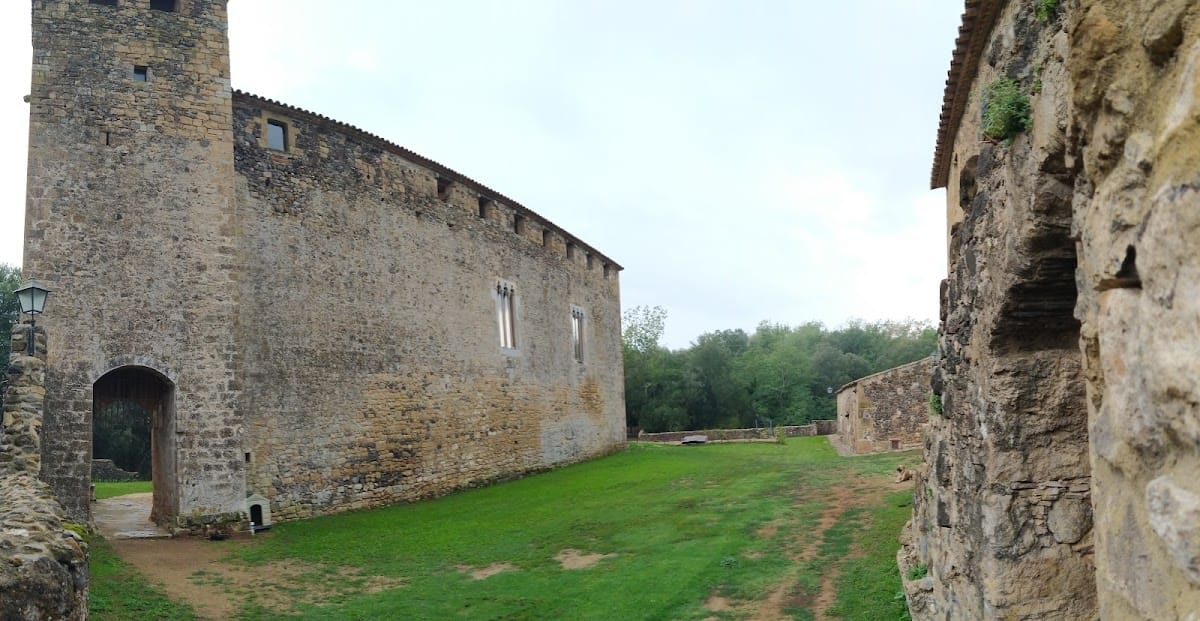
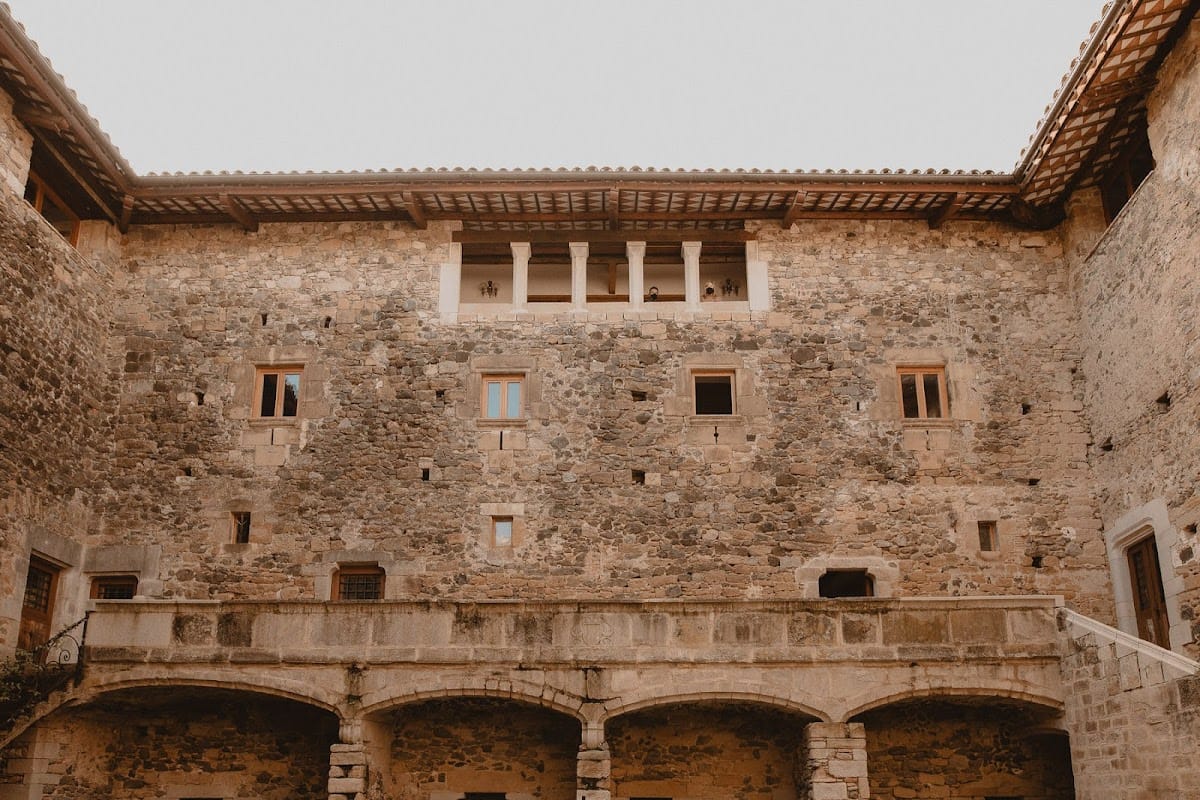
The principal building has a U-shaped plan with a ground floor, an upper floor, and an attic. Masonry forms the load-bearing walls, while ashlar blocks strengthen the corners and frame the openings. The central courtyard is rectangular, with two lateral stone stairways rising to a first-floor terrace. Very shallow stone arches support the terrace. Gothic windows with moulded surrounds open onto the second floor, and the upper part of the principal façade is finished with crenellations.
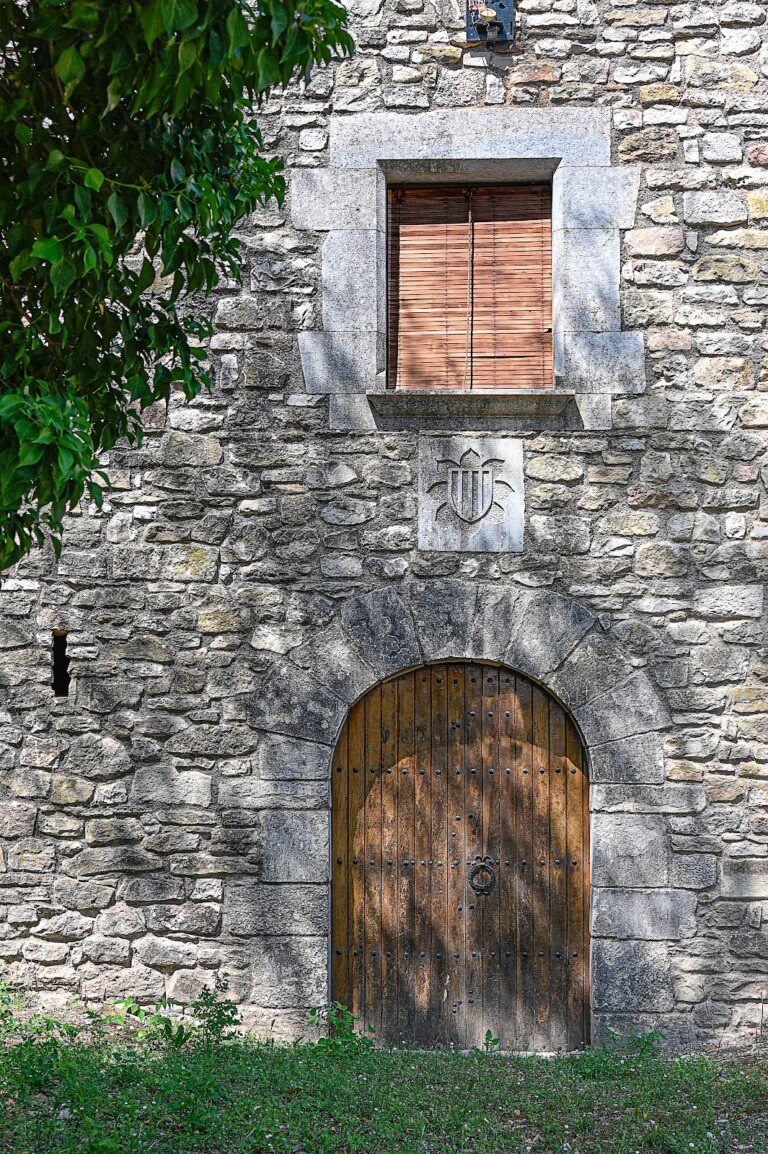
A doorway made with wedge-shaped stone voussoirs leads through the principal façade to the inner courtyard. The first floor contains a bifora, or two-part window, with trefoil-headed arches. Other exterior openings also have ashlar frames. The interior staircase is an early-modern addition, reflecting the later adaptation of the medieval complex as a residence and farm.
Main tower and defensive fabric
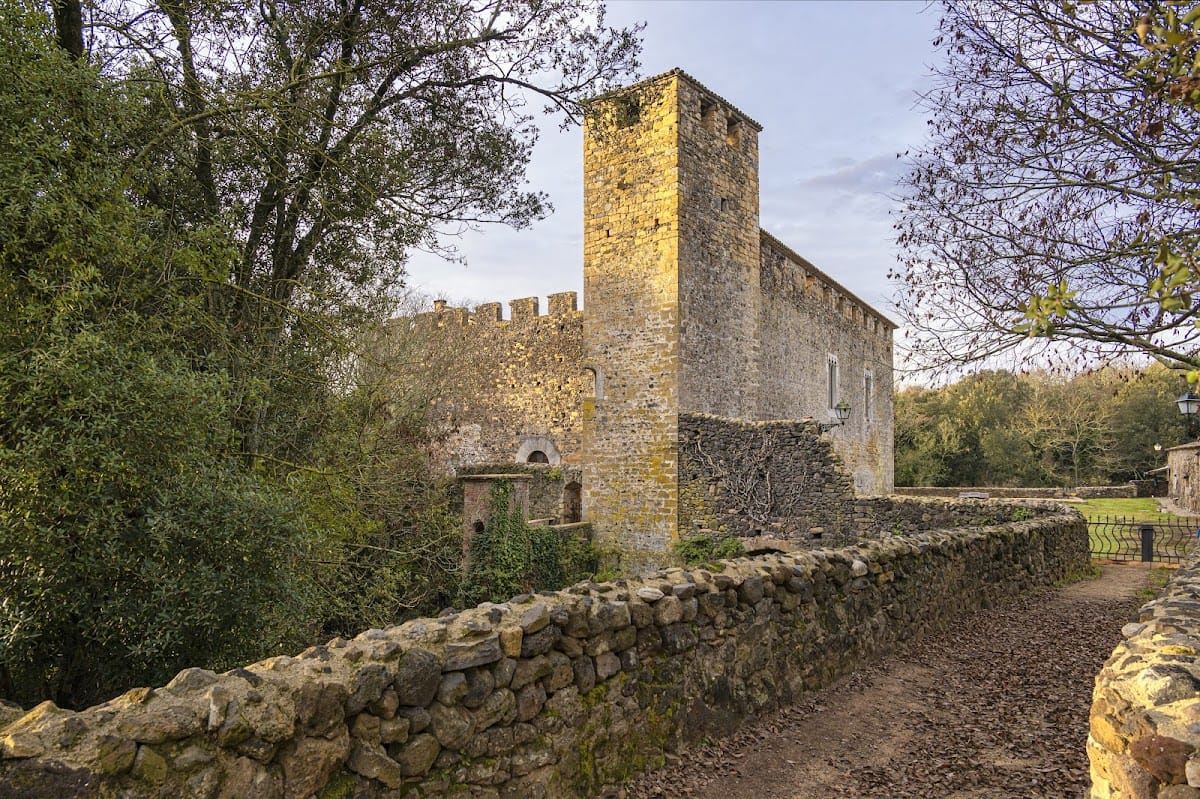
One arm of the U-shaped complex extends farther than the other and is arranged as a tower. Its ground floor remains open to allow entry into the enclosure, while its first floor has an angled window. The main tower is intact and connects with the rest of the castle through an extension of the north wall.
Parts of the walls date from the twelfth and thirteenth centuries, while much of the castle’s construction and its windows belong to the fourteenth century. The perimeter masonry is fairly irregular. Fragments of opus spicatum, a herringbone arrangement of stones, survive only on the east wall, where the principal gate is located. Crenellated sections and the fortified enclosure reflect the building’s earlier defensive role, while the courtyard and residential arrangements express its later palace-like character.
Chapel of Our Lady of Hope
The castle chapel, called the Chapel of Santa Maria in 1238 and now known as the Chapel of Our Lady of Hope, has a rectangular plan ending eastward in a polygonal apse. Its two-pitched roof is covered with Arabic tiles, and a single-opening bell gable rises above the roof. Agricultural adaptations raised the chapel by two levels. The ground-floor load-bearing walls are made of ashlar, and an exterior staircase attached to the apse reaches the upper floor.
The entrance is on the south façade. Its doorway was originally made with voussoirs but now has a stone lintel. Inside, a single nave is covered by a barrel vault, a continuous semicircular or nearly semicircular ceiling. The chapel probably had three double-splayed windows, one in the apse, one in the south wall, and one in the west wall beneath the bell gable.
The small squared stones of the chapel’s original fabric are laid in fairly regular courses, contrasting with the rubble masonry of the later raised levels. The interior is entirely whitewashed, with painted decoration imitating ashlar blocks across the apse and the lower wall surfaces. Its original construction corresponds to advanced twelfth-century architectural forms and was probably carried out in the thirteenth century.