Pisz Castle: A Teutonic Fortress and Ducal Residence in Poland


Site at a Glance
- Rating
- 2.6
- Popularity
- Very Low
- Country
- Poland
- Primary era
- Medieval
- External website
- Open
- Eras represented
- Medieval, Early Modern
- Civilizations
- Duchy of Prussia, Teutonic Order
- Site type
- Military
- Remains
- Castle
On this page9 sections
History
Pisz Castle was a Teutonic stronghold and later a ducal residence in Pisz, Poland, established on the western bank of the Pisa River in territory formerly associated with Galindia. The Teutonic Order, a medieval Catholic military-religious order that governed fortified settlements across Prussia and the eastern Baltic, probably built the first Teutonic manor between 1289 and 1344. Tradition places a fortified hunting lodge here in 1268, but that date is considered unlikely because the conquest of the Prussian lands was not complete until 1283.
Teutonic Origins and Conflict
The earliest Teutonic settlement was probably a defensive wooden-and-earth manor built on an earlier Prussian stronghold. It was administered by a procurator, a Teutonic official responsible for governing a district or castle, who was subordinate to the commander of Balga. The site’s position among marshes and wetlands made it difficult to approach, while its fortifications protected the western bank of the Pisa River.
In 1361, Kiejstut captured and burned the castle in retaliation for a Teutonic expedition against Lithuania during which his son had been abducted. Kiejstut, a medieval Lithuanian ruler and the uncle of Jogaila, later King Władysław II Jagiełło of Poland, led repeated attacks against Teutonic strongholds. The castle’s procurator, Johan Collyn, and part of the garrison escaped into a detached tower, probably a dansker, a projecting defensive tower often associated with sanitary facilities. The tower was set on fire, and Collyn was captured. After returning from Lithuanian captivity, he was attacked again by Kiejstut in 1365. He escaped when burning boats were directed towards the tower, filling it with smoke and flames.
A new masonry castle was built in the 1370s. In 1392 and 1393, large Teutonic expeditions against Mazovia and Lithuania departed from Pisz under Grand Marshal Werner von Tettingen. During these campaigns, unarmed fishermen and beekeepers were killed, and peasants were hanged in front of their homes. The castle remained outside the main operations of the Great War of 1410 and the Hunger War of 1414, despite its proximity to Polish territory.
Expansion and the Thirteen Years’ War
The fortifications were expanded in 1431 and 1435, probably in response to the use of firearms. The work included raising earthworks, thickening walls, and possibly constructing powder towers. At the beginning of the Thirteen Years’ War, a conflict between the Teutonic Order and the Prussian estates and their allies, the procuratorial district was occupied in autumn 1455 by rebel free peasants opposing the Order. Polish mercenary troops commanded by Jan Skubel subsequently held the castle.
Under the Second Peace of Toruń, Pisz remained within the Teutonic state, whose capital was at Königsberg. The castle changed little until the rule of Albrecht Hohenzollern. Albrecht was the last Grand Master of the Teutonic Order and became the first duke of Prussia after the Order’s Prussian state was secularized in 1525. His political ambitions led to the castle’s expansion and strengthening.
In 1519, at the beginning of the final Polish-Teutonic War, Polish troops commanded by Paweł Brzeski, the starost of Łomża, seized Pisz. A starost was a royal or ducal territorial official. The Teutonic procurator Hans Kolbitz fled to Szczytno, but Teutonic forces recaptured the castle in 1520. From 1525, the complex became the seat of the ducal starost. Albrecht and his successors frequently stayed there, particularly while hunting in the Pisz Forest. In 1538, Albrecht and his court remained at the castle for an extended period after an epidemic forced them to leave Königsberg.
Ducal Residence and Fortress
A general rebuilding and enlargement began in 1561, near the end of Albrecht’s life, and continued between 1580 and 1585 under Christopher Römer, the court architect of Königsberg. The works transformed the castle while preserving its military role. In 1628, Duke George William ordered the engineer Christian Rose to strengthen the fortifications. The work extended beyond the castle moat and temporarily required land belonging to townspeople.
Further improvements followed. In 1647, the ducal surveyor Wilhelm Treber came to Pisz to complete the enlargement. In 1655, artillery developments led to the incorporation of the town founded in 1646 into the fortress system. The castle and town thereby formed one extensive defensive complex. The fortress survived the Swedish Deluge, the series of wars that devastated much of the Polish-Lithuanian Commonwealth in the mid-seventeenth century, as well as a Tatar invasion. Its survival appears to have resulted from the preparedness of Pisz as a whole rather than from exceptionally powerful castle fortifications.
A fire partially damaged the castle in 1679, and repairs were completed two years later. Under General von Waldeck, the surrounding defenses were first supplemented with a wooden palisade. Between 1679 and 1698, these defenses were replaced or developed into a bastioned fortification system. Bastions were projecting angular platforms designed to support artillery and protect the walls. The system followed the model presented in a military treatise by Adam Freytag and was probably complete by the meeting of Augustus II the Strong of Poland and Frederick III Hohenzollern at Pisz on 4 June 1698.
Count Carl Wilhelm Finck von Fincensten held the title of governor of the Johannisburg fortress from 1686 to 1714. In 1709, a plague epidemic left either 14 or 15 inhabitants alive, and the castle lost much of its importance. A military storehouse was required in 1729, and the complex continued to operate as a fortress with a garrison until the end of the first half of the eighteenth century. A renovation in 1740 adapted the interiors to contemporary needs as the complex gradually became a more comfortable residence.
Decline and Destruction
Pisz was the setting for major political meetings in 1698 and 1734. In the late seventeenth century, Augustus II was received at the castle by Frederick III Hohenzollern. In 1734, Stanisław Leszczyński reached Pisz in disguise while fleeing from Gdańsk because of the Russian military threat. He was recognized and detained there.
The Johannisburg fortress was dissolved in 1787. The castle was sold, its fortifications were dismantled, and the land created by their removal was returned to the townspeople. Part of the buildings and defensive walls was demolished in 1837. The remaining complex then stayed almost unchanged for about a century.
During the Second World War, destruction affected about 75 percent of Pisz, and the castle was almost entirely destroyed. The surviving ruins were dismantled in the 1960s. Archaeological work in 2004 examined the former fortress site to establish the castle’s precise outline and support the eventual reconstruction of at least part of the complex. A local legend associates the castle with an underground passage beneath the Pisa River leading to the former Teutonic farm at Łupki.
Remains
Castle Site and Early Fortifications
The castle occupied the difficult ground of the western bank of the Pisa River, among marshes and wetlands. Its setting restricted access, while the defensive works formed the main protection of the settlement. The earliest Teutonic complex was a wooden-and-earth manor erected between 1289 and 1344, probably over a Prussian stronghold. A masonry castle replaced it in the 1370s, establishing the principal stone phase of the site.
The castle’s defenses were enlarged in 1431 and 1435. Raised earthworks and thicker walls probably strengthened the enclosure against firearms, and powder towers may also have been added. The masonry complex was then rebuilt and extended from 1561, with further construction between 1580 and 1585 under Christopher Römer. These works altered the castle’s form as it served both as a fortified administrative center and as a residence for the dukes of Prussia.
Artillery Fortress and Later Residence
Christian Rose’s strengthening of the fortifications in 1628 extended beyond the castle moat and probably produced an outer defensive structure. Further enlargement continued through the seventeenth century. In 1655, the defenses were expanded to include the town founded in 1646, creating a broad defensive system adapted to artillery rather than an isolated castle enclosure.
After the fire of 1679, damaged parts of the castle were rebuilt by 1681. The later fortress included an initial wooden palisade and a bastioned system developed between 1679 and 1698. The bastions provided projecting angular platforms for artillery and formed part of the defenses surrounding the castle and town. A military storehouse was needed in 1729, while the 1740 renovation reshaped the interiors for contemporary use as the complex moved from a military stronghold towards a residence.
Surviving Fragments
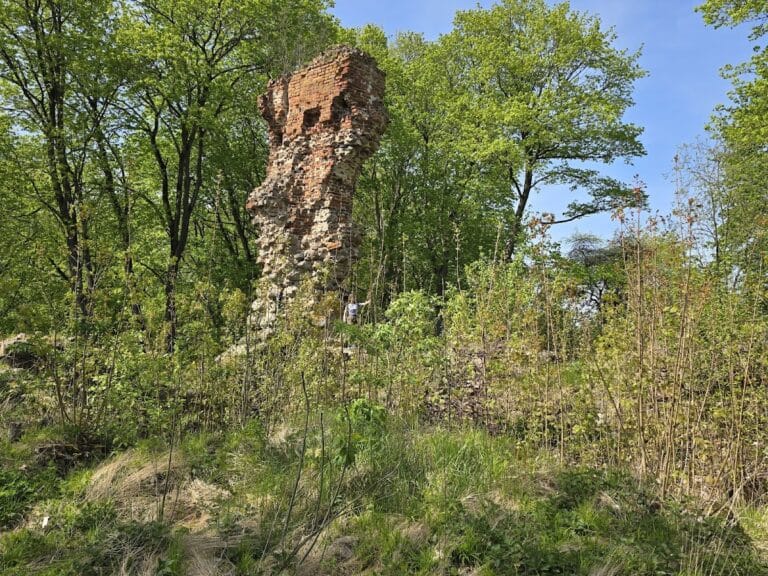
The dismantling of the fortifications after 1787 and the demolition of part of the buildings and walls in 1837 reduced the physical extent of the complex. The Second World War caused further destruction, and the remaining ruins were dismantled in the 1960s. Fragments of a wall survive in a park beside the Pisa River. Archaeological work in 2004 sought to define the former castle and fortress outline, providing a basis for considering the reconstruction of part of the complex.