Sant Miquel Castle (Gironès): A Fortified Summit Complex



Site at a Glance
- Rating
- 4.6
- Popularity
- Medium
- Country
- Spain
- Primary era
- Modern
- External website
- Open
- Eras represented
- Medieval, Early Modern, Modern
- Civilizations
- Crown of Aragon, Spanish
- Site type
- Military
- Remains
- Fort
On this page10 sections
History
Sant Miquel Castle is a fortified architectural complex in Spain, on the summit of Sant Miquel mountain between the municipalities of Girona and Celrà in the Gironès region. The summit was probably fortified during the medieval period for military purposes and territorial surveillance, although the date of that first installation is unknown. The site later became a chapel, a military position, and an optical-telegraph station, reflecting successive changes in its strategic and communications functions.
Medieval Fortification and Chapel
The earliest fortified phase is represented by remains that may include two cisterns and a section of wall associated with the base of a semicircular tower. The first historical records, however, concern a chapel dedicated to Saint Mary and Saint Michael the Archangel, built in the mid-fifteenth century. Hermits appear to have occupied the chapel, probably continuously, between the sixteenth and eighteenth centuries.
The Peninsular War
During the Peninsular War, the conflict caused by the First French Empire’s invasion and occupation of parts of Spain, French imperial troops occupied Sant Miquel during operations connected with the second siege of Girona in 1808. On 16 August 1808, miquelets, irregular Catalan militia forces, commanded by Joan Clarós attacked from Els Àngels. They expelled the French troops and forced their retreat to Campdorà.
The summit regained military importance during preparations for the 1809 siege of Girona. On 9 May, about 100 troops of the Vic tercio, a military unit associated with Vic, withdrew before an estimated 500 French soldiers. The French then entrenched themselves at Sant Miquel. The chapel appears to have been destroyed after the Peninsular War, leaving its remains available for later military adaptation.
Optical Telegraphy and Later Status
In 1848, the chapel ruins were reused for two optical-telegraph towers. Optical telegraphy transmitted messages through visible mechanical signals displayed on towers. One tower formed part of the military Madrid to French frontier line, while a newly built neighboring tower served the civil line. The complex was fortified and enclosed by a perimeter moat, a defensive ditch around the site.
The system soon became obsolete when an electric telegraph line began operating in 1856. The towers subsequently passed under Civil Guard control. Sant Miquel Castle is listed in Catalonia’s architectural heritage inventory under reference 21551 and is classified as a Cultural Asset of Local Interest. It lies within the protected Gavarres massif and belongs ecclesiastically to the Diocese of Girona, the Roman Catholic territorial jurisdiction, in the parish of Sant Feliu de Celrà. Its administrative affiliation has been disputed: the site was historically more closely linked to Celrà, while an apparently contested reassignment to Girona took place during Spain’s democratic transition.
Remains
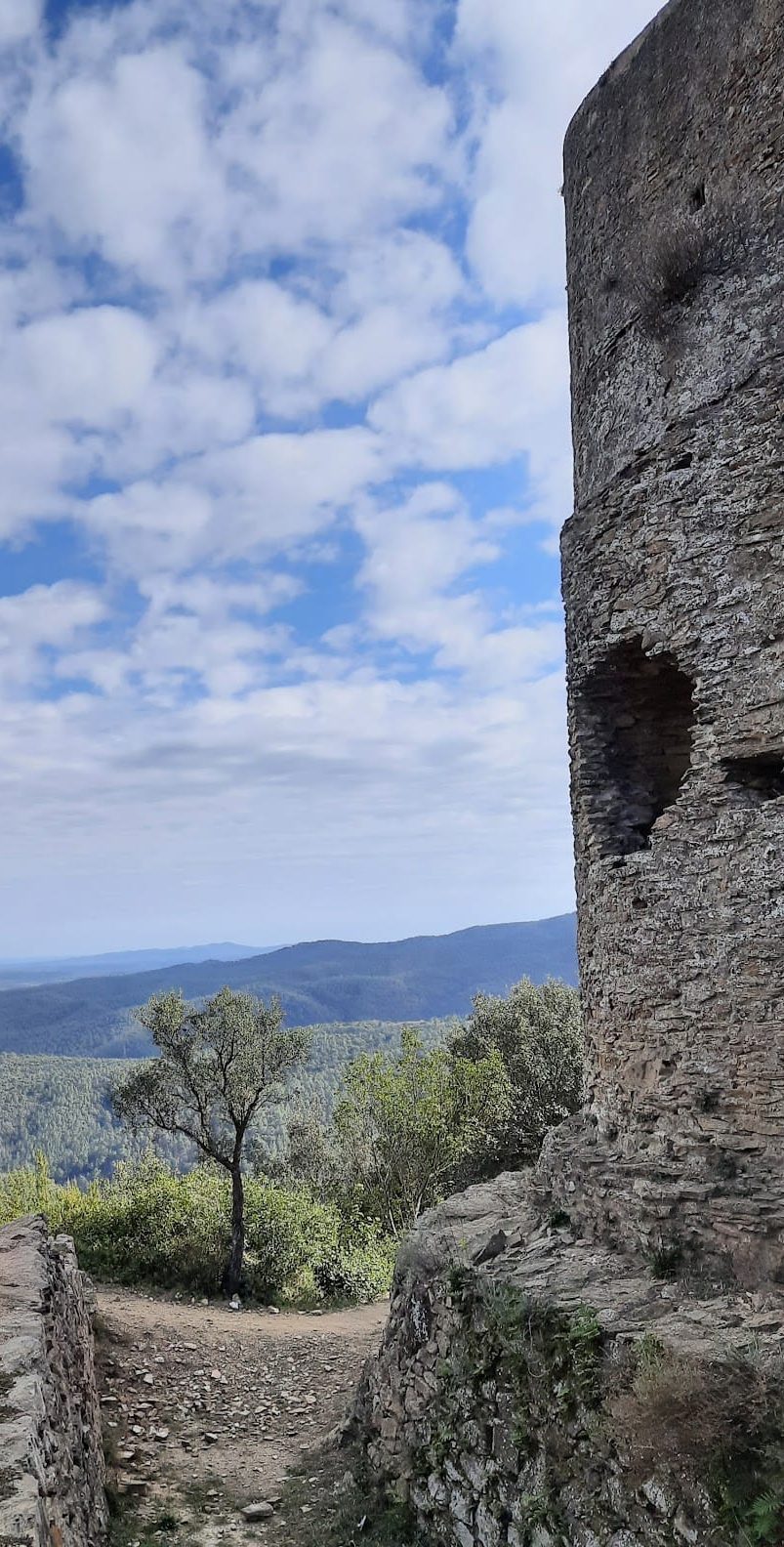
The summit complex stands at approximately 385.3 metres above sea level and is enclosed by a moat. It combines the remains of an earlier fortification with the chapel of Saint Michael the Archangel and square-based tower structures. Its elevated position provides extensive territorial visibility across the Gironès plain and the Gavarres, as well as toward the Costa Brava from Pals, the eastern Pyrenees, Les Guilleries, Montseny, Rocacorba, the Serra de l’Albera, Montgrí, northern Montnegre, Puig Alt near Sant Martí Vell, and the Sanctuary of Els Àngels.
Earlier Fortified Remains
Two quadrangular cisterns belong to the earlier fortified phase. One was partly destroyed when the moat was constructed. A surviving wall section retains the remains of the base of an associated semicircular tower, linking these features to the predecessor defensive installation on the summit.
Chapel of Saint Michael
The chapel has a single nave and a polygonal apse built over the base of an earlier circular tower. The nave was enlarged around the eighteenth century. Its original brick-arch roof was later replaced by a stone vault, and an external bell gable stood midway along the nave. Loopholes, narrow openings used for observation or firing, remain visible in the apse and side wall and belong to the site’s military adaptation during the Peninsular War.
Optical-Telegraph Towers
Military Tower
The military optical-telegraph tower occupies the southern side of the chapel and was installed over the ruined apse. It has a square plan, a battered base, meaning a base that slopes outward for added stability and protection, and several loopholes.
Civil Tower
The neighboring civil optical-telegraph tower was purpose-built on a square plan. Its entrance was positioned on the first floor, while a second level held the communications equipment. The terrace carried the signaling apparatus used by the civil optical-telegraph line.
Nearby sites