Castle of Alba: A Medieval Fortress in Losacino, Spain


Visitor Information
Google Rating: 4.4
Popularity: Low
Google Maps: View on Google Maps
Country: Spain
Civilization: Unclassified
Remains: Military

History
The Castle of Alba is a medieval fortress located in the municipality of Losacino, Spain. It was built and utilized by the medieval Christian kingdoms on the Iberian Peninsula, primarily during the Middle Ages when territorial conflicts shaped the political landscape.
The origins of the castle date back to at least the 10th century. It is mentioned in a 960 document from Sahagún, where it appears as “Alba Castello” in a donation by King Sancho I of León. The fortress likely saw early revitalization during the reign of Alfonso III of Asturias, reflecting its strategic importance overseeing the area between Castrotorafe and Portugal. By the late 12th century, the castle had established recognized governors, including García López and Pedro Fernández de Castro “El Castellano,” and underwent significant strengthening, probably under Fernando II of León amid tensions with Portugal.
During the reign of Alfonso IX of León, the castle was a key military site in the border conflicts involving León, Portugal, and Castilla. The fortress also represented political alliances forged through Alfonso IX’s marriages to Teresa of Portugal and Berenguela of Castilla. In 1196, Alfonso VIII of Castilla captured the castle, reflecting the ongoing contest for control. A decade later, the 1206 Treaty of Cabreros assigned the castle to Infante Fernando of León, settling disputes over frontier fortresses.
Alfonso IX pledged the Castle of Alba to the Knights Templar in 1211, with the arrangement finalized in 1220. The Templars then maintained control for about ninety years, a period during which the castle’s defenses were likely enhanced. After the early 14th-century suppression of the Templar order, ownership transferred to the Order of Saint John. Throughout the 14th and 15th centuries, the castle changed hands among various noble figures, including Infante Pedro of Aragón in 1430 and Álvaro de Luna in 1434. Later, it passed to Admiral Alonso Enríquez, whose family was honored in 1459 when Enrique Enríquez received the title Count of Alba, establishing the castle as the seat of the Counts of Alba de Aliste.
The site’s final recorded military engagement took place during the Portuguese Restoration War, when Portuguese forces captured it in 1640. Following this period, the castle gradually lost its military significance and fell into ruin.
Remains
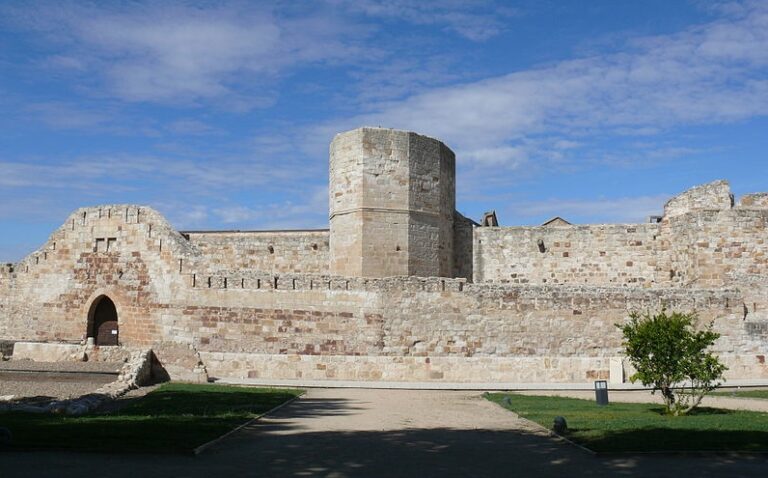
The Castle of Alba occupies a rocky hill that commands views over the Aliste River and the Retael stream, enhancing its military advantage in controlling key routes between Castrotorafe and Portugal. The fortress was built primarily using stone, following typical medieval construction methods aimed at defense.
The most prominent remaining structure is a large square tower known as a torreón, which dates back to the 13th century and is attributed to the Templar period of occupation. This tower features gently pyramid-shaped roofing and narrow arrow slits positioned near its upper sections, designed to allow defenders to shoot arrows while remaining protected. The tower’s design reflects the military architectural style of the time, balancing fortification with functionality.
Surrounding walls survive in fragments, indicating the extent of the castle’s former perimeter, though these are partially ruined. The castle’s location near the village of Castillo de Alba and the changes brought by the construction of the Ricobayo dam have altered the landscape, reducing the visibility of its defensive prominence. Despite this, the remaining tower and wall sections still mark the site of an important medieval stronghold.
No inscriptions, decorative elements, or associated artifacts have been documented within the surviving structures. The castle exists today largely as a historical ruin, providing evidence of its centuries-long role in the border dynamics of medieval Spain.
Nearby sites