Bioul Castle: A Medieval Fortress and Residential Estate in Belgium


Site at a Glance
- Rating
- 4.5
- Popularity
- Low
- Country
- Belgium
- Primary era
- Early Modern
- External website
- Open
- Eras represented
- Medieval, Early Modern, Modern
- Civilizations
- Habsburg, Holy Roman Empire
- Site type
- Domestic
- Remains
- Castle
On this page15 sections
History
Bioul Castle, also known as Vaxelaire Castle, is a fortified residential estate in Belgium, standing in the village of Bioul above the Meuse valley. Its history reaches back to the tenth century, when a first tower was built, while the principal sixteenth-century complex became one of the largest of its kind in Namur Province. The castle developed from a feudal stronghold into a seigneurial residence, a building associated with a lord’s estate and authority.
Medieval lordship
The fortress appears in texts dating from the tenth century. Further buildings were later added around the original tower, forming a quadrangular farm complex. From the eleventh through the thirteenth century, Bioul belonged to the d’Orbais family. In the thirteenth century, the lordship passed to the Jauche family when Berthe d’Orbais, heiress of Bioul, married Gérard II de Jauche. Gilles Jauche was recorded as the castle’s owner in 1343.
During the fifteenth century, the Jauche family mortgaged Bioul. Their financial difficulties were linked to an expensive lifestyle and to the ransoms needed to free Jacques de Jauche, who had been captured by the French on two occasions. Poor maintenance contributed to the castle’s deterioration, and the army of Dinant severely attacked it in 1454. These pressures left the earlier feudal complex in decline.
Rebuilding and noble residence
In 1522, the land and castle passed to Jehan de Jauche, a cousin of the last male representative of the senior Jauche line. Jehan sold the property to Jean de Hosden, who resold the lordship on 22 December 1522 to Thierry de Brandebourg, lord of Château-Thierry, Bioul, and Hubinez. Thierry built a new tower in 1523, replacing or transforming the ruined feudal castle.
French troops commanded by King Henry II burned the castle in 1554 during the wider destruction of buildings in the Spanish Netherlands, the Habsburg-ruled territories of the Low Countries. The Brandebourg family later converted the damaged feudal stronghold into a prestigious residential manor. After the Brandebourg line became extinct in 1708, a lord of Bilquin acquired the estate and gave it to his daughter. Her marriage to a French member of the Moreau family brought the property to a leading iron-producing family in Namur Province. The Bilquin and Moreau families successively held Bioul from 1708 to 1870.
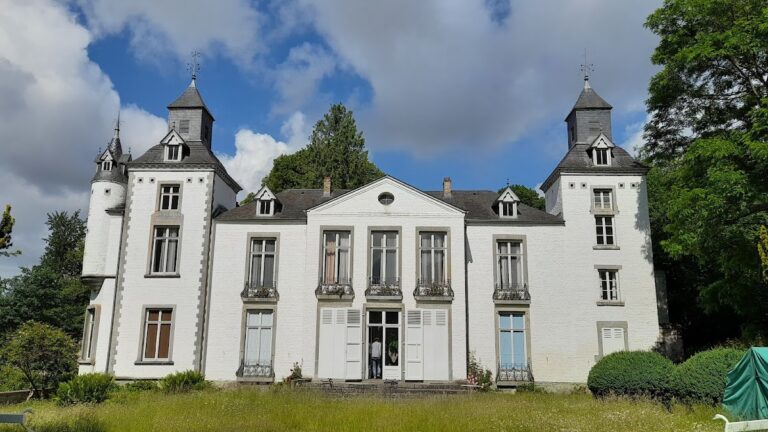
Guillaume-Nicolas de Moreau restored the castle and its park in 1776. In 1870, the Moretus-de Theux family of Antwerp, connected with the Plantin family, acquired the estate. The Vaxelaire family moved into Bioul as tenants in 1896 and became owners in 1904. François Vaxelaire then commissioned Edmond Franken-Willemaers and Léon Cabarche to remodel the castle while respecting its sixteenth-century character. After François died in 1920, his sons, Baron Raymond Vaxelaire and the writer Georges Vaxelaire, inherited it.
Bioul during the First World War
Bioul Castle became involved in the opening operations of the First World War. Colonel Philippe Pétain, commander of the French 4th Infantry Brigade and later Marshal of France, stayed there on the night of 15 August 1914 before the Battle of Dinant. On 23 August, remnants of the Belgian 4th Army Division and the Namur garrison gathered in the village and castle while German forces almost surrounded them.
Senior Belgian officers held a council of war in the castle’s outbuildings to decide whether a breakthrough remained possible. With assistance from the village schoolteacher, the Belgian units crossed Ronquière Wood at night and reached the French lines. During the Dinant commemorations in September 1927, Pétain and Captain Charles de Gaulle, who later became a prominent French general and statesman, stayed at Bioul as guests of Raymond and Georges Vaxelaire. A dinner and fireworks display were held in their honour.
Twentieth-century preservation
Baron François Vaxelaire, Raymond’s son, undertook major renovation work in 1956 and engaged the landscape architect René Pechère. The Wyckmans-Vaxelaire family continues to occupy the estate, oversee its preservation, and conduct economic and tourism activities there. Viticulture began on part of the park in 2009, adding wine production to the estate’s continuing uses.
Remains
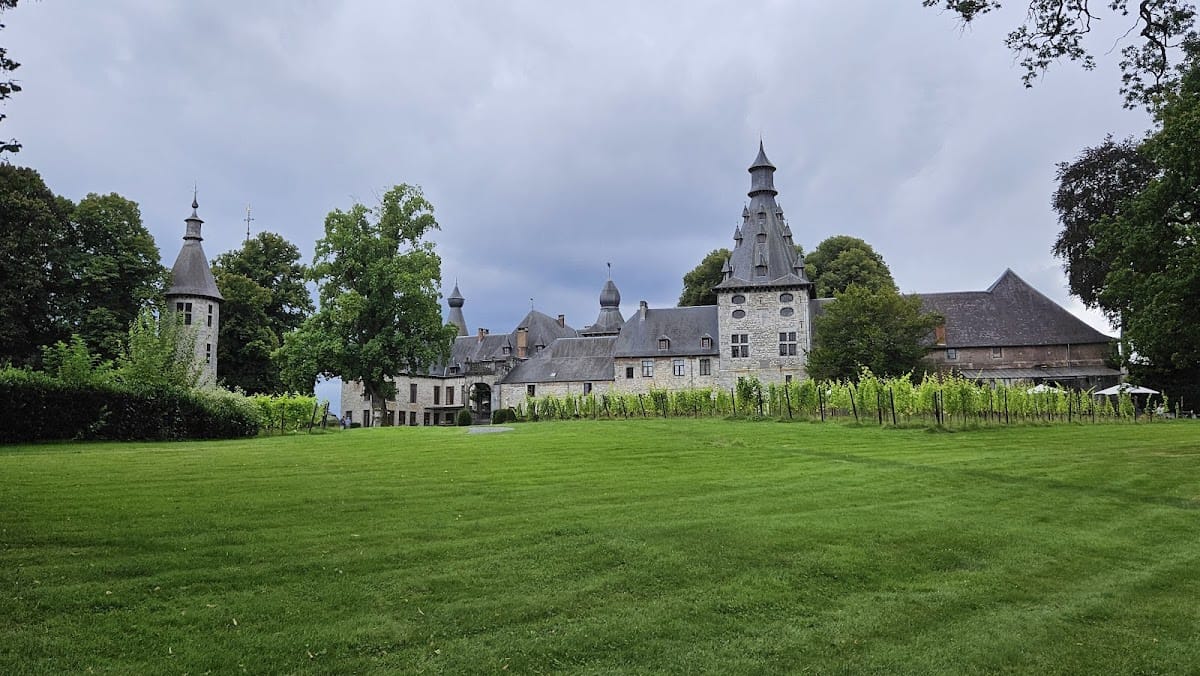
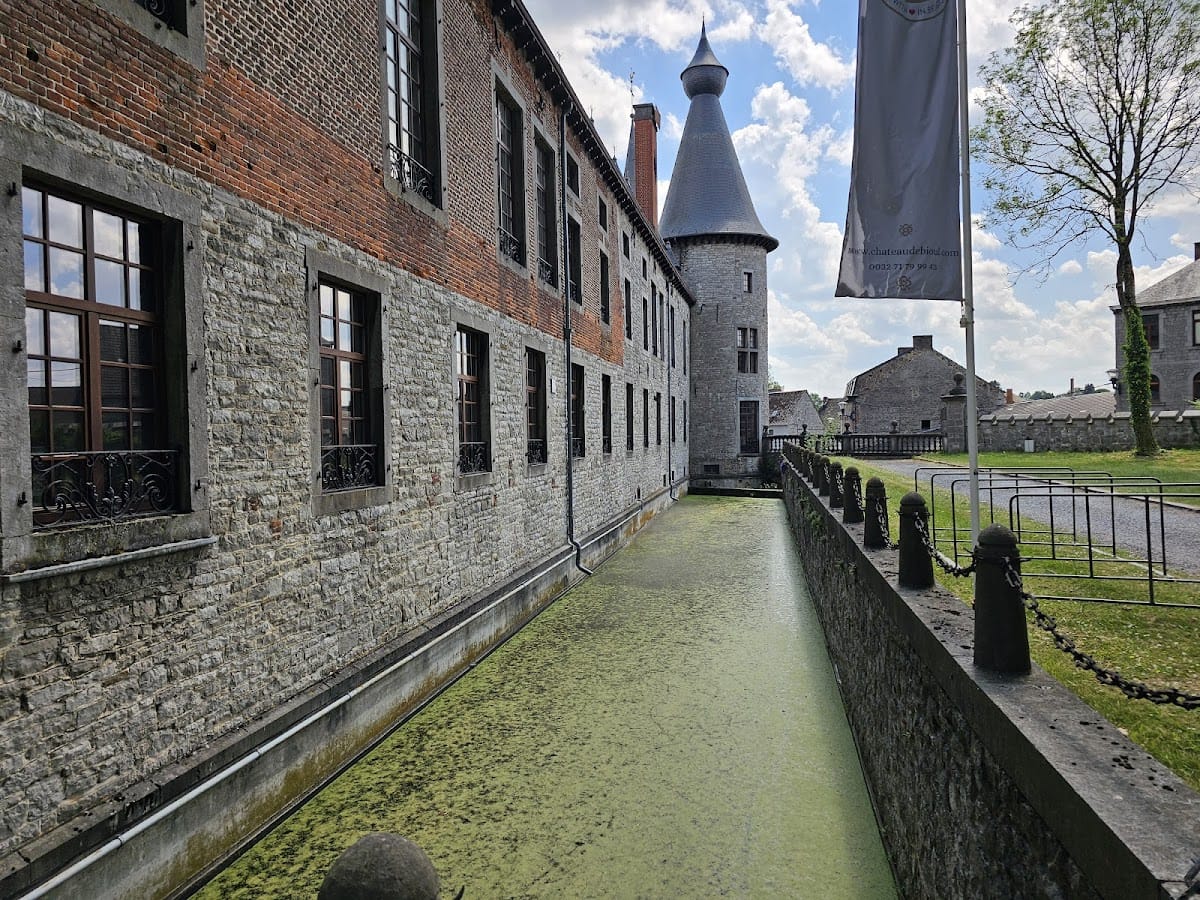
Bioul Castle is principally built of limestone and retains a massive defensive appearance. The complex is organized around two extensive courtyards, with fortified towers and seigneurial buildings enclosing the spaces. A surviving section of moat, defensive openings, drawbridge fittings, and a park remnant of the earlier feudal castle preserve evidence of both military and residential phases.
Fortifications and entrance
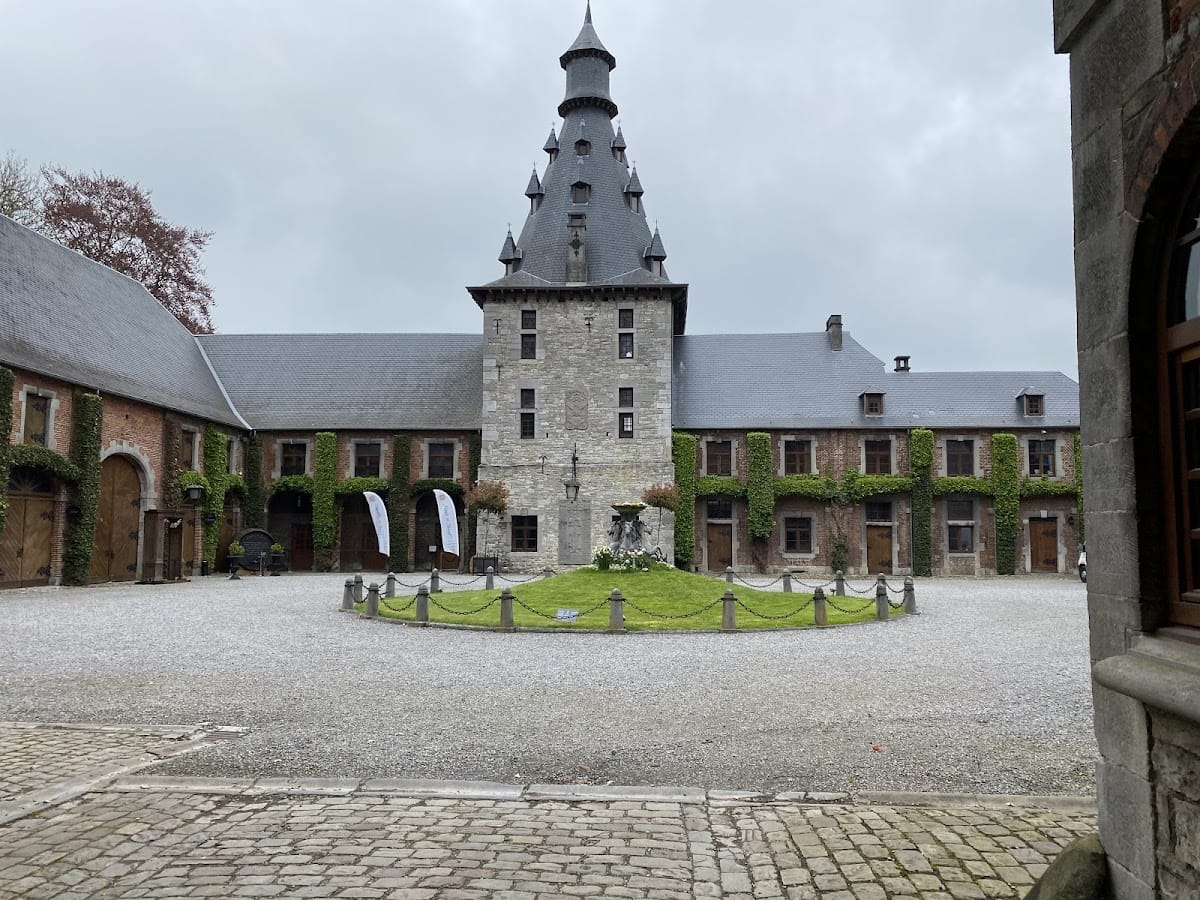
Square tower of 1523
A square tower stands in the courtyard and bears the arms of Thierry de Brandebourg, its builder, together with a Gothic inscription dated 1523. The tower belongs to the rebuilding that followed the decline of the earlier feudal castle and forms part of the limestone complex associated with the sixteenth-century transformation of Bioul.
Gateway and moat
An entrance porch and a long avenue of lime trees lead to a large carriage gate passing through the principal building. Part of the moat remains in front of the exterior facade. Narrow loopholes, openings through which weapons could be used, flank the gateway, while the entrance retains the mortises, or sockets, that held the moving arms of the former drawbridge.
Towers and surviving feudal element
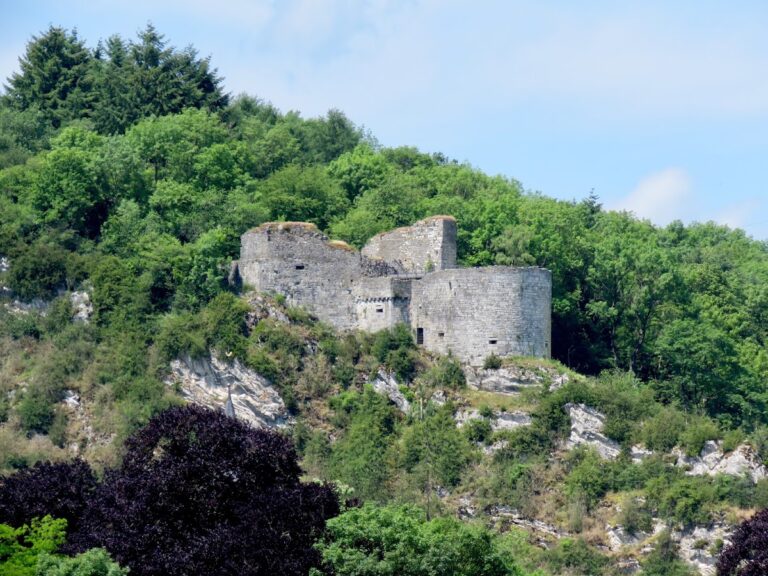
Three round towers and two square keeps flank the castle. A keep is a fortified tower intended for defense or residence. The complex is partially ruined, yet its surviving buildings retain their seigneurial character. In the park, a loophole tower survives as a remnant of the earlier feudal castle, linking the landscaped grounds with the site’s medieval defensive phase.
Courtyards and landscaped grounds
Service courtyard
One courtyard is enclosed by service buildings and outbuildings. These structures form part of the working side of the estate and contrast with the more formal courtyard used for the lord’s residence and representation.
Courtyard of honour
The larger courtyard is the courtyard of honour. It opens toward an English-style landscape park, a garden arranged with informal lawns, trees, water, and natural-looking views rather than a rigid geometric plan. The park is bordered by a pond and covers 40 hectares. It contains centuries-old trees of various species, and part of its area has been converted to vineyard use.
Chapel and later residential features
Neo-Gothic chapel
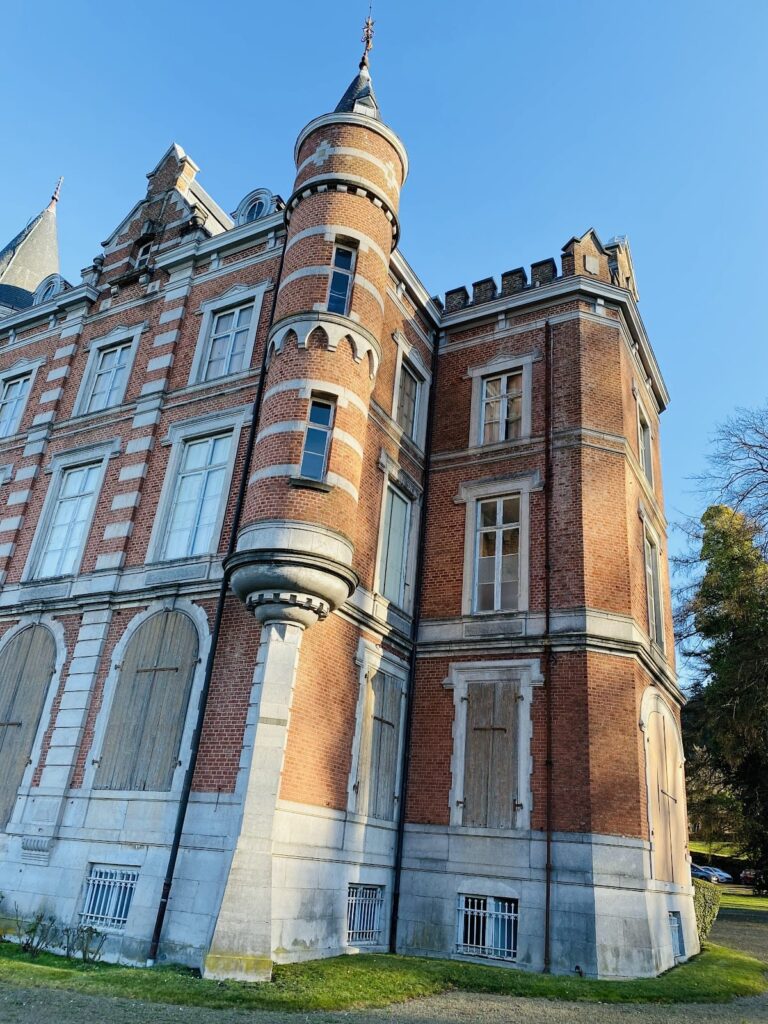
A neo-Gothic chapel was added to the castle during the nineteenth century. Its construction belongs to the later residential development of the estate, when Bioul’s fortified architectural inheritance continued to be adapted for the needs and presentation of a noble country residence.