Dave Castle: A Medieval Stronghold and Aristocratic Estate in Belgium


Site at a Glance
- Rating
- 4.4
- Popularity
- Very Low
- Country
- Belgium
- Primary era
- Early Modern
- Eras represented
- Medieval, Early Modern
- Civilizations
- Habsburg, Holy Roman Empire
- Site type
- Domestic
- Remains
- Castle
On this page7 sections
History
Dave Castle is a medieval castle in Namur, Belgium, whose origins are connected with the lords of Dave and whose later history linked it to the Spanish ducal family of Fernán Núñez. The site became a centre of power for the influential lords of Dave, and its medieval structure was ruined in the seventeenth century before being reconstructed during the eighteenth and nineteenth centuries.
The Lords of Dave
Dave was one of the oldest titled vicomtés in Namur, a feudal territory associated with a viscount. Warnier de Daules held the domain in 1284, after which it passed through his descendants, including Godefroi de Dave. Godefroi built a castle on a rocky site on the right-hand side of the mountain ridge, where it could be seen from the terrace of the later castle.
Godefroi requested that the property be held as a fief, meaning land possessed under a formal feudal relationship with a superior lord, from Guillaume I of Namur, Count of Namur. This arrangement was granted on 22 July 1372. The castle thereafter served as the centre of authority for the lords who controlled the domain.
Changes of Ownership
The domain passed to the House of Boulant in 1530 and to the House of Barbançon in 1577. Henri de Barbançon was the last holder from that family. His daughter Marie married Albert de Ligne, Duke of Aremberg and Prince of Barbançon, in 1616.
Their son Octave, Prince of Barbançon, lived from 1643 to 1693 and served as Governor of Namur. Through his line, the domain passed to Marie del Patrocinio, who married Henri-Auguste de Vignacourt, Count of Lannoy and La Roche-en-Ardenne and Baron of Hannef. Henri-Auguste held Dave in the eighteenth century.
After Henri de Wignacourt died in 1760, his only daughter, Marie-Gabrielle, inherited the domain. She had married Alonso de Solis, Duke of Montellano, at the Abbey of Roncevaux in 1737. From this period, the castle remained in Spanish hands. On 1 March 1761, Marie-Gabrielle and Alonso de Solis commissioned Pierre Dupuit, receiver of Dave and a procurator before the Council of Namur, to have the lands of Dave and Naninne formally entered as fiefs in the duchess’s name before the feudal court of Namur.
Marie-Gabrielle died on 18 October 1791 and left her property to her only son, Alphonse de Solis, Duke of Montellano. He was the last feudal lord of Dave. The succession then continued through María Vicenta de Solís y Vignancourt Lasso de la Vega and her husband Carlos José Gutiérrez de los Ríos y Sarmiento de Sotomayor, Duke of Fernán Núñez; their daughter María Francisca de Asís Gutiérrez de los Ríos y Solís Vignancourt; and María Francisca’s husband Felipe María Ossorio y de la Cueva, Count of Cervellón and Duke of Fernán Núñez.
Reconstruction and the Fernán Núñez Connection
A description written around 1740 praised the beautiful House of Dave, its exterior embellishments, and its surrounding grounds. It stated that the resident lord continually expanded the improvements. The medieval castle had already suffered ruin in the seventeenth century, and the estate was reconstructed during the eighteenth and nineteenth centuries under the Dukes of Fernán Núñez. The name Fernán Núñez Castle reflects this Spanish ducal association.
María del Pilar Ossorio y Gutiérrez de los Ríos, born in 1829 and deceased at Dave in 1921, was the twenty-fourth Lady of Dave, second Duchess of Fernán Núñez, seventh Duchess of Montellano, Princess of Barbançon, and Viscountess of Dave. She married Manuel Falcó y d’Adda Valcárcel, fourteenth Marquis of Almonacid de los Oteros and Duke of Fernán Núñez, who served as Spain’s ambassador in Paris from 1860 to 1873.
Later holders included Manuel Falcó y Osorio, Marquis of la Alameda and Duke of Fernán Núñez, and Manuel Falcó y Álvarez de Toledo, Duke of Fernán Núñez. Manuel Falcó y de Anchorena is the current owner. He holds five grandeeships of Spain, including the dukedoms of Fernán Núñez and Bivona, the Marquisate of la Mina, and the counties of Barajas and Cervellón.
Remains
Castle Buildings and Riverside Setting
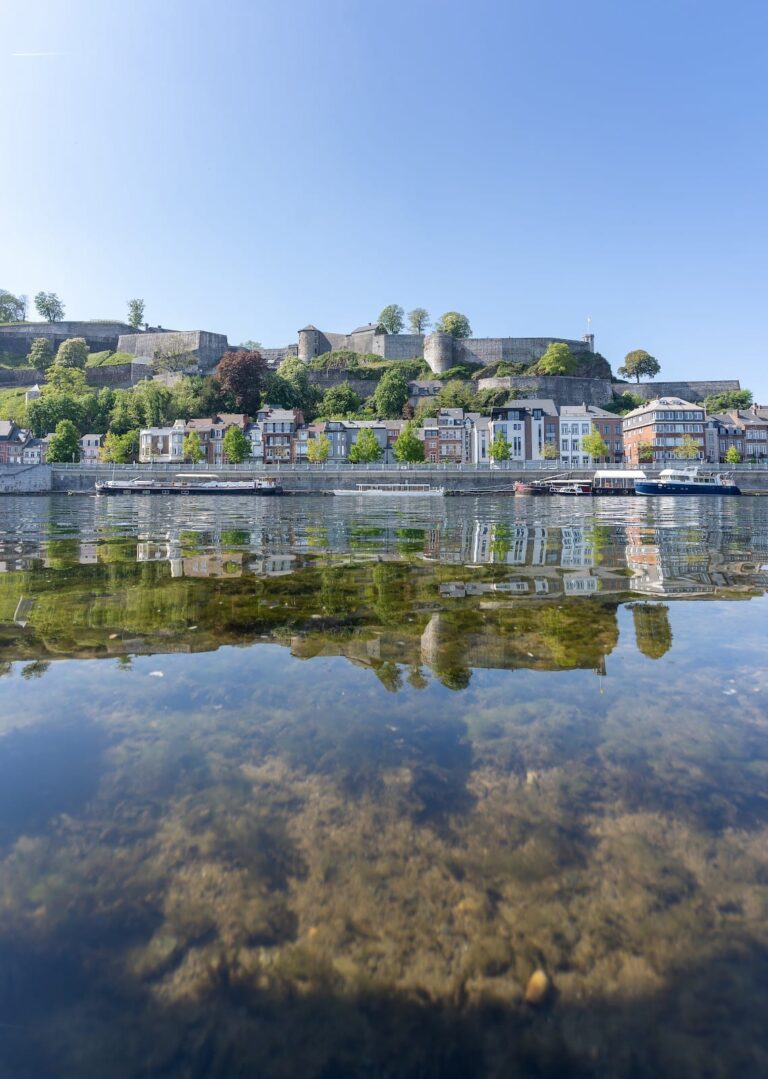
Dave Castle consists of several buildings arranged between the Namur-Dinant railway and the Meuse. The oldest buildings stand along the railway, while the eighteenth-century castle stands directly beside the river. The main château occupies the banks of the Meuse, and the earlier castle was built on the rocky site on the right-hand side of the mountain ridge, visible from the later château terrace.
The present château is associated with the work of Alphonse Balat, a Belgian architect. Its form belongs to the rebuilding and transformation of the estate after the medieval structure was ruined, while the surviving group of buildings preserves the relationship between the older castle remains, the later riverside residence, and the wider estate.
Park and Woodland
The estate includes a seven-hectare park designed in the English landscape style by Denis and Eugène Bühler. This type of designed landscape uses naturalistic planting and informal-looking views rather than a rigid geometric layout. The park contains several rare varieties of trees.
Extensive woods west of the railway also form part of the estate. These wooded areas are managed for timber production and extend the physical setting of the castle beyond the park and its landscaped grounds.