Lispida Castle: A Former Monastery and Agricultural Estate in Italy


Site at a Glance
- Rating
- 4.5
- Popularity
- Low
- Country
- Italy
- Primary era
- Medieval
- External website
- Open
- Eras represented
- Medieval, Early Modern
- Civilizations
- Venetian
- Site type
- Domestic
- Remains
- Castle
On this page14 sections
History
Lispida Castle in Italy developed from the religious complex of Santa Maria di Lispida, also known in medieval documents as Ispida. The monastery was active by the beginning of the twelfth century and passed through several religious communities before becoming a villa and agricultural estate. Its history includes Augustinian, Benedictine, Hieronymite, and Carthusian phases, as well as extensive quarrying on Mount Lispida.
Augustinian foundation and medieval protection
The foundation of the monastery and the circumstances of its establishment are uncertain. Canons of Saint Augustine were present at Lispida by the early twelfth century, during a period when Bishop Sinibaldo encouraged the creation of regular religious communities in several dioceses of Padua. The Augustinian Rule, attributed to Saint Augustine of Hippo, governed the religious life of communities of canons and other orders.
The earliest surviving reference dates from 15 June 1150, when Pope Eugene III issued a papal bull, a formal document sealed by the pope, to Prior Marco and the canons of Saint Mary of Ispida. The bull placed the community under the protection of the Holy See, confirmed its observance of the Augustinian Rule, recognized its possessions and donations, and granted it ten plots of land on Mount Lispida in return for an annual payment of one byzantine, a medieval gold coin used as a monetary unit.
During Frederick Barbarossa’s second expedition into Italy, probably around 1160, the prior of Lispida took refuge at the monastery of San Zaccaria in Venice. He returned around 1164 and appears to have remained rector for about twenty years. A dispute recorded in 1170 concerned property that the abbess of San Zaccaria regarded as compensation for the costs incurred during his refuge.
The monastery continued to appear in ecclesiastical records through the twelfth and thirteenth centuries. An annual payment was noted in 1192, a bequest was made to a Lispida hermit in 1197, and papal interventions followed in 1225 and 1227. Pope Honorius III confirmed protection over the community, its monastery and possessions, and Mount Lispida. Because of the community’s poverty, he also considered joining Lispida to Santa Maria delle Carceri.
In 1227, Pope Gregory IX ordered the prior of Santa Maria delle Carceri to reform the monastery. He also sought protection for its monks and nuns from people in Padua and its diocese who exploited the mountain’s stone and timber. Documents from 1230 and 1238 show that both male and female religious members were present at Lispida.
Benedictine reorganization and later medieval life
After the Augustinian friars and nuns died, the monastery was reorganized as a female Benedictine community. The reform was carried out by Giordano Forzatè, prior of Saint Benedict, together with the minister of the Friars Minor, probably before Forzatè went into exile in 1237. Benedictine observance derived from the Rule of Saint Benedict, one of the principal rules governing Western monastic life.
Little documentation survives from the period of Ezzelino da Romano’s rule between 1237 and 1256. After Padua was freed from his authority, Lispida resumed regular religious activity. In 1264 the community consisted of four nuns, Prior Rondine, Maria, Diambra, and Abbess Cunizza. Friars assisted them with external affairs. The monastery received devotional bequests and expanded its land through the dowries brought by new nuns.
During the late thirteenth century, the nuns became involved in disputes over tithes and properties being reclaimed for cultivation. In 1283, Pope Martin IV authorized them to celebrate the divine offices and hear Mass behind closed doors even during an interdict. An interdict was a church penalty that could suspend or restrict certain public religious services in a territory or community.
Religious life declined in the fourteenth century, while warfare affected monasteries throughout the region. By 1393, Lispida controlled 190 fields, including about 100 on Mount Lispida, 60 in the territory of Pernumia, and 29 around Monselice. Its possessions also included houses, part of a mill and a mill-right at Rivella, and the Lake of Lispida. The wider estate contained vineyards, olive groves, arable fields, meadows, orchards, woodland, marshes, and facilities for agricultural production.
Fifteenth-century reforms and changes of ownership
The monastery’s lands supported both direct management and leasing. The nuns appear to have administered the Lispida properties themselves, while land at Rivella, Pernumia, and Monselice, together with the lake and possibly the mill, was leased. Fishing rights on the lake could be rented to local people, and reeds from the wetlands were used for making mats.
In the fifteenth century, Antonio Zeno, bishop of Padua, ordered the expulsion of the Benedictine nuns under Abbess Antonia da Piove. The stated reasons included breaches of the rule, scandalous conduct, the admission of disreputable people, inadequate means of support, and the monastery’s isolated position. The nuns resisted. On 12 October 1436, Pope Eugene IV commissioned Ludovico Barbo, abbot of Santa Giustina, to enforce the expulsion and unite Lispida with San Giovanni Decollato.
The union did not last. On 5 July 1438, Eugene IV separated Lispida from San Giovanni Decollato and transferred it to the canons of San Giacomo of Monselice. They later renounced the complex because they considered its surroundings unhealthy, owing to stagnant waters, and inconveniently located. In 1443, the pope transferred Lispida to the Hermits of Pietro da Pisa, known as the Hieronymites or Gerolamini. The Gerolamini were an eremitical order associated with Pietro da Pisa and Saint Jerome.
The Gerolamini experienced disputes soon after arriving and ceded the monastery and church to the Carthusians in 1468. The Carthusians, a contemplative order combining solitary and communal religious life, were later challenged by the Gerolamini, who sought to reverse the transfer. The dispute ended in 1485 with a final judgment in favor of the Gerolamini.
The Carthusians’ neglect had left the complex in very poor condition. After regaining it, the Gerolamini repaired the damage, rebuilt the monastery, and restored its community. Lispida then entered its most prosperous period, which lasted for the following two centuries.
Prosperity, reconstruction, and quarrying
During the sixteenth and seventeenth centuries, Lispida was an active and prosperous monastery that hosted the general chapters of the Gerolamini. Major reconstruction and reorganization took place in 1523. The church was rebuilt, the bell tower was raised, and the quarters used by the religious community were greatly enlarged. The monastery also added more than 300 fields to its holdings, reclaimed surrounding marshland, and intensified quarrying on Mount Lispida.
Stone from the mountain supplied major building and defensive works. During the sixteenth century it was used for the defensive walls of Padua and for the Basilica of Santa Giustina. From the fifteenth century, the Venetian Republic became the principal purchaser of the quarry stone for lagoon defenses and sea walls. A mid-fifteenth-century agreement restricted the sale of stone intended for Venice to private buyers and regulated navigation along the canals used to transport it.
For much of the monastery’s history, quarrying was managed directly. The monastery assigned individual quarries by contract to master quarrymen, while the prior controlled prices and sales. Under the Gerolamini, the system became indirect. The quarries were leased to entrepreneurs, often members of the urban elites of Padua and Venice, who controlled production and marketing. Their increasing interference led to repeated complaints by the religious community.
Stone was carried by cart to the Canal de Arquà, which ran along the southern slopes of Mount Lispida. The heavy stones known as lido stones were taken to Pizzon, east of Battaglia, transferred to larger boats, and transported toward the Venetian lagoon. The channel was filled during the 1562 reclamation project at Monselice, whose hydraulic reorganization seriously affected the movement of stone.
Suppression, villa conversion, and modern use
The monastery was definitively suppressed in 1780. The Corinaldi family subsequently acquired the complex, renovated it, converted it into the present villa, and developed the surrounding property as an agricultural and wine-producing estate.
During the final years of the First World War, the villa housed the headquarters of King Victor Emmanuel III and subsequently became known as Villa Italia. Wine production resumed in the 1950s. The complex is now called Lispida Castle and combines wine production with accommodation and spaces for events and weddings.
Remains
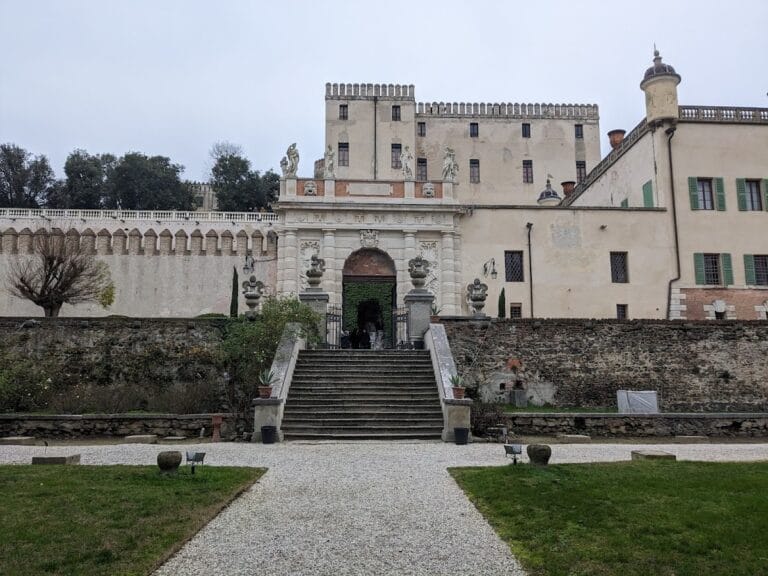
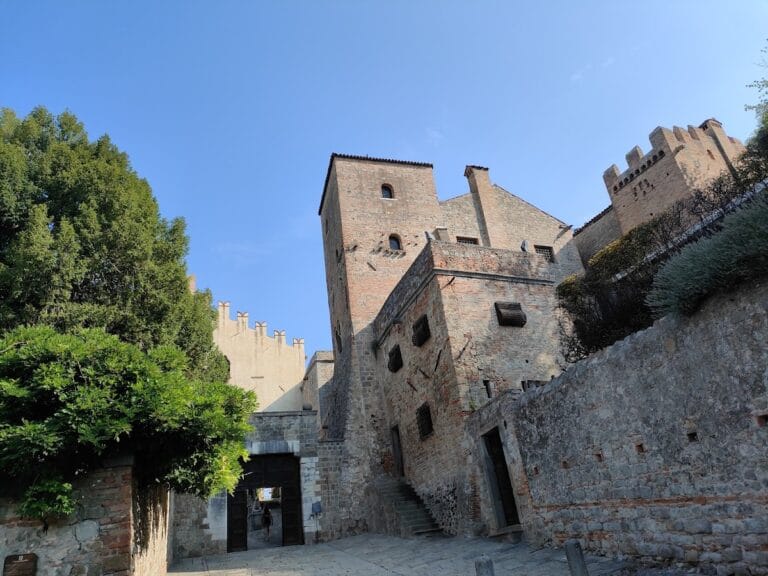
The surviving complex brings together the main villa, rural annexes, a large park, and the land of the former agricultural estate. Its architectural character results from the medieval monastery, the seventeenth-century expansion, the conversion into a villa, and later alterations. Only sections of the ancient masonry remain, incorporated into the tower near the principal building.
Villa and architectural complex
Main villa
The main villa has a rectangular plan and two stories. Its ground floor is faced with rustic rustication, a treatment that gives masonry a deliberately rough, heavy appearance. Round-headed openings, portals, and paired bifora windows with an oculus at the point where the arches begin organize the lower level. The upper story has further pointed bifora windows aligned with the openings below. The building is crowned by Ghibelline crenellations, notched battlements supported by blind arches.
Towers and connecting wing
Two square towers adjoin the principal building. One has chamfered corners that turn its upper part into an octagonal form. The other has the rural annexes built against it and stands near the surviving sections of ancient masonry. Turreted portals, the adjoining towers, and terraces formed by the ground give the complex a castle-like character, although its present appearance developed from the former monastery, the villa conversion, and subsequent changes.
A two-story wing extends at right angles to the main building and includes a loggia with two arches. Together with the towers and annexes, this wing forms part of the surviving arrangement of the former religious and agricultural complex.
Mount Lispida quarries and transport landscape
Stone deposits and quarry areas
Mount Lispida contains deposits of trachyte, a volcanic building stone. Some occurs in intact, compact blocks of workable size, while other material consists of medium and small fragments created when larger blocks fractured. At least seven quarries were active by the middle of the fifteenth century on the western and southern slopes.
Three quarrying areas, or priare, lay along the road rising from the south toward the monastery. Another stood beside a waterway, one was called Priara Magna, and two were located beside the monastery and its small church. The religious community exercised especially direct control over the last two so that extraction would not interfere with its regular activities.
Master quarrymen and stonecutters carried out the skilled work, assisted by less-skilled laborers generally recruited from nearby settlements. Extraction used top-cutting followed by separation with hammers and wedges, as well as a method of breaking blocks with picks and large levers. Stonecutters roughly shaped and initially worked the material at the quarry, whose work yards were required to remain clean, unobstructed, and unchanged.
Stone preparation and waterways
The quarries produced heavy, irregular blocks for Venetian sea defenses and lagoon sea walls. Higher-quality stone was rough-shaped, dressed, and squared at the quarry for construction, paving, and ornament. From the sixteenth century, limestone was also extracted, mainly as raw material for lime used in building around Lispida and in Padua.
The water system around Mount Lispida formed part of the quarry transport network. The Canal de Arquà bordered the southern slopes, while the route through Pizzon connected the extracted stone with larger waterways leading toward the Venetian lagoon. The mountain’s southern side was also associated in the medieval period with the Lake of Lispida, which was controlled by the religious community and still exists at the foot of the mountain.
Estate landscape and agricultural remains
The former estate included vineyards, olive trees, fruit trees, woods, meadows, marshland, and the lake. The cultivated area of Pernumia contained a wooden house enclosed by a wall and a stone oven. At Rivella, the holdings included a mill and a mill-right. The lands around Monselice and lower Lispida were characterized mainly by marshland, while the waterways connected agricultural production and quarrying with the surrounding settlements.