Altenstein Castle: A Medieval Fortress in Markt Maroldsweisach, Germany


Visitor Information
Google Rating: 4.6
Popularity: Low
Official Website: www.maroldsweisach.de
Country: Germany
Civilization: Medieval European
Site type: Military
Remains: Castle

History
Altenstein Castle stands in Altenstein, a locality within the municipality of Markt Maroldsweisach in Germany. Its origins trace back to the medieval period when it was constructed and inhabited by members of the Free Knightly family known as the lords of Stein zu Altenstein.
The earliest indirect record of the castle dates to 1225, referring to a “Marquard Magnus de antiquo lapide,” while a direct mention appears in 1231 describing the site as a fortified castle with an adjoining church. Initially independent nobles, the family transitioned to serve as vassals to the Prince-Bishops of Würzburg from the early 1300s, also holding various fiefs granted by religious institutions such as the abbeys of Banz and Langheim. Over the 13th and 14th centuries, Altenstein evolved into a Ganerbenburg—a shared castle occupied by multiple branches of the Stein family. By 1296, eight family lines lived within the complex, and a 1441 agreement set peaceful terms governing ten related families residing in distinct quarters.
During the 14th and 15th centuries, the family slowly expanded their local influence by securing a minor lordship centered around Altenstein. Yet the castle and its inhabitants faced turmoil during the Peasants’ War of 1525, which caused significant damage. Mid-16th century developments included a grant from Emperor Charles V in 1549, empowering the family with high court jurisdiction and the right to carry out capital punishment under the Imperial Court Hanging Law. However, political conflicts soon arose. In 1567, Wilhelm von Stein zu Altenstein opposed the Prince-Bishopric of Würzburg during the Grumbach Feud; his execution followed, and the family lost their fiefs.
The Thirty Years’ War further destabilized the family and castle, with severe damage inflicted upon the fortress. In 1634, Caspar von Stein was killed by marauding mercenaries amid the widespread conflict, marking a period of decline. Although Emperor Leopold I elevated Johann Casimir von Stein zu Altenstein to the status of imperial free baron in 1695, the family’s fortunes continued to wane. The castle was occupied until 1703, after which they relocated to a newly built palace in Pfaffendorf. A request made by the prince-bishopric in 1670 to restore Altenstein Castle was unsuccessful, leaving the site to fall into ruin.
The extinction of the German branch of the Stein family occurred in 1875 with the death of Karl von Stein zum Altenstein. Ownership passed to the lords of Rotenhan in 1895, who undertook limited repairs at the end of the 19th century and again after World War II. Since 1972, the castle ruins have belonged to the Haßberge district, which conducted extensive preservation and archaeological efforts around the turn of the 21st century. Among the family’s members, Karl Sigmund Franz Freiherr von Stein zum Altenstein (1770–1840) is notable, albeit often confused with an unrelated statesman from the Rhineland bearing a similar name.
Remains
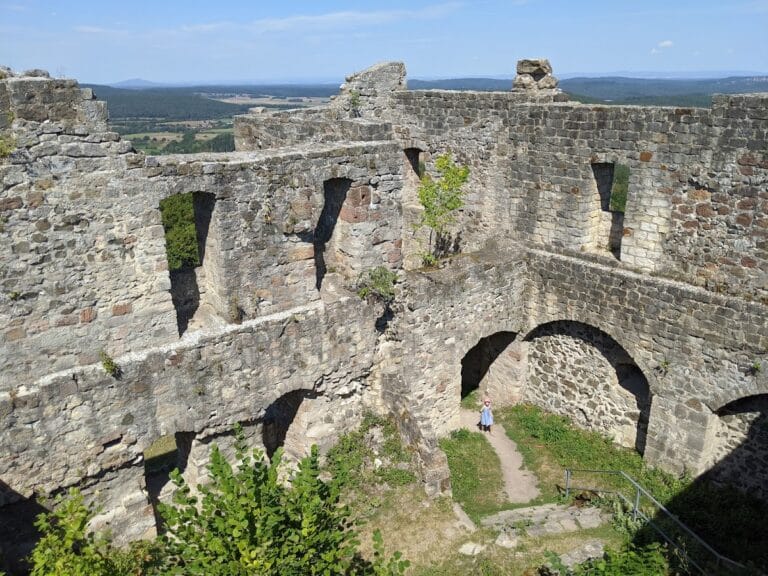
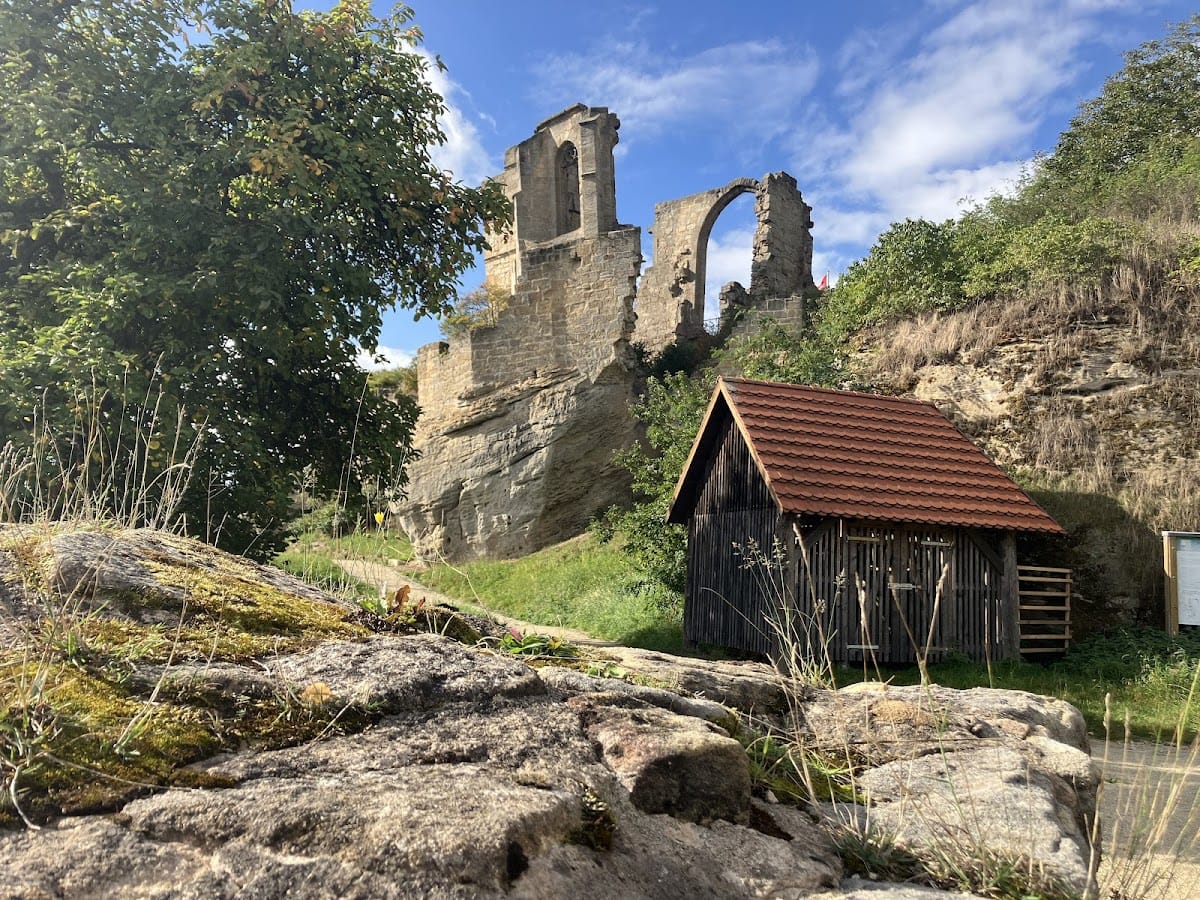
Altenstein Castle is one of the largest ruined medieval castles in Franconia, perched on a ridge approximately 452 meters above sea level and rising sharply about 150 meters above the Weisach river valley. The castle’s strategic location is complemented by nearby medieval fortifications, including an ancient earthen motte on the adjacent Galgenberg hill and other castles within a short distance.
Access to the castle is gained through a well-preserved gatehouse of the outer ward, dating from the 17th or 18th century but built upon a 13th-century foundation. This gatehouse once protected the Romanesque core of the castle and remains inhabited. Its southeastern outer ward is supported by an imposing retaining wall reinforced with flying buttresses, a technique designed to stabilize the structure on the steep terrain.
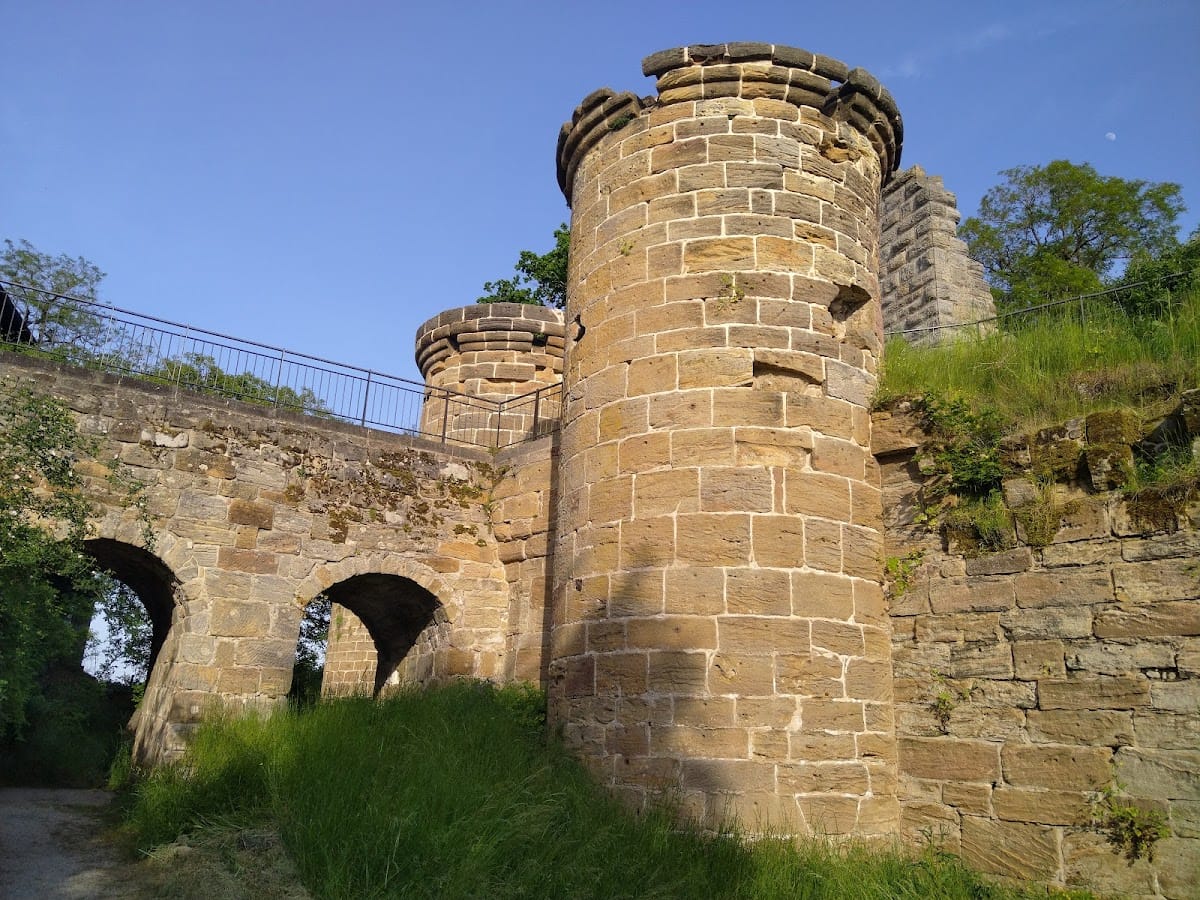
A stone bridge from the 18th century spans a roughly 15-meter-wide dry ditch or neck ditch that separates the outer ward from the main gate. The gate itself is flanked by two massive round towers and forms part of a defensive enclosure known as a zwinger, constructed around 1430 during the Hussite period. This outer gatehouse replaced the castle’s original southern entrance, which was walled up at that time for defensive reasons. The existing gate entrance dates to about 1567 and features a bretèche—a projecting stone platform above the gateway that allowed defenders to attack assailants below.
Above the main gate, a weathered stone display shows the Stein family coat of arms, which includes three hammers, flanked by figures holding shields. The two round towers each rise in three floors without vaulted ceilings and contain T-shaped keyhole openings for defense, allowing archers or gun operators to cover the entrance while minimizing their exposure. Short connecting walls with two more round towers extend from the gatehouse, creating a fortified front.
Within the middle ward, the castle’s design reflects adaptations for early firearms. Remnants of the Hussite-era fortifications survive on the eastern side of this ward, while the western defenses were remodeled in 1567, evident from simple stone corbels supporting the walls.
Behind the gatehouse stands the castle’s bergfried—a tall, square Romanesque keep whose north wall still rises about 10 meters. Measuring roughly 9.8 meters per side, this tower shows impressive masonry work with large rusticated stones on its exterior, carefully fitted without visible lifting marks, suggesting medieval lifting techniques. The inner core consists of bricks arranged in a herringbone pattern, known as opus spicatum. The bergfried originally had a raised entrance facing into the courtyard to improve defense, and a garderobe (latrine) shaft at its base indicates that a neck ditch once lay immediately in front.
The internal courtyard is home to the remains of several residential buildings that once housed different branches of the family sharing the castle. These include vaulted cellars hewn partly out of solid rock, the main residential building known as the palas situated in the southwest, a castle well, and a chapel built in the Late Gothic style. Some of the vaulted cellars were sealed during recent restorations to protect bat populations, though key areas remain open on occasions or permanently accessible.
The castle’s foundations rest on Rhaetian sandstone, a type of rock prone to slow sliding downhill. This natural instability has caused recurrent collapses over time, including the loss of stacked vaults above the old gate in 1960 and subsequent wall collapses in later decades. Restoration efforts since 2000 have aimed to stabilize the ruins, securing their condition for at least several centuries.
A circular walking path established since 2003 enables a comprehensive circuit around the inner ward, allowing access to previously unreachable parts of the ruins.
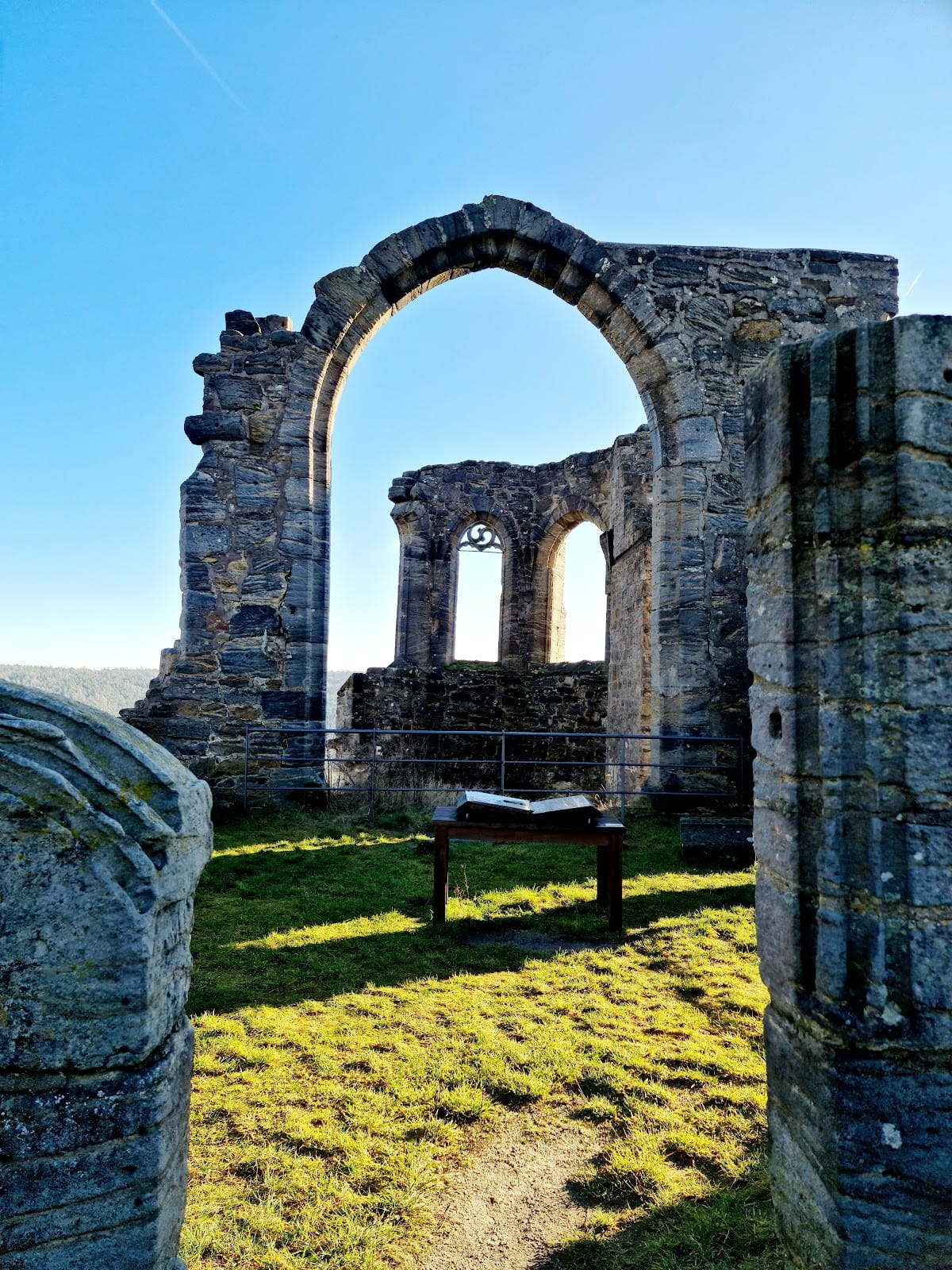
The castle chapel, positioned on the eastern side, was constructed beginning in 1438 after the Prince-Bishop of Würzburg elevated its status to serve as a parish church. Dedicated to St. Nicholas and the Virgin Mary, the chapel features a rectangular nave built atop the barrel-vaulted old southern gate and an adjoining choir with intricately ribbed vaulting. The choir once housed the family crypt and is supported by stepped buttresses with pointed-arch Gothic windows, one of which retains original window tracery.
South of the choir, a tower-like annex rises two stories, divided by stone ledges, with narrow windows lighting a groin-vaulted ground floor. An elevated door connects this annex to an older projection of the chapel’s wall, and a small staircase tower accessible from the nave completes the complex. Entry to the annex is through a distinctively shaped arch set into the choir wall.
The separation between nave and choir is marked by a profiled arch, while decorative shields still adorn the intersections of the choir vault ribs. The chapel’s sandstone walls exhibit characteristic tool marks from the use of specialized lifting equipment called an external Lewis, a three-legged device employed to insert the precisely cut stones. Embedded fragments of gravestones once lined the chapel floor.
Due to ongoing rock movement beneath the site, the chapel walls lean noticeably, but extensive renovation work starting around 2000 has strengthened the structure, preserving it for future generations.
Nearby sites