Irmelshausen Castle: A Medieval Water Castle in Germany
Site at a Glance
- Rating
- 4.8
- Popularity
- Very Low
- Country
- Germany
- Primary era
- Medieval
- External website
- Open
- Eras represented
- Medieval, Early Modern
- Civilizations
- Holy Roman Empire
- Site type
- Military
- Remains
- Castle
On this page8 sections
History
Irmelshausen Castle is a medieval water castle in Germany, in Höchheim, whose present structure was erected by the von Bibra noble family in the fifteenth century. Its history reaches back to the Lords of Irmelshausen, a collateral branch of the Counts of Henneberg, and the castle has remained associated with the von Bibra family since 1376.
The Lords of Irmelshausen and the Henneberg Succession
The castle’s predecessor buildings probably date from the eleventh century. In the twelfth century, Poppo III became the first recorded member of the family that took its name from Irmelshausen. The Lords of Irmelshausen were a collateral line of the Counts of Henneberg, a medieval dynasty whose lands included parts of present-day Franconia and Thuringia.
In the mid-thirteenth century, possession returned to the main Henneberg-Schleusingen line. This principal branch of the dynasty sold Irmelshausen to the Prince-Bishopric of Würzburg in 1354. The von Bibra family acquired the castle in 1376 and retained it thereafter.
The von Bibra Building Campaigns
The von Bibra family erected the present castle during the fifteenth century. They enlarged it in 1514, and Hans von Bibra carried out a further expansion between 1556 and 1561. This campaign added three wings, creating the group known as the Hansenbau and giving the castle its present form.
The family held an influential position in the political affairs of Franconia, southern Thuringia, and the wider Holy Roman Empire. The castle’s interior architecture, furnishings, and art treasures reflect the way of life of a landed noble family. It has also served as a film location.
Divided Ownership and the Modern Family Lines
In the late eighteenth century, Eugen Georg von Bibra and Ludwig Friedrich von Bibra divided the castle equally between the older and younger lines of the family. This created a Ganerbenburg, a castle jointly held by several family branches through divided ownership and shared rights.
The older-line half passed by inheritance from the diplomat Sigismund von Bibra to his second wife, Renate, widow Baroness von Bibra, née Baroness von und zu Guttenberg. She transferred it to her adopted daughter Elisabeth Schenk, Countess von Stauffenberg, née Baroness von und zu Guttenberg. Elisabeth was the wife of Franz Ludwig Schenk, Count von Stauffenberg, who owned Kirchlauter Castle.
Since 1984, the older-line half has belonged to the Stauffenberg family. Elisabeth’s son, Karl Schenk, Count von Stauffenberg, inherited it in 2002, and he and his family have lived there since 2014. The family operates an events agency and holiday apartments. The younger-line half belongs to Hans, Baron von Bibra, who occupies it with his family.
Remains
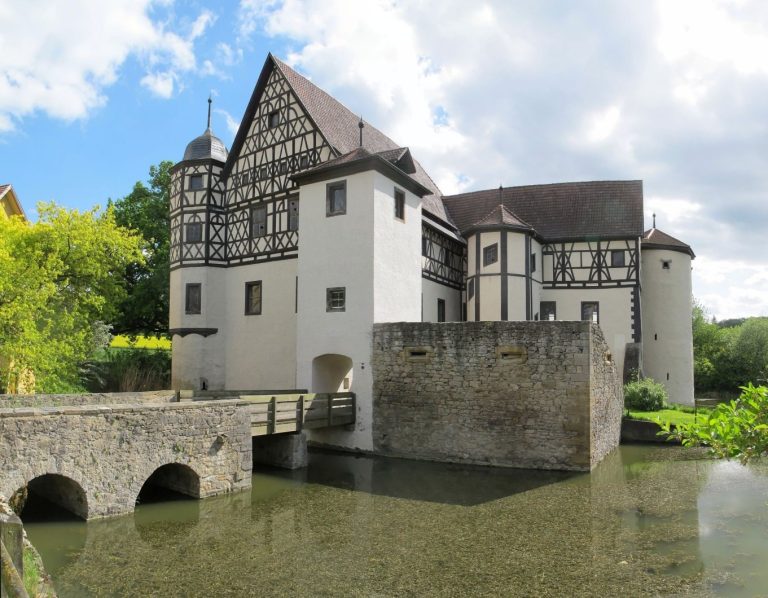
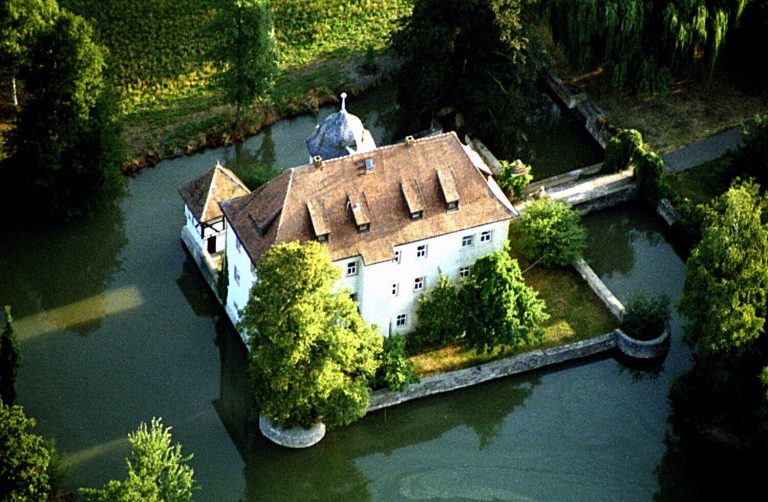
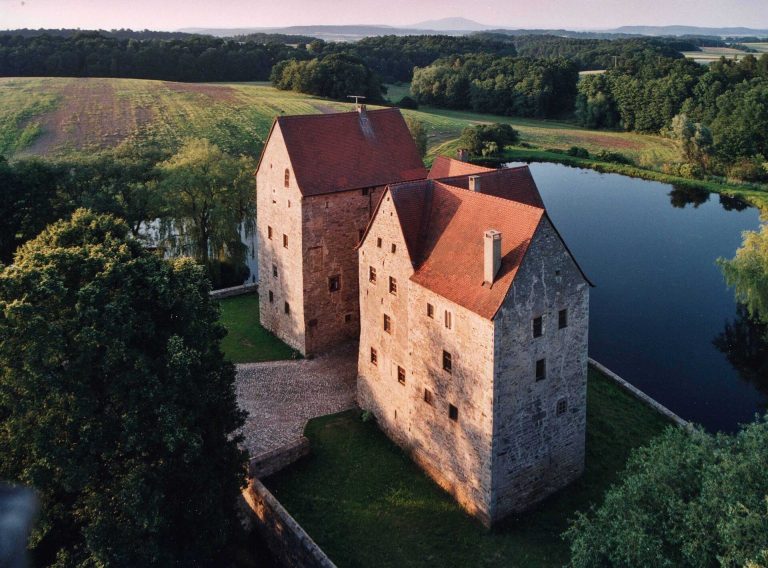
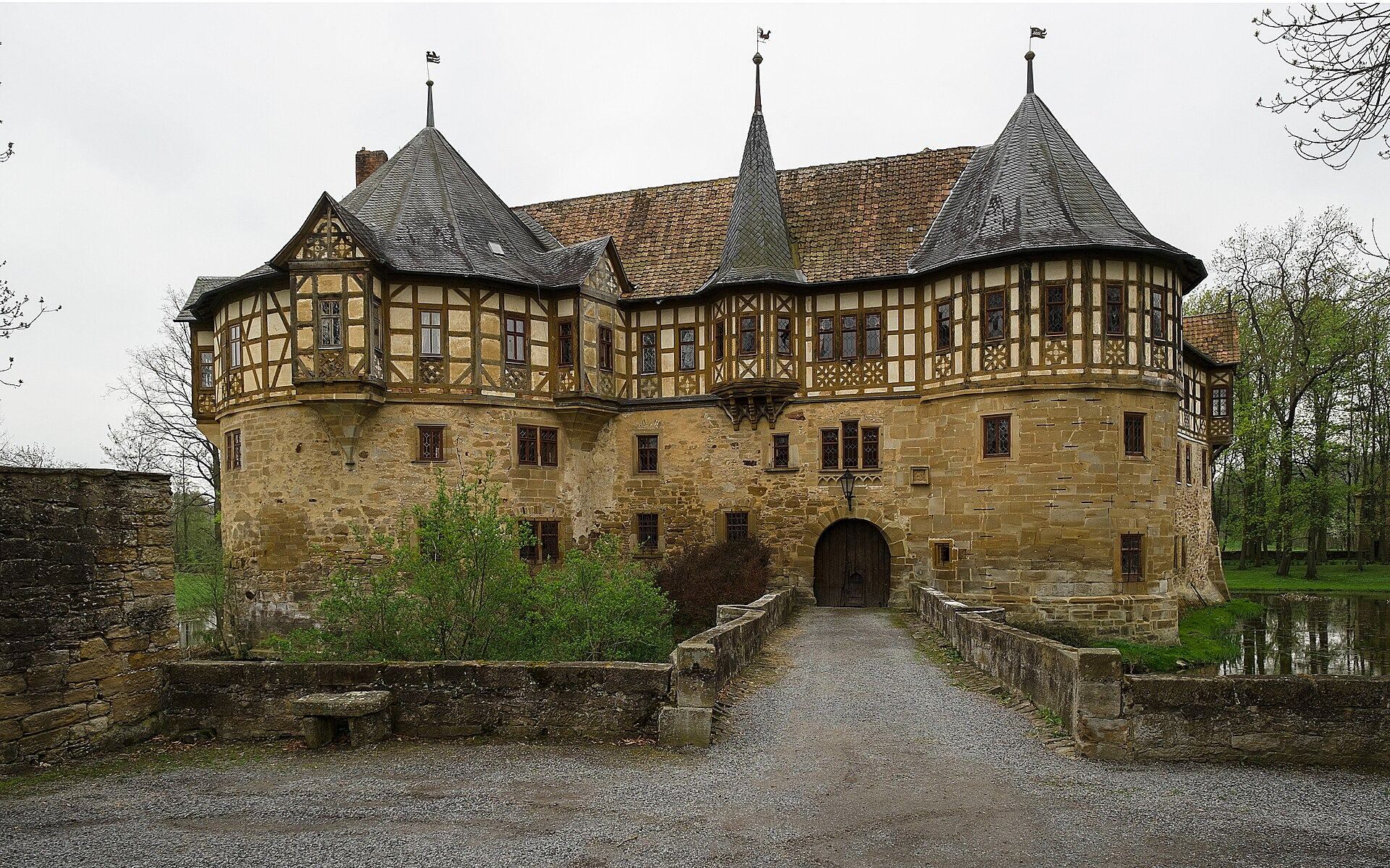
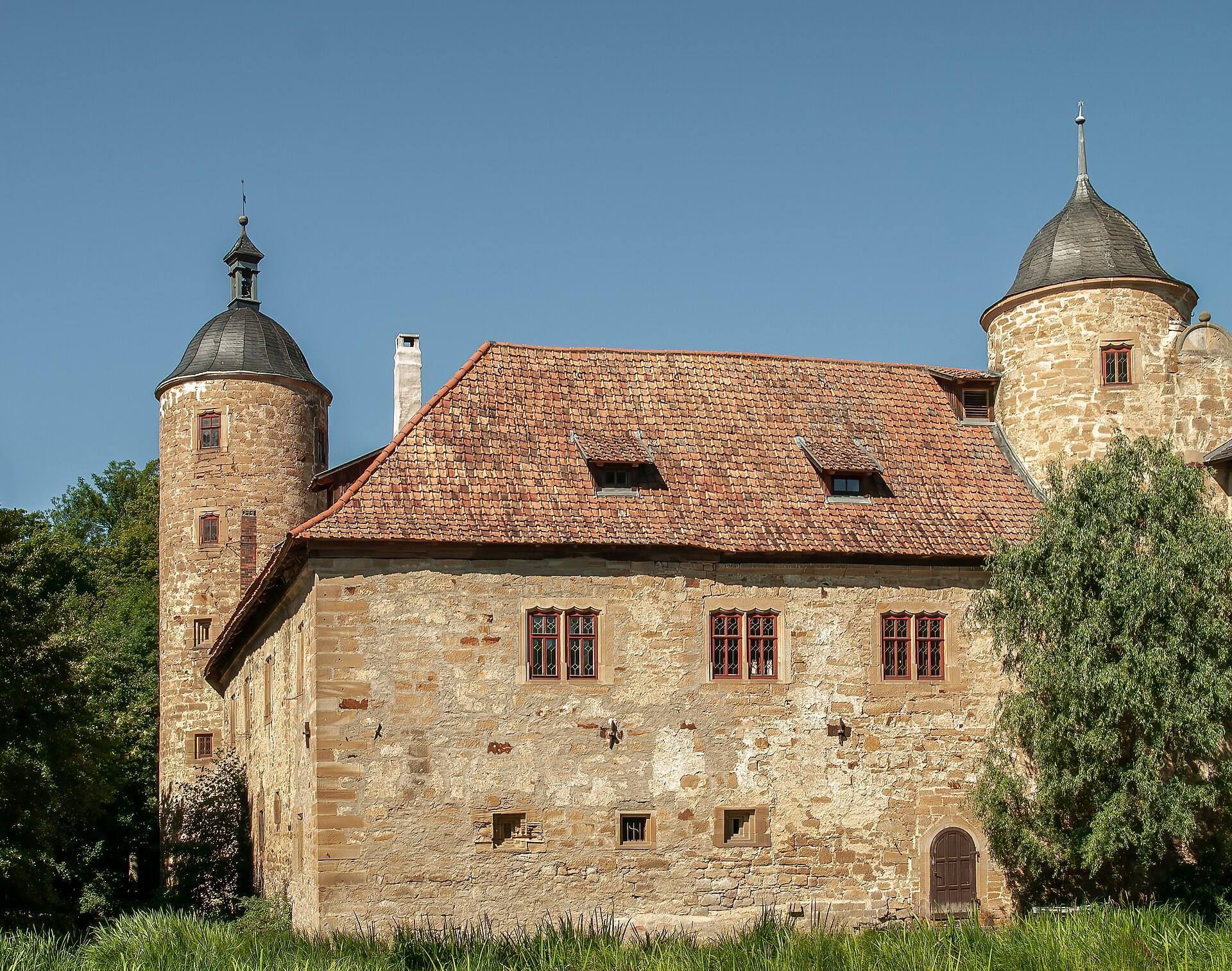
Irmelshausen Castle stands on an artificial island in the Milzgrund, where former marshland was transformed into a pond by damming the Milz. The medieval water castle survives in full, with an irregular pentagonal plan, stone lower storeys, and half-timbered upper sections.
Island Fortress
A spacious five-sided curtain wall surrounds the castle. Corner turrets reinforce its perimeter, while a gatehouse controls the entrance. In the Middle Ages, the enclosed fortification could be reached from the village side only by crossing a drawbridge. Around 1700, the drawbridge was replaced by a stone bridge.
Outer Defences
On the landward side, remains of a small outer bailey, or barbican, survive. A barbican is a fortified defensive work placed before or near a gate. This outer feature formed part of the approach to the principal enclosure.
The Hansenbau
The three wings built during Hans von Bibra’s expansion of 1556 to 1561 are collectively called the Hansenbau. They form the sixteenth-century addition that completed the castle’s present architectural arrangement, alongside the earlier stone and half-timbered buildings within the surrounding wall.