Burg Vichtenstein: A Medieval Hilltop Castle in Austria
Site at a Glance
- Rating
- 3.8
- Popularity
- Very Low
- Country
- Austria
- Primary era
- Medieval
- Eras represented
- Medieval, Early Modern
- Civilizations
- Holy Roman Empire
- Site type
- Military
- Remains
- Castle
On this page12 sections
History
Burg Vichtenstein is a medieval hilltop castle in Austria, standing at Vichtenstein above the Danube valley. Its origins lie in the eleventh century, and its construction is generally placed around 1100, although fired-brick remains indicate activity at the site around 1050. The castle controlled an important stretch of the river and overlooked the Altstrasse salt-trade route, which avoided the high tolls imposed at Passau.
Origins and the Formbach family
A Roman watchtower may have occupied the rocky projection earlier, but this identification remains uncertain. The settlement of the previously sparsely inhabited Sauwald intensified after the Battle of Lechfeld in 955, when the westward advance of the Hungarians was halted. The castle was probably founded by the Forbacher family, an imperial noble house that held county rights in parts of eastern Bavaria from the ninth century. From 1028, the family used the title Counts of Formbach, and the Formbach lordship of Vichtenstein emerged during the final quarter of the eleventh century.
Tiemo I von Vornbach is identified as the builder. A record from 1116 associates the Counts of Formbach with Vichtenstein, which is also regarded as having belonged to the County of Formbach. When the Formbach family divided into four lines late in the eleventh century, Heinrich II founded the Formbach-Neuburg-Vichtenstein branch. Vichtenstein then became the centre of this family’s power.
Transfer to Passau
In 1125, Dietrich I von Formbach sold the castle to Wirnto, abbot of the Benedictine Abbey of Vornbach. Dietrich retained only the title Count of Vichtenstein. After his line ended with his death in 1145, his daughter Hedwig inherited the lordship through her marriage to Engelbert III, Count of Hall and Wasserburg. Vichtenstein later lost importance because Engelbert’s main seat was at Wasserburg am Inn, although their son Gebhard II lived at Vichtenstein and continued to use its comital title.
In 1169, Gebhard entered the Augustinian monastery at Reichersberg and transferred the lordship to his brother Dietrich II. The nearby Danube customs post brought substantial revenue. Dietrich, who belonged to the court of the Babenbergs, the ruling dynasty of the medieval Duchy of Austria, joined Emperor Frederick Barbarossa on the Third Crusade in 1189. He returned safely to Vichtenstein and died there in 1205, marking the end of the castle’s period of greatest prosperity.
The conflict over the lordship
Dietrich’s son Konrad von Wasserburg-Vichtenstein joined the Fifth Crusade, a campaign against Egypt intended to weaken the powers controlling the Holy Land. On 22 October 1218, while preparing for the expedition, he borrowed 1,000 marks of silver from Ulrich II, Prince-Bishop of Passau. He pledged Vichtenstein and his estates in the upper and lower Kösslbach valleys as security, while agreeing that the castle could be redeemed only with his own resources and could not be pledged to outsiders.
Konrad soon married Kunigunde, Countess of Lambach-Hirschberg, and transferred Vichtenstein to her. In 1219 he took part in the siege of Damietta, a fortress in the Nile Delta. Although Damietta fell, the crusade failed, and Konrad and Bishop Ulrich returned home. Ulrich died on 30 October 1221, while the disagreement over Vichtenstein continued.
Vichtenstein’s retainers and other raiders attacked episcopal property, disrupted trade and shipping by blocking the Danube, and were placed under imperial ban. Mediation by Duke Leopold VI of Austria in 1224 gave Konrad the residential palace while the keep passed to the Diocese of Passau, the ecclesiastical principality and bishopric that controlled Vichtenstein for much of the medieval and early-modern period. The arrangement proved impractical, and the diocese acquired the palace three years later.
Konrad continued to resist. In 1230 he captured Bishop Gebhard of Passau and his entourage, who were released after a substantial ransom. He tried to recover Vichtenstein by force in 1240, but definitively ceded the castle under a peace treaty in 1244. The Diocese of Passau paid him substantial advances, which were not fully settled until about twenty years later. Since Konrad died without children, the diocese ultimately retained the castle it had contested and paid to acquire.
Episcopal administration and later ownership
From the thirteenth century, Vichtenstein declined in importance and was administered by episcopal custodians, stewards, or burgraves. Bishop Otto von Lonsdorf was the first Bishop of Passau recorded as residing there, at least temporarily, in 1254. In 1367, Andreas Haller, Passau’s city judge and leader of a citizens’ revolt against Bishop Albrecht III von Winkel, held the castle in pledge. After the revolt failed, Haller illegally sold it to the knight Friedrich von Puchberg, leading to another two-year struggle over possession.
In 1370, the financially weakened Diocese of Passau pledged Vichtenstein and its lordship to the Schaunberg family. Count Heinrich VII von Schaunberg greatly enlarged the defensive works. Duke Albert III of Austria acquired the castle from the Schaunbergs in 1382 and returned it to the Diocese of Passau. Trusted Passau officials continued to administer Vichtenstein until the secularization of the Prince-Bishopric of Passau in 1803. This ended the territorial rule of the prince-bishops and transferred their former sovereign property to the Austrian state. Between 1810 and 1816, the territory briefly came under Bavarian jurisdiction.
Around the middle of the nineteenth century, the Austrian state transferred control to the Austrian National Bank. Laurenz Fölser, an industrialist from Haslach, bought the property in 1862 for its forests and sold it in 1864 to Count Julius von Falkenhayn. Falkenhayn, later Austrian agriculture minister and governor of Upper Austria, closed a brewery established in the castle and moved its equipment to Engelszell Castle. Count Robert Pachta acquired Vichtenstein in 1868, while his son Alfons Pachta lived there. In 1938, Alfons’s son, Count Parcival Pachta, died shortly after falling from the stairs while trying to open the keep’s high entrance.
During the Second World War and its aftermath, the castle served as a transit and reception camp for refugees and displaced people. About 350 people were housed there, causing serious damage, especially to the furnishings. After the property became fully available to the family again in 1955, the worst damage was repaired. The Schulz-Wulkow family now owns the castle, with Klaus Schulz-Wulkow identified as the current owner. Vichtenstein has remained continuously inhabited and has consequently undergone repeated alterations and renovations. It is protected as an Austrian monument under number 38365.
Remains
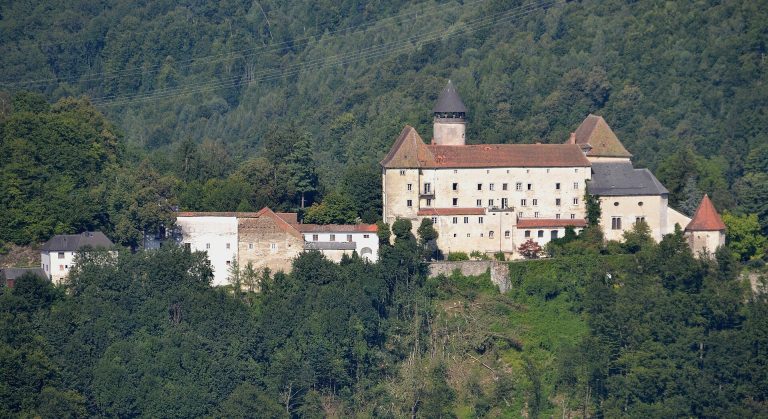
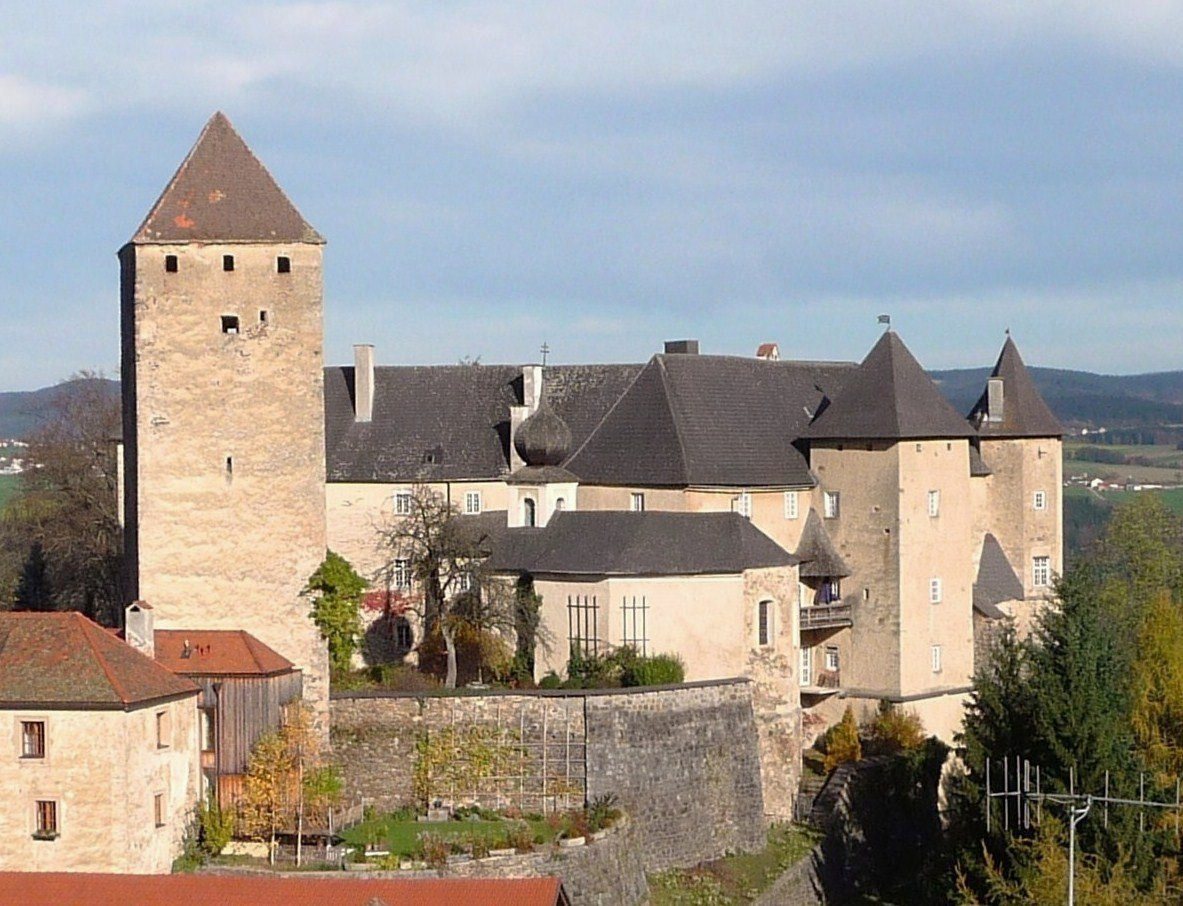
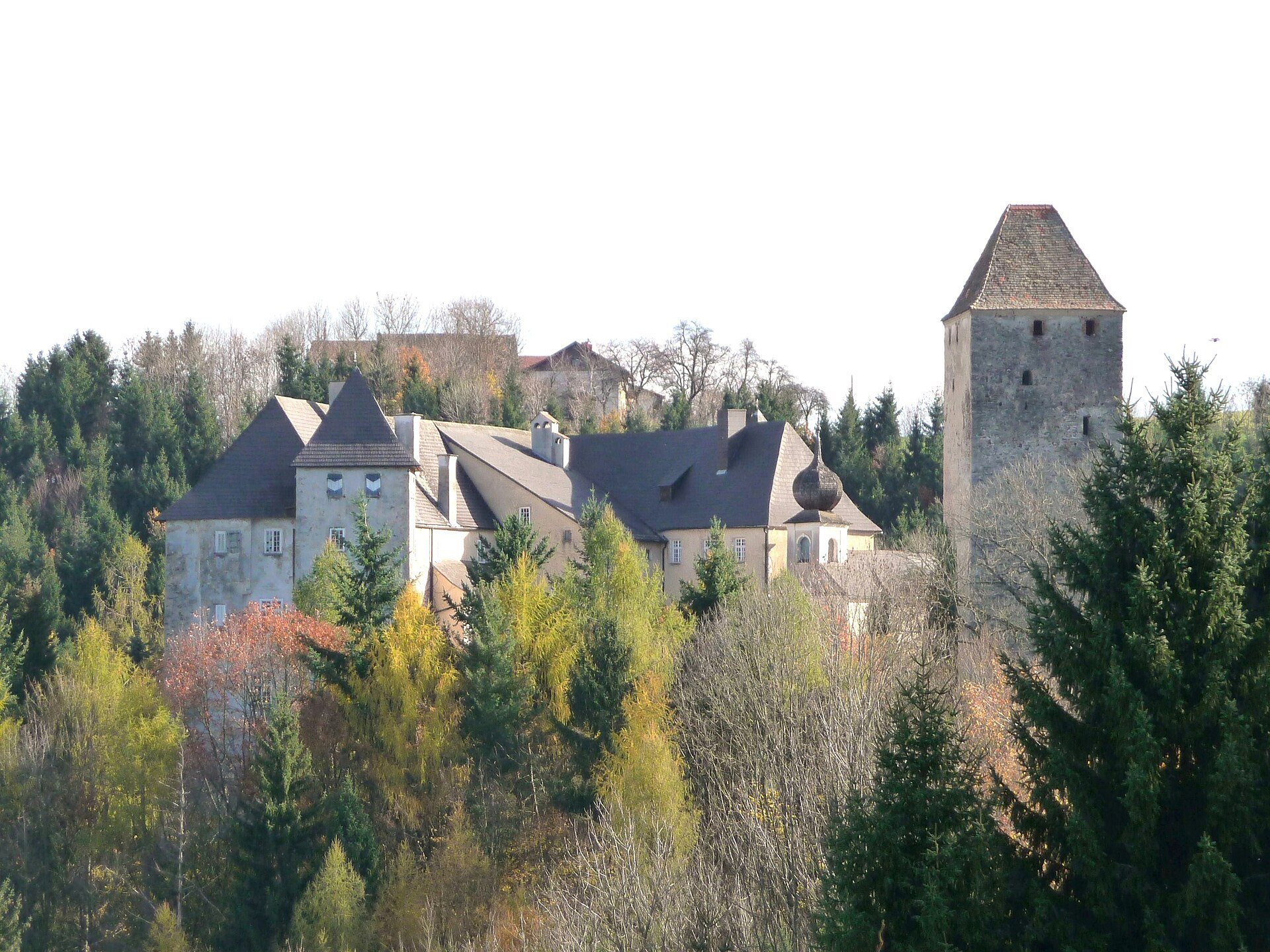
Burg Vichtenstein occupies a rocky projection at about 540 metres above sea level on the steep northern slope of the Sauwald, above the right bank of the Danube and opposite Obernzell in Lower Bavaria. The complex has been rebuilt repeatedly from the sixteenth through the twentieth centuries while retaining its medieval character. Its surviving layout includes an entrance bridge, outer and inner court areas, residential buildings, a tall square keep, the Saint Hippolytus chapel, and projecting towers attached to the fortified enclosure.
Entrance and courtyards
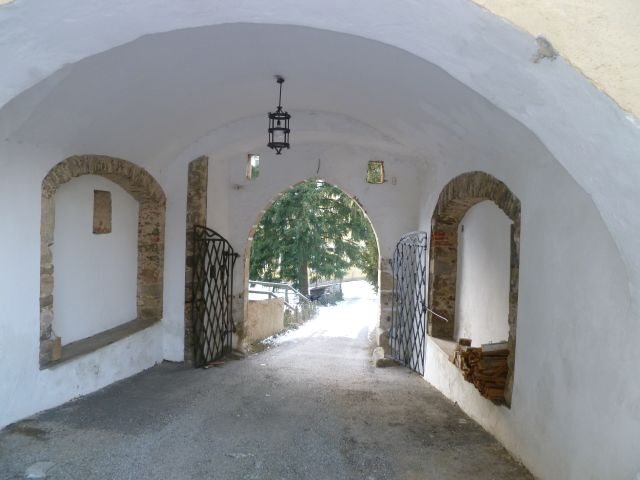
A brick bridge crosses the former moat and ends at a high Gothic gate with a pointed arch. Openings for the rollers of an earlier drawbridge remain visible. The brick entrance passage was later plastered and originally led into a long outer courtyard bounded by curtain walls on both sides. From there, a narrow elongated section and a second gate gave access to the main castle. In the nineteenth century, the Counts Pachta largely dismantled the curtain wall and second gate, removing the former distinction between the outer and main castle. Crenellation formerly stood above the courtyard side of the entrance gate.
Inner castle buildings
Residential buildings
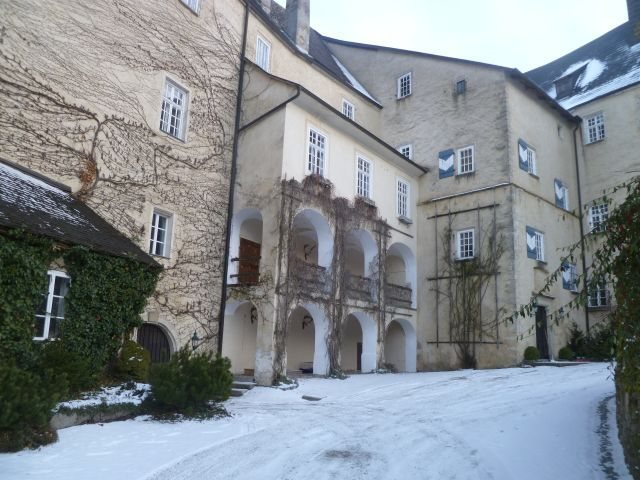
Three-storey residential buildings once stood against the northern and eastern curtain walls of the inner courtyard and are now largely freestanding. They preserve parts of the twelfth-century Romanesque palace, including basement foundations. Romanesque architecture is a medieval style associated with heavy masonry and round-headed arches. On the west side, a Romanesque arched portal survives, while a twelfth-century gable on the third floor contains a male bust.
Square keep
The square keep rises nearly 35 metres and has walls about 2.5 to 3.5 metres thick on its first four floors. Three further floors were added during the Gothic period, with considerably thinner walls. Built from quarry stone, the tower has a steep hipped roof, corners reinforced with roughly bossed blocks, and regular granite blocks. A keep was the principal fortified tower of a medieval castle, often serving as a lookout, refuge, and sign of authority rather than as ordinary living accommodation.
The tower probably had no crenellation and was seldom used for active defence. Three Romanesque arched windows on each of its four façades could not be viewed from below, indicating that they served chiefly as symbols of authority and as emergency refuges. The keep also functioned as a lookout. A stone staircase is set within the thickness of its upper walls.
Saint Hippolytus chapel
The Saint Hippolytus chapel is a separate building on the eastern side of the castle. Its small tower has an onion dome. The medieval fabric includes a cross-vaulted presbytery and a nave with a seventeenth-century barrel vault set at an obtuse angle. Figurally decorated vault bosses remain inside the chapel.
Reused sculpture and defensive towers
A granite relief bust found on the eastern side of the castle was once considered possibly Roman or Celtic. During the 1960s it was built into the castle stairwell and is treated as a reused architectural element, or spolia, meaning an earlier architectural or sculptural piece incorporated into a later building.
Former stables between the chapel and the keep were removed when the curtain walls were demolished. Three projecting towers survive as elements of the castle’s lateral defence. The square western tower began as a stair tower and was later converted into a residential tower. The square southeastern tower also became residential, while the northeastern round shell tower, the oldest defensive tower, later received an octagonal upper section. A shell tower is partly open toward the courtyard, reducing the masonry required while allowing defensive fire along the walls. The two square residential towers date from the fifteenth or sixteenth century, and the residential and service buildings remain attached to the fortified enclosure, whose towers were designed for flanking defence.