Westenhanger Castle: A Medieval Fortified Manor in England

Visitor Information
Google Rating: 4.8
Popularity: Low
Google Maps: View on Google Maps
Official Website: www.westenhangercastle.co.uk
Country: United Kingdom
Civilization: Medieval European
Remains: Military

History
Westenhanger Castle, situated in the municipality of Hythe in England, was established by the Anglo-Saxon civilization and reflects nearly a millennium of English history. Its origins trace back to 1035, when the estate belonged to King Canute, a Danish ruler who held the English throne at that time. This early association marks the site as a royal possession long before the castle’s stone walls were built.
The first significant construction took place in 1343, when the de Criol family, descendants of Bertram de Criol, erected a permanent fortified manor house on the estate. This quad-shaped manor, boasting as many as 126 rooms, signified considerable wealth and status in medieval England. The castle remained under the ownership of the de Criols until the turbulent period of the Wars of the Roses in the 15th century. During this time, Sir Thomas de Criol was executed by order of Queen Margaret of Anjou following the Second Battle of St Albans. As he left no male heirs, Westenhanger passed to his son-in-law, Sir John Fogge, thus marking the first major transition of ownership aligned with the national conflict.
Over the centuries, Westenhanger Castle hosted several notable English figures. Henry II and Rosamund de Clifford are among the early connections. Later, figures such as Edward Poynings, Henry VIII, and Queen Elizabeth I were linked to the site. In particular, during the Spanish Armada crisis of 1588, the castle under Customer Smythe served as the command post for Kent’s militia, overseeing a force of 14,000 men tasked with defending the southern English coast against invasion.
The castle continued to hold strategic and political significance into the 17th century. In 1656, while Charles II was in exile, plans were made for him to lodge at Westenhanger upon his return to England. However, an assassination plot against the king was uncovered before he left France, preventing any attack on the site. The Smythe family maintained ownership of the estate for several centuries until 1869, after which the property passed to Captain Hugh Baillie, who died without heirs in 1876.
In the late 20th century, efforts to preserve Westenhanger Castle began in earnest. Since the mid-1990s, its current owners have worked alongside English Heritage, the national organization responsible for protecting historic sites, to conserve and restore the structures, halting their long decline.
Westenhanger Castle also holds a connection to early American history. Sir Thomas Smythe, one of its owners, commissioned the ship Discovery in 1600. This vessel later took part in the 1606 expedition that established Jamestown, Virginia, the first permanent English-speaking settlement in North America. In recognition of this link, a replica of the Discovery was placed at the castle in 2008 by the Jamestown UK Foundation.
Remains
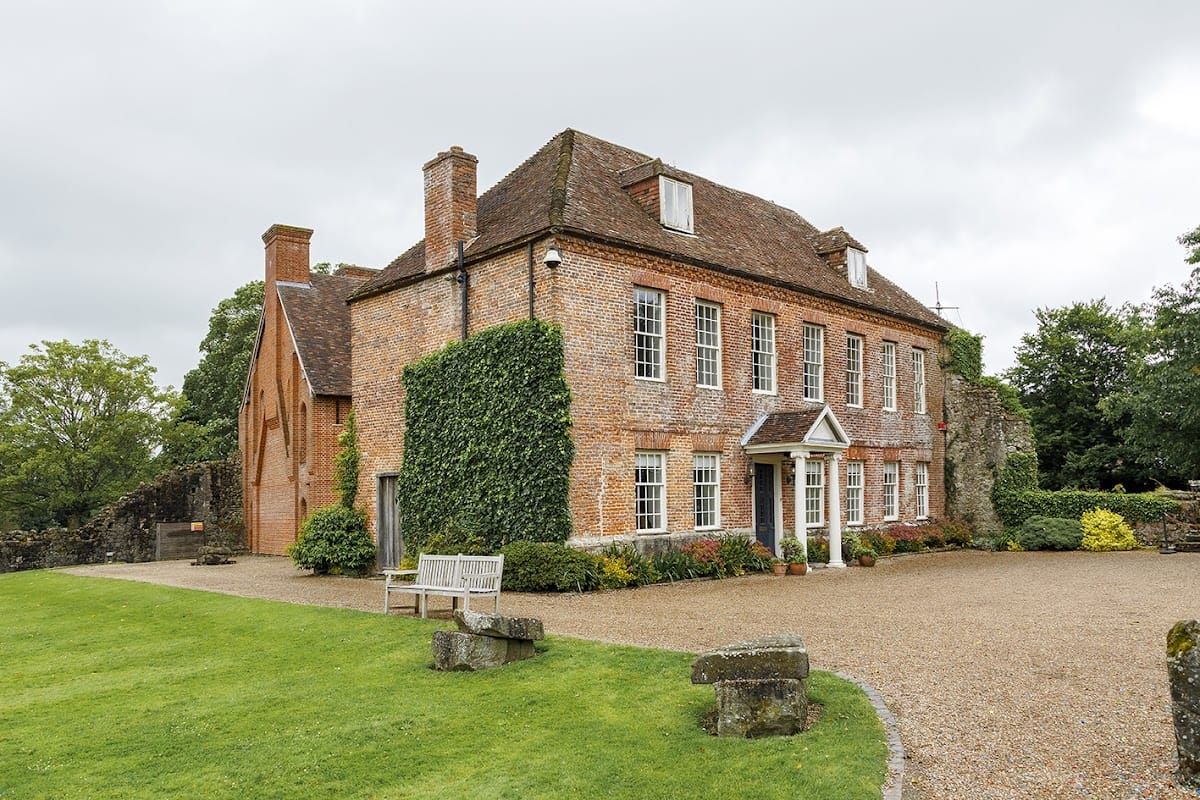
Westenhanger Castle is a medieval quadrangular manor, characteristic of 14th-century fortified residences. It was originally surrounded by curtain walls forming a defensive enclosure, with the main residence and ancillary buildings arranged within. Although centuries of neglect have reduced its size, significant portions of these defensive walls still stand, marking the castle’s former extent.
Among the most notable surviving structures are the medieval barns located beyond the main curtain wall. These barns reflect the agricultural and storage functions essential to sustaining the estate and are constructed from robust masonry typical of their period. Recently reunited under the same ownership as the castle, they are undergoing restoration aimed at returning them to their near-original state.
The castle itself has experienced considerable deterioration, with many sections lost or fragmentary. Nevertheless, the fabric that remains offers insights into its layout and scale during its prime, particularly the outer fortifications and some internal walls. English Heritage has recognized the architectural significance of Westenhanger by designating it as a Grade I listed building, emphasizing its importance as a historic monument.
Access to the site is controlled via the entrance to the nearby Folkestone Racecourse, adjacent to which the castle stands, set on slightly elevated terrain roughly 72 meters above sea level. Despite modern surroundings, the castle’s enduring presence on this landscape offers a tangible connection to its medieval past.
No specific archaeological finds such as decorative inscriptions, mosaics, or typical domestic artifacts have been detailed, and structural features remain the primary evidence of the castle’s history and function. The ongoing conservation work ensures the preservation of these remains for study and appreciation.
Nearby sites