Wartenstein Castle: A Medieval Fortress in Pfäfers, Switzerland

Visitor Information
Google Rating: 4.5
Popularity: Low
Official Website: www.pfaefers.ch
Country: Switzerland
Civilization: Medieval European
Site type: Military
Remains: Castle

History
Wartenstein Castle is located in the municipality of Pfäfers in Switzerland. It was built in the early 13th century by leaders of the Imperial Abbey of Pfäfers, a religious institution that needed to protect its extensive estates.
The castle’s foundation dates to around 1206 when Abbot Konrad of Zwiefalten initiated its construction to safeguard the abbey’s interests. Its earliest recorded mention comes from 1208, when Emperor Otto IV entrusted Knight Heinrich von Sax with the protective lordship over the abbey’s lands, including Wartenstein. Shortly after, in 1210, the castle came into the possession of Heinrich von Falkenstein. However, by 1257 the abbey itself had regained authority, repurchasing the rights from both the Empire and the Sax family, reflecting its ongoing interest in direct control over the fortress.
From 1261 onward, the administrative duties known as vogtship—similar to that of a bailiff or steward—were held by the Lords of Wildenberg, who lived at nearby Freudenberg Castle rather than at Wartenstein itself. In the 14th century, the Counts of Werdenberg-Heiligenberg took over this role, with related counts of Werdenberg-Sargans promising not to damage the castle, indicating political agreements designed to preserve it. Significant maintenance and improvements occurred in 1341 under Abbot Hermann II of Arbon, who also added a chapel, though its precise location is now lost to history.
Around 1430, the castle became the residence of Abbot Gerold von Eroltzheim, marking a period when it was directly inhabited by abbey leadership. During the late 15th century’s Swabian War, Wartenstein was fortified and served as a strategic military base for the Swiss Confederates. In 1482, control of the vogtship passed to the Swiss, though it was eventually returned to the abbey in 1504. The abbey renewed the castle’s defenses under Abbot Wilhelm von Fulach, equipping it with updated armaments.
Reformation-era tensions in 1531 led to the castle being reoccupied by the vogt Aegidius Tschudi as a precaution against attacks aimed at the abbey. Despite this continued use, by the middle of the 16th century Wartenstein had fallen into disrepair. The abbey abandoned the castle in 1586, after which local residents began quarrying stone from its ruins for other construction projects.
A devastating fire in the abbey in 1665 prompted Abbot Bonifaz Tschupp to order much of Wartenstein dismantled, removing materials to aid in rebuilding efforts elsewhere. The abbey itself was dissolved in 1838, with the castle site then transferring to state ownership. Subsequently, the ruins were rented to the manager of nearby spa facilities. Efforts to stabilize and preserve the ruins began in 1951, including major restoration work on the main structure from 1974 to 1976 and on the broader site in 1991. In the vicinity of the castle ruins, a hotel named Schloss Wartenstein was established west of the site after 1880. Today, the ruins are recognized as a cultural property of national significance in Switzerland.
Remains
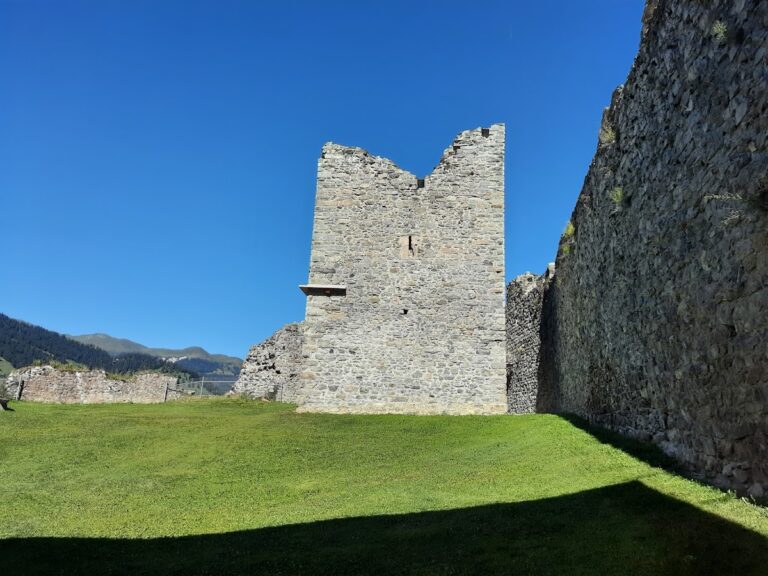
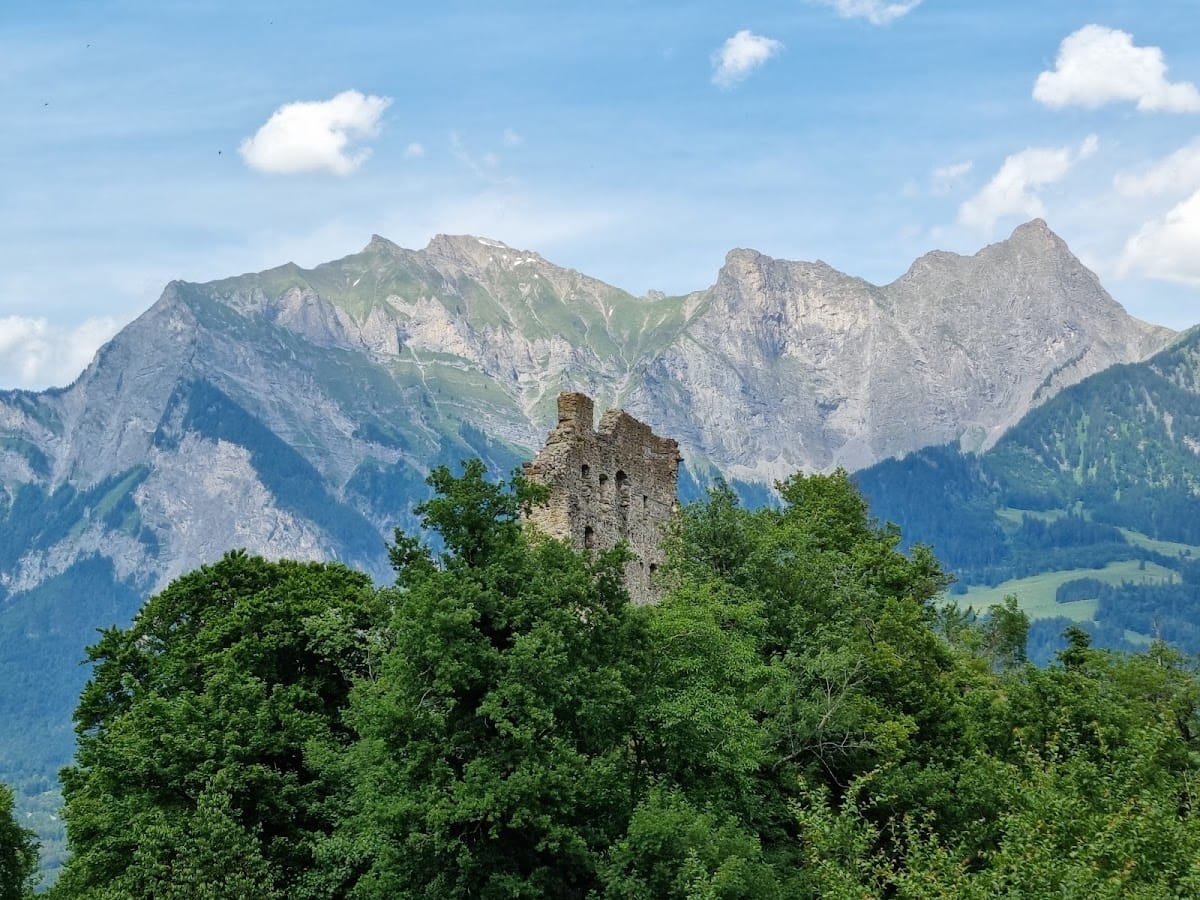
Wartenstein Castle is situated atop a steep rocky outcrop overlooking the Rhine Valley, creating a naturally defensive position southwest of Bad Ragaz. The castle’s layout centers on a large four-story tower commonly called a keep, originally serving both residential and protective functions. Its walls are notably thick, measuring about two meters, and the main entrance was once positioned high above ground level to enhance security.
The interior of the tower was adapted for living quarters from the second floor upward. Evidence of this includes window niches and traces of a smoke vent, suggesting the presence of a fireplace to provide warmth and ventilation for inhabitants. During a second building phase in the mid-1300s, additional residential and service buildings were constructed just north of the tower. However, around 1400 these structures were removed to create an outer defensive area known as a zwinger—a walled enclosure designed to hinder attackers. Within this courtyard, a cistern was installed to collect water, supporting the castle’s self-sufficiency during sieges.
Some remnants of the zwinger’s defensive walls remain, including three battlements—parapets with gaps—equipped with beam holes that likely supported a wooden walkway for guards to patrol and defend the perimeter. The original high entrance to the tower was replaced at this time by a gate featuring a pointed arch, reflecting architectural evolution aimed at maintaining security while allowing easier access.
Below the main castle, approximately 50 meters downhill, lies the lower castle or Unterburg. This area contains the foundations and ruins of at least five buildings, which most likely served additional residential or economic functions complementing the main fortress above.
Following damage and neglect in later centuries, the castle ruins underwent significant preservation efforts in the 20th century. These stabilizations have helped secure the core tower and associated structures from further decay, allowing the site to survive as a visible and informative reminder of medieval castle construction and the abbey’s historical role in the region. A short footpath connects the castle from the nearby road to Pfäfers, providing access to the ruins perched on their prominent rocky platform.
Nearby sites