Villaricos Archaeological Site: A Phoenician and Roman Settlement in Spain
Visitor Information
Google Rating: 4.3
Popularity: Low
Google Maps: View on Google Maps
Official Website: www.turismo.cuevasdelalmanzora.es
Country: Spain
Civilization: Phoenician, Roman
Remains: City

History
The Villaricos Archaeological Site, in the municipality of Villaricos, Spain, was established by Phoenician settlers.
Colonists from the Phoenician world founded the settlement in the eighth century BCE at a strategic spot beside the mouth of the Almanzora River. Known in antiquity as Baria, the community controlled access to Mediterranean shipping lanes and the river valleys inland, and it sat near mineral workings in the Sierra Almagrera that provided iron, lead and copper. In the course of the sixth century BCE Baria grew into an autonomous urban center of roughly six hectares, developing public and religious spaces and becoming an important local node in maritime and inland networks.
Religious life in the Phoenician period is attested by sanctuaries devoted to the goddess Astarte, with large quantities of terracotta fragments that represent Astarte-Tanit, reflecting the local cult practices. From the sixth century BCE onward the necropolis to the north acquired monumental underground tombs, and the richest burials from the sixth to the fourth centuries BCE contained imported Greek pottery and ornately decorated ostrich eggs, evidence of long-distance contacts and elite consumption.
The settlement suffered a decisive blow during the Second Punic War, when Roman forces under the general Publius Cornelius Scipio destroyed the city. Under Roman administration the site was reorganized as a civitas stippendiaria, a municipal community required to pay tribute, and it lost control of its mines and its mint. Despite those losses, the town expanded again between the late first century BCE and the fourth century CE, including a district outside the built core dedicated to fish salting and storage.
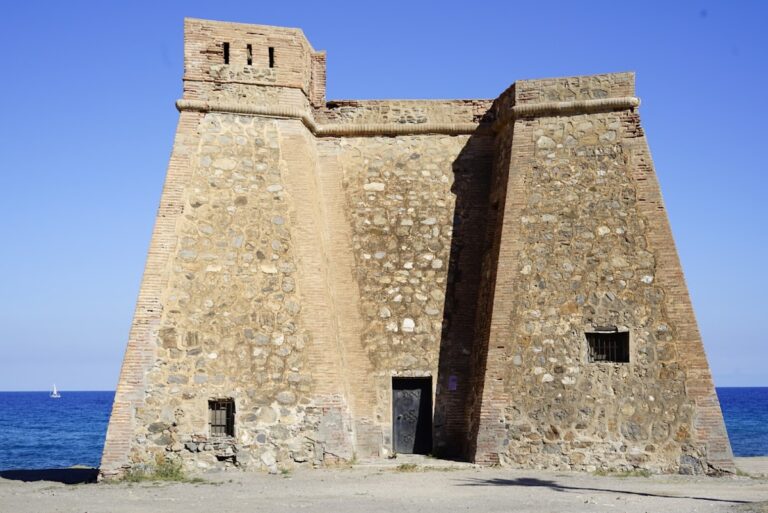
From the third century CE onward the population began to fall, and occupation shifted to the nearby hill of Cerro Montroy, where people remained into the ninth century CE. In later centuries the coastal landscape acquired new features: an eighteenth-century watchtower, the castle of Villaricos, stands near the Roman district, and industrial works from the mid-nineteenth century mark a renewed phase of mineral exploitation. Scholarly excavations in the early twentieth century produced a notable find, a fifth-century BCE limestone funerary stele inscribed in Punic that names Gerashtart, son of Baal-piles; discovered by Luis Siret in 1903–04, that monument is now conserved in the National Archaeological Museum in Madrid. In 2005 regional authorities granted the area protection as a Bien de Interés Cultural, recognizing its archaeological value and historic layers.
Remains
Overall, the surviving ensemble is dominated by a northern burial area and a series of later industrial and military installations clustered near the ancient shoreline. The funerary zone is characterized by large rock-cut chambers and worked masonry, while Roman and modern remains lie closer to the coast and on lower ground, reflecting different episodes of activity over more than two millennia.
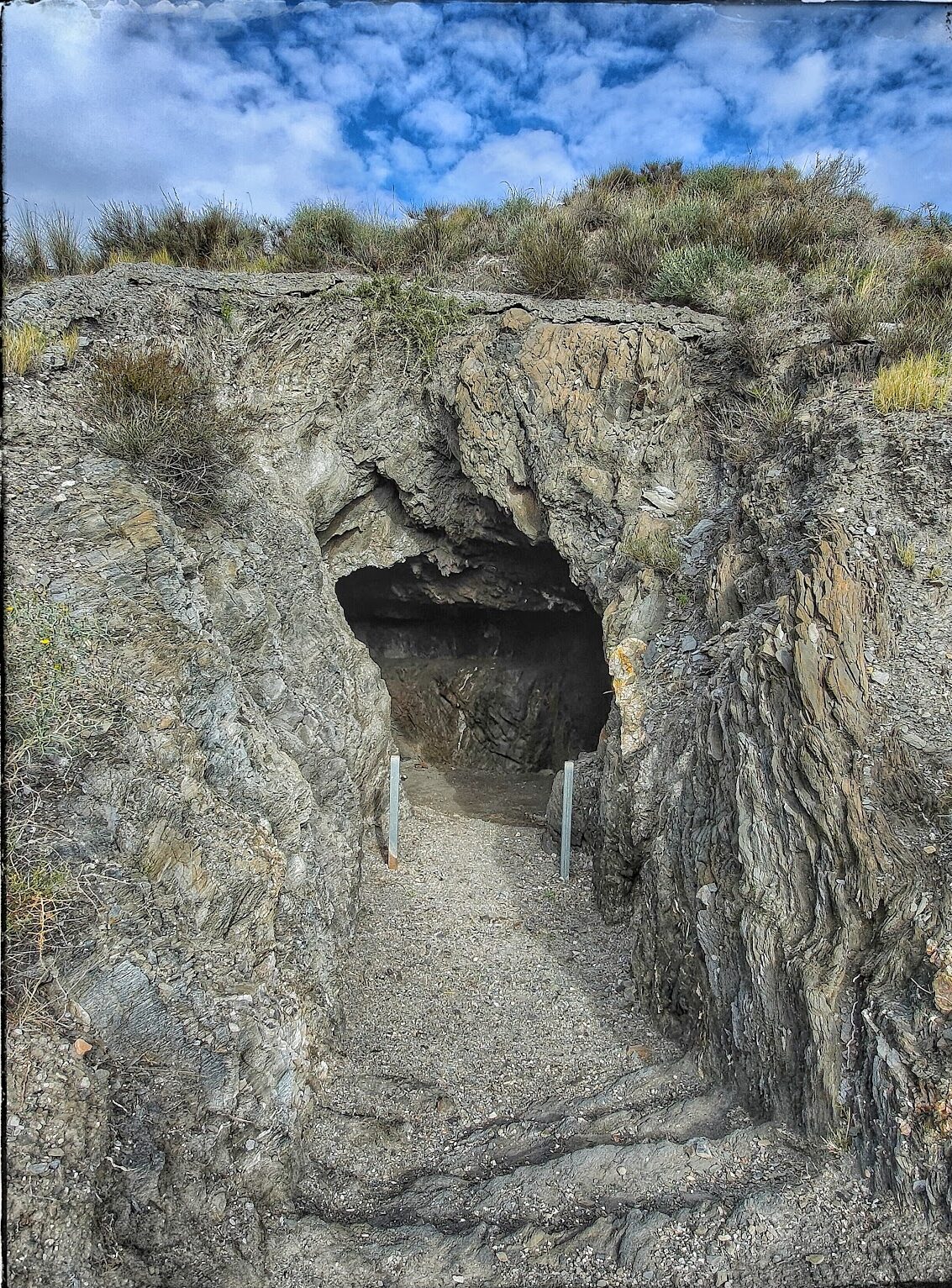
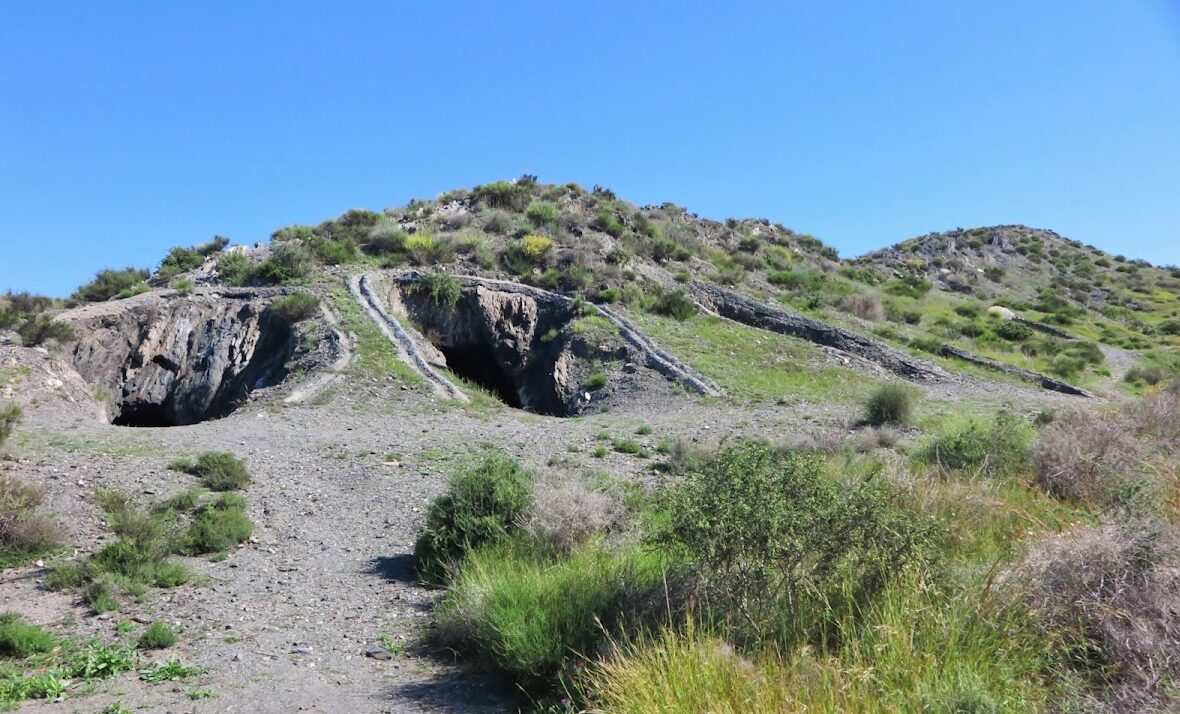
The principal element visible on the ground today is the necropolis. A necropolis, literally a city of the dead, here consists of monumental hypogeal tombs; hypogeal means built below ground level or carved into the rock. These tombs date from the sixth century BCE onward and were formed either by cutting chambers directly into bedrock or by combining rock work with masonry. Interior walls were often covered with plaster and painted, and access was through corridors that sometimes include steps. Entrances were closed with wooden doors that had stone slabs placed to protect them. The burial record in these tombs shows a shift through time from inhumation, burial of the body, toward cremation, and many of the graves contained high-status offerings such as Greek ceramics and decorated ostrich eggs. The necropolis survives in situ and presents a clear sequence of Phoenician-era funerary practices.
A noteworthy individual object from the funerary field is a limestone stele carved in the fifth century BCE. The monument measures about 90 centimetres tall, 27 centimetres wide and 22 centimetres thick. Its face bears a four-line inscription in Punic script composed of seventeen characters, and scholars have observed regional letter forms that may reflect contact with local Iberian writing systems. The inscription records the name Gerashtart, son of Baal-piles, and was recovered in excavations by Luis Siret in 1903–04. The stele is preserved in the National Archaeological Museum in Madrid rather than at the site.
Remains from the Roman period appear as an extramural industrial quarter devoted to fish salting and storage, in use from the late first century BCE through the fourth century CE. These installations occupy land outside the Roman town proper and reflect large-scale processing and preservation of marine products for distribution. Archaeological evidence indicates organized masonry and storage areas adapted to coastal conditions, and the structures show reuse and modification across the Roman centuries.
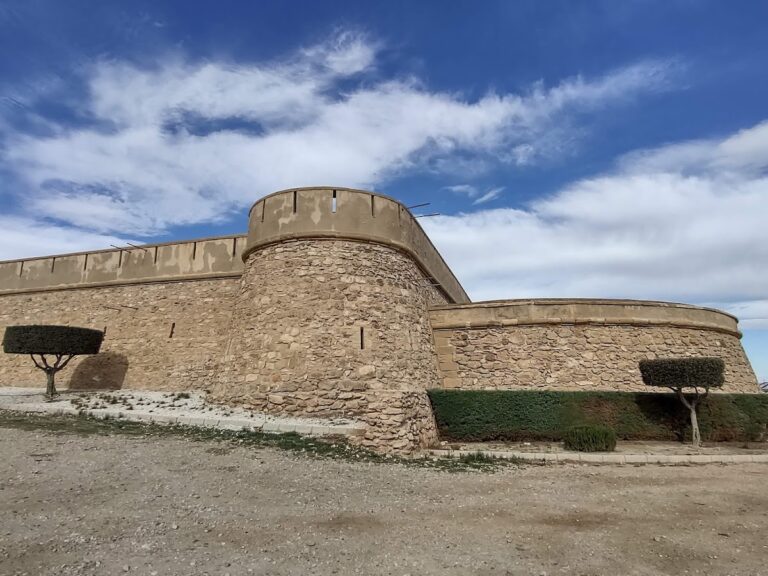
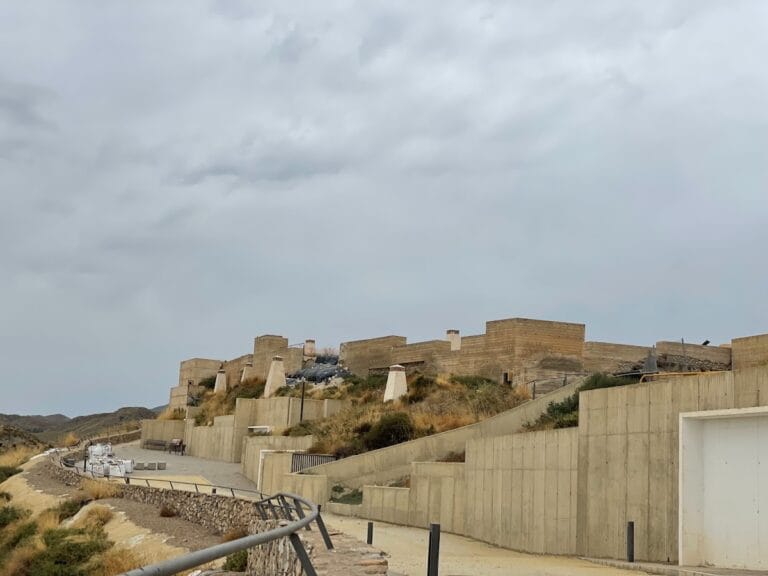
Near the Roman industrial zone stands the eighteenth-century coastal watchtower known locally as the castle of Villaricos, positioned close to the shore and the Roman remains. Mid-nineteenth-century industrial features connected with lead and iron extraction and processing are also visible in the vicinity of the hypogeal tombs, where mining-related buildings and infrastructure testify to renewed exploitation of the same mineral resources that had made the site important in antiquity. The combined set of funerary, Roman industrial, military and industrial nineteenth-century remains provides a layered record of settlement, economy and ritual use at Villaricos.
Nearby sites