Museum of the Royal Tombs at Aigai: An Underground Museum of Macedonian Royal Burials


Site at a Glance
- Rating
- 4.8
- Popularity
- High
- Country
- Greece
- Primary era
- Classical
- External website
- Open
- Eras represented
- Iron Age, Classical
- Civilizations
- Kingdom of Macedon, Thracian
- Site type
- Museum
On this page12 sections
History
The Museum of the Royal Tombs at Aigai is an underground archaeological museum in Vergina, Greece, built around the royal tombs of the ancient Kingdom of Macedon at Aigai. Construction began in 1993, and the museum opened in 1997. Its collections consist chiefly of grave goods recovered during excavations that began in 1861 and continue today. The surrounding archaeological site was inscribed on the UNESCO World Heritage List in 1996 for its exceptional architecture and its evidence of the transition from city-states to empires in European civilization.
Early investigations at Aigai
Interest in the burial mounds near Vergina had begun by 1855, when archaeologists suspected that the ancient city of Aigai lay in the area. The first investigations found only empty tombs. Excavation resumed in 1861 under Léon Heuzey, a French archaeologist working with the sponsorship of Napoleon III, emperor of the Second French Empire.
Heuzey uncovered part of a large building near Palatitsa. The structure had been partly destroyed by fire and was regarded as one of the palaces of Antigonus III Doson, a Hellenistic king of Macedon conventionally dated to 263–221 BC. The excavators identified the building with the ancient city of Valla, an interpretation that remained prevalent until 1976. Work was then abandoned because malaria made continued excavation dangerous.
Settlement, war, and renewed excavation
In 1922, Greek refugees resettled from Anatolia after the Greco-Turkish War established a settlement at the site. They named it Vergina, after a legendary queen. By that time, much of the palace had been scavenged for building materials. Excavations by Konstantinos Romaios between 1937 and 1940 uncovered the first royal tomb while he was working among the palace remains. The excavation ended when war with Italy began in 1940, followed by the wider disruption of the Second World War and the Greek Civil War of 1946–1949.
Excavations resumed in 1949 under Manolis Andronikos. After completing work on the palace in 1970, Andronikos turned to the Great Tumulus, the large burial mound believed to conceal the tombs of Macedonian kings. In 1977, he uncovered four buried tombs beneath it, two of which had never been disturbed. He initially identified Tomb II as the tomb of Philip II, the fourth-century BC king of Macedon and father of Alexander the Great, and Tomb III as the tomb of Alexander IV, Alexander’s son and a posthumous claimant to the Macedonian throne.
Royal tomb identifications
The identities assigned to the tombs have remained an important archaeological debate. A later interpretation proposed Tomb I as the tomb of Philip II, Tomb II as that of Philip III of Macedon, and Tomb III as that of Alexander IV. Tomb I also contained the remains of a woman and a baby, identified in this interpretation as Philip II’s young wife Cleopatra Eurydice and their newborn child. Cleopatra Eurydice and the child were reportedly assassinated.
Evidence supporting the identification of Tomb II with Philip II includes its greaves, one shaped for a leg with a misaligned tibia, and damage to the right side of the skull consistent with the arrow wound historically attributed to Philip. A 2015 study instead assigned Philip’s remains to Tomb I and identified Tomb II with King Arrhidaeus and Eurydice II. The Greek Ministry of Culture rejected that interpretation, arguing that the ankylotic knee belonged to another body placed in Tomb I after its looting, probably between 276/5 and 250 BC. More recent research identifies Tomb II with Philip II and his Thracian wife Meda.
Further discoveries and museum development
A burial cluster discovered in 1987 included the tomb of Queen Eurydice I. Between 1991 and 2009, excavations uncovered more than 1,000 tombs, along with city districts, farmhouses, cemeteries, streets, sanctuaries, and sections of the city fortifications. The work also revealed a royal burial cluster belonging to the Temenids, the ancient Macedonian royal house associated with the rulers of Aigai and of Dorian Greek provenance.
In March 2014, five additional royal tombs were discovered. They were considered possibly associated with Alexander I of Macedon and his family, or with the family of Cassander, a later Macedonian king and founder of the Antipatrid dynasty. The Museum of the Royal Tombs is now organized as part of the Polycentric Museum of Aigai, inaugurated on 19 December 2022. Its central building, about 1 kilometre northwest, contains the virtual museum Alexander the Great: From Aigai to the World, temporary exhibition spaces, the restored upper floor of the Palace of Philip II’s facade, and a model of the archaeological site.
Remains
The underground museum brings together four interconnected exhibition areas: the palace, the Temenid royal burial cluster, also called Burial Cluster C, the burial cluster associated with Philip II, and an entrance gateway with a semi-open-air display of sculptures from the sanctuaries of the ancient city. The archaeological landscape associated with Aigai includes city districts, farmhouses, cemeteries, streets, sanctuaries, fortification sections, tumuli, and the palace.
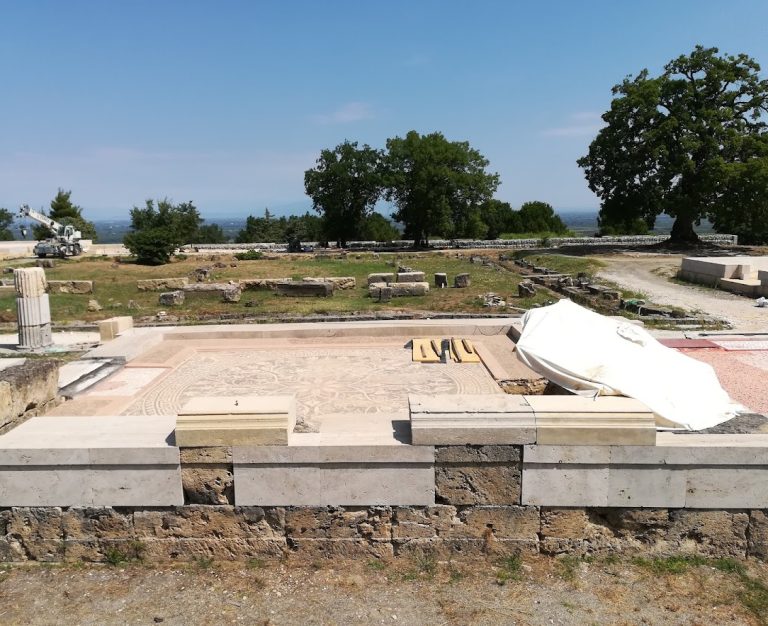
The palace
The palace covered 21,336 square metres and was described as three times the size of the Parthenon. It was probably designed by Pythéos of Priene, the Greek architect also associated with the Mausoleum of Halicarnassus. Around 30 large columns surrounding the principal peristyle, an open court enclosed by columns, have been reconstructed, with some reaching 7.62 metres in height. The southern frieze of the peristyle has also been reconstructed. More than 1,524 square metres of palace mosaics have been conserved, including scenes of the abduction of Europa and natural motifs. The palace design follows a mathematical and philosophical scheme based on the golden ratio, the Pythagorean triplet, and Plato’s concept of the construction of the “world soul” described in the Timaeus.
Royal burial complexes
Temenid royal burial cluster
The Temenid royal burial complex lies at the southwestern edge of the tumulus cemetery, beside the former town hall of Vergina and along the road leading to the palace. It comprises three Macedonian tombs, two hypostyle tombs, meaning burial chambers supported by columns, and a series of monumental cist tombs, which are stone-built graves constructed from slabs. The burials date from the first half of the sixth century BC to the beginning of the third century BC. Conservation and enhancement work has been carried out at the complex.
Burial group associated with Philip II
The burial group associated with Philip II consists of four tombs. It includes the burials of Philip II, his sixth wife Meda of Odessos, originally a Thracian princess, Alexander IV, and another distinguished family member thought to have been Nicesipolis, Philip’s Thessalian wife. Tomb II contains a gold larnax, a chest or coffin for human remains, with the sixteen-rayed Sun of Vergina on its lid. The king’s bones were placed inside it. Other objects connected with the tomb include a gold funerary wreath, a silver-and-gold diadem with a Heracles knot, silver and bronze vessels from the funeral feast, and carved ivory ornaments from the funerary couch.
The tomb’s other finds include gold armour and greaves, one custom-fitted to a leg deformed by an improperly healed tibial fracture, ivory-inlaid shields, weapons, ivory reliefs, jewellery, and terracotta votive figurines. Individual objects include an ivory plaque showing a boar, a silver oinochoe, a vessel for pouring wine, decorated with a relief of Silenus, a bronze lantern with a relief of Pan, a gold Gorgon head from the cuirass, a silver cup, and a silver kylix, or stemmed drinking cup. Objects associated with Meda include a gold funerary wreath, a gold gorytos, a combined quiver and bow case, greaves, and neck armour. The museum also displays a gold fibula with two pins and a chain tied with a Heracles knot.
Painted and associated funerary material
A large wall painting, 5.6 metres wide, is positioned above the entrance to Tomb II. Its hunting scene may represent Philip II and Alexander. A funerary fresco showing Hades abducting Persephone is also associated with the royal tombs. Other burials yielded a miniature of Sabazios made of gold and ivory, gold jewellery and clothing ornaments linked with a Macedonian queen, and jewellery and bodily ornaments from the ninth-century BC “Lady of Aigai.” Similar grave goods from the other burials are displayed alongside the finds from Philip II’s tomb.
Gateway and sculptures
The entrance gateway incorporates a semi-open-air display of sculptures recovered from the sanctuaries of the ancient city. It also includes the restored upper floor of the Palace of Philip II’s facade, linking the gateway display with the palace remains presented elsewhere in the museum. Objects once displayed in the Archaeological Museum of Thessaloniki were later transferred for exhibition at the Museum of the Royal Tombs, adding to the material presented within the underground complex.